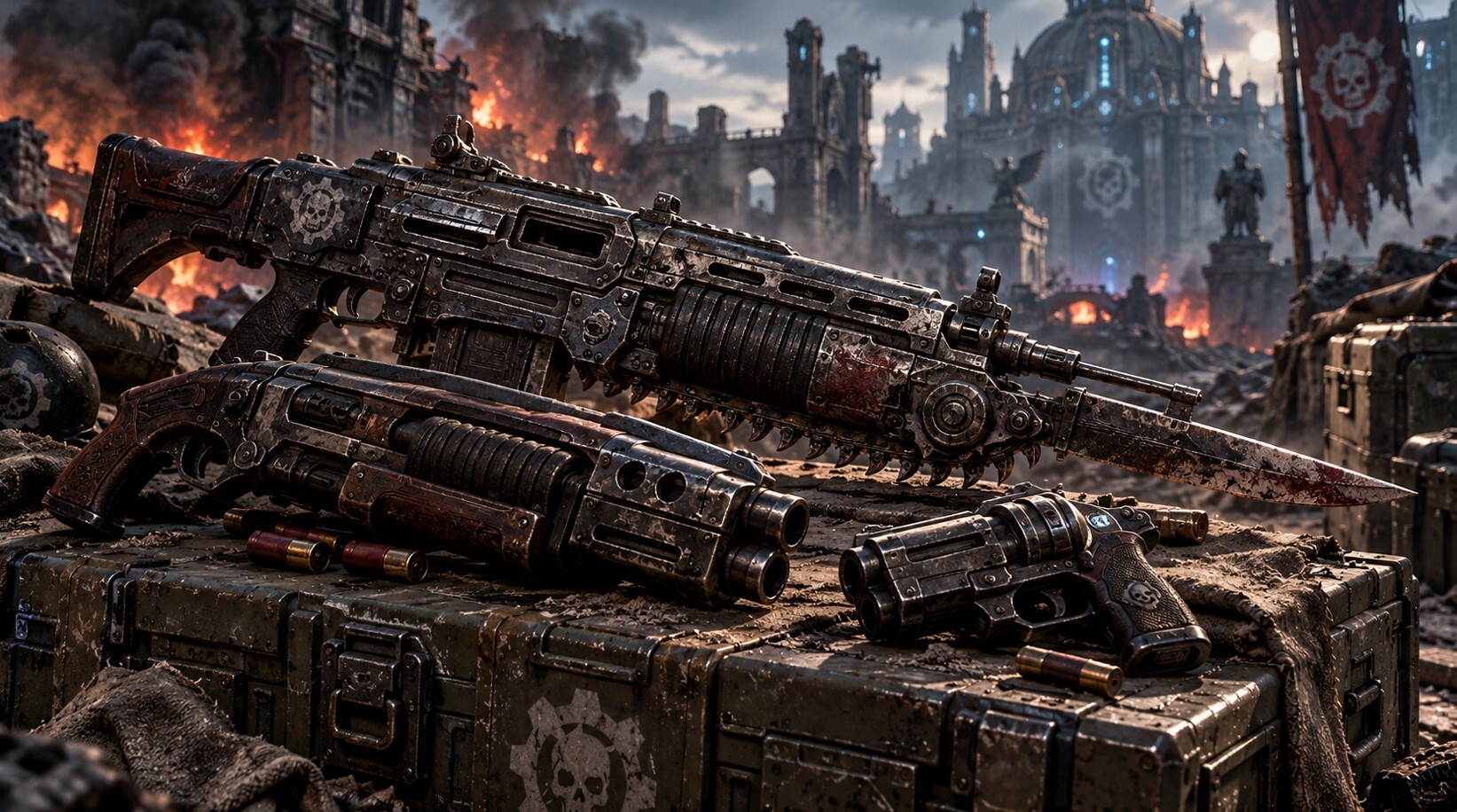
Gears of War E-Day Weapons, Sorted by the Problem They Solve
Most weapon guides hand you a list organised by category. Rifles here, shotguns there, pistols at the bottom like an afterthought. That’s a terrible way to think about a Gears game, because category tells you what a gun looks like rather than what it’s for. In a firefight, you’re never asking “do I want a rifle?” You’re asking, “How far away is that Drone and how long do I have?”
So let’s sort the whole arsenal by distance instead.
E-Day launched today, October 6, on Xbox Series X|S and PC, day one on Game Pass. The base loadout pool runs to ten primary and secondary weapons, two sidearms and four equipment items, with heavy weapons picked up during fights. Two guns are brand new to the series, one makes its Gears debut, and the one everybody’s arguing about got nerfed before anyone fired it.
| Range Band | Weapons | What They’re Solving |
|---|---|---|
| Point-blank | Gnasher, chainsaw Lancer, executions | Something is already on top of you |
| Short | Incinerator, Gut Puncher, Ripper, Retro Lancer | Clustered enemies in a confined space |
| Mid | Lancer MK1, Prototype Lancer, Hammerburst, Snub, Striga | The default distance of most encounters |
| Long | Longshot, Breechshot, Torque Bow | Picking targets before they close |
| Area denial | Frag, Smoke, Concussion, Heavies | Changing the shape of the fight |
Work through those bands and you’ve covered everything. Let’s take them in order of how fast they’ll kill you if you get them wrong.
Point-Blank: The Gnasher Argument
Start here because it’s the change with the most noise around it.
The Gnasher dropped from eight shells to six. For a weapon that’s been the competitive spine of this series for twenty years, that’s not a tuning pass – that’s a design statement. Two fewer shells means two fewer whiffed shots before you’re reloading in someone’s face.
What softens the blow is the new round-by-round active reload. You can chamber mid-cycle rather than committing to a full reload animation, which means a smart player gets shells back into a fight faster than the raw capacity suggests. The trade is that you’re now managing a resource during a duel rather than before it.
Practical reading:
- Six shells rewards patience over pressure. The old spray-and-pray Gnasher rush is a losing play now.
- Round-by-round chambering is your lifeline – practise interrupting the reload cycle so you’re never fully empty.
- Pair it with something mid-range. A Gnasher-only loadout leaves you helpless in the gaps between cover.
- Distance discipline matters more than ever, because missing twice is now a third of your magazine.
Then there’s the chainsaw Lancer, which E-Day treats as a story beat rather than a given. The campaign covers its origin, which is a genuinely fun bit of prequel design – you watch a thing you’ve taken for granted since 2006 get invented.
Mechanically, it’s still the reward for closing distance successfully, and executions now restore health if you’ve got the right armor mod equipped. More on that later.
Short Range: The New Stuff Lives Here
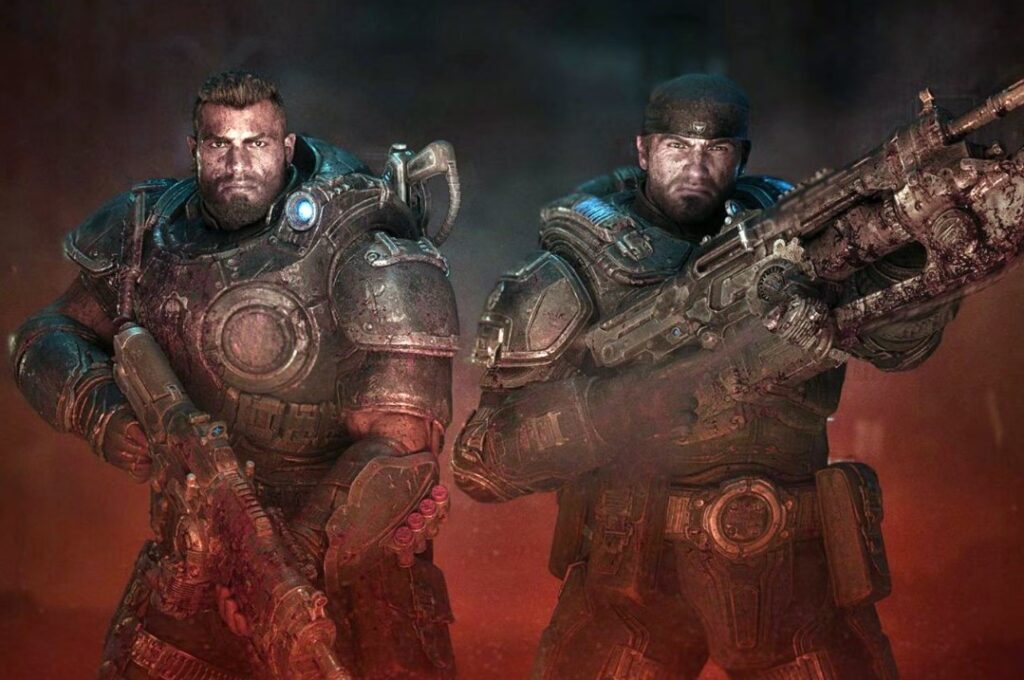
Both of E-Day’s brand-new weapons sit in this band, and they’re the most interesting additions in years.
The Incinerator is an Imulsion-based shotgun that keeps working after the initial shot. The burn effect continues damaging whatever you hit, which turns it from a burst weapon into a damage-over-time one. Reviewers described it as an acid shotgun and flagged it as strong against clustered enemies, which is exactly right – you’re not trying to delete one Drone, you’re trying to set a group on fire and let the tick damage do the rest.
The Gut Puncher is a grenade launcher with manual detonation. You hold the fire input and release it to trigger the charge, meaning you’re placing explosives and picking the moment rather than firing and hoping. That makes it a reading weapon. If you can predict where a squad will be in a second and a half, it’s devastating. If you can’t, you’re decorating a wall.
The Ripper is the LMG making its Gears debut, and its hook is that fire rate climbs the longer you hold the trigger. Sustained pressure gets rewarded, which inverts the usual burst-fire discipline most shooters train into you. Hold it down.
Rounding out the band, the Retro Lancer returns with its bayonet charge intact – still the most committed thing you can do in a Gears game, still occasionally the right call.
Gears of War E-Day Weapons for the Mid-Range Majority
This is where most of your trigger time actually happens, and it’s the band people underinvest in.
Lancer MK1 is the baseline, and it being an MK1 matters – this is the weapon before it became the icon. Prototype Lancer is the variant with a higher fire rate, which makes it the better pick when you’re suppressing rather than placing shots.
Hammerburst returns as an accurate six-round burst. Precise, controlled, and the correct answer when a Drone is behind thin cover and you need rounds in the same spot twice.
Sidearms split cleanly. The Snub is the familiar backup pistol. The Striga is new – a pistol introduced for E-Day with its own showcase, and the second of the two sidearm slots.
- Suppression and accuracy are different jobs – Prototype Lancer for the first, Hammerburst for the second.
- Sidearms aren’t a last resort anymore, since weapon mods apply to them too.
- Mid-range is where ballistics bite. Every projectile now has real travel time, so holding the crosshair on a moving Drone will miss behind it.
- Shoulder swapping while aiming finally lets you peek left-hand cover without exposing your whole body.
That ballistics point deserves repeating because it undoes a decade of muscle memory. Tracers and impact effects now match the actual simulation, so what you see is what the game calculated. Lead your shots.
Long Range: Three Very Different Snipers
- Longshot is the classic bolt-action – high damage, slow cycle, punishing if you miss.
- Breechshot is the one that’ll dominate conversation, because it delivers a one-shot headshot kill in PvP. That’s a enormous statement in a competitive shooter, and it makes map control around Breechshot spawns a priority in Versus.
- Torque Bow returns with its charged explosive bolt, still the most satisfying way to delete a Drone and still requiring you to hold a charge while exposed.
New wrinkle for all three: scope sway. Precision shooting now fights you a little, which rewards bracing in cover and taking a beat rather than quickscoping. Combined with projectile travel time, long-range shooting is a genuinely different skill here than it was in Gears 5.
Area Denial and Heavies
Four equipment items sit in the base kit, and the grenades do more than they used to.
Smoke grenades are now volumetric – they genuinely saturate a space rather than drawing a sphere on screen. That means they work as real concealment for repositioning, and it also means the Locust throwing one at you is a serious problem rather than a visual annoyance.
Frag and Concussion round out the throwables. Frag for emergence holes, concussion for disruption.
Heavy weapons get a mobility change worth knowing: you can rip a Heavy straight off a turret base and carry it. That turns static emplacements into portable firepower, and it changes how you approach any arena with a mounted gun in it – the turret isn’t a position to hold, it’s a weapon to steal.
The Mod System Is the Real Depth
Here’s the part most launch-day lists skip, and it’s where loadout building actually lives.
Every reloadable weapon supports up to four mod slots, though in the campaign you start with one. Mods attach to the weapon rather than to a class, so investment follows the gun you like rather than a role you picked.
There are nine slot types to fill.
| Slot Type | What It Governs |
|---|---|
| Barrel | Accuracy and damage at range |
| Stock | Handling and recoil control |
| Magazine | Capacity and reload behaviour |
| Scope | Optics and sway |
| Body | General weapon characteristics |
| Ammo | Round properties |
| Fire Mode | How the weapon delivers shots |
| Perfect Reload | Bonuses tied to active reload timing |
| Misc | Everything else |
That Perfect Reload row is the one to care about. Full Metal Jacket sits in that slot and grants increased damage on successful perfect reloads – community consensus has already landed on it as the strongest mod available, and it fits the series’ core rhythm perfectly. Nail the reload, hit harder. That’s Gears in one sentence.
Other examples worth hunting: Forged Barrel improves accuracy and damage range, and Cover Brace raises accuracy specifically when firing from cover, which, given how much of this game happens behind concrete, is close to a permanent buff.
How you get them:
- Hard Cases are hidden containers scattered through the campaign – the collectible hunt with an actual mechanical payoff.
- Secondary campaign objectives hand out mods, which makes the optional content more worthwhile than its repetitive reputation suggests.
- Horde Siege class leveling opens further options.
- Weapon Parts are the currency – earning a mod and equipping it are two separate steps, so budget accordingly.
- More mod slots come through progression, so your first weapon will feel thin before it feels strong.
There’s also a second mod category. Armor mods are passive character bonuses earned through Horde Siege class progression – Muscle Memory widens the active reload window, Executioner restores health on executions. And tactical gear mods enhance active abilities like the Sonic Disruptor and Adrenaline Injector, with options like Retention Battery extending how long gear stays active.
Gears of War E-Day Weapons in Versus: Mods Stay Home
This is the single most important thing to understand before you queue competitive, and plenty of people are going to learn it the hard way.
Mods don’t exist in Versus. The system applies to campaign and Horde Siege only. Every player starts with the same loadout and no weapon mods, and advantage comes from power weapons placed on the map.
That’s a deliberate and, honestly, correct decision. It means Versus is decided by map control and mechanical skill rather than by who ground more Hard Cases. The four launch modes – Team Deathmatch, Conquest, Demolition and Crucible – all run on that same level playing field.
Practical consequence: the hours you spend building a monster Lancer in the campaign make you better at Versus only insofar as they taught you the weapon. The gun itself resets at the door.
One caveat worth stating plainly. Versus Ranked and Horde Siege were both absent from review builds, so published scores cover the campaign alone. Anything anyone tells you today about the competitive meta – including me – is reading design documents rather than live matches. Give it a fortnight.
What Veterans Need to Relearn?
Condensed, because it’s the fastest way to stop dying:
- Projectiles travel. Hitscan instincts miss at range.
- Scope sway exists. Brace, breathe, then shoot.
- The Gnasher holds six. Your muscle memory says eight.
- Round-by-round reloading is new and it’s how you survive duels.
- Smoke actually obscures now, both for you and against you.
- Heavies come off their mounts, so stop treating turrets as fixed positions.
FAQ
How many weapons are in E-Day?
Ten primary and secondary weapons, two sidearms and four equipment items in the base pool, plus heavy weapons found during combat.
What are the new weapons?
The Incinerator, an Imulsion shotgun with burn damage, and the Gut Puncher, a grenade launcher with manual detonation. The Ripper LMG and the Striga pistol also debut.
Did the Gnasher get nerfed?
Capacity dropped from eight shells to six, offset by a new round-by-round active reload.
How many mod slots does a weapon have?
Up to four, across nine slot types, though you start with one slot in the campaign.
What’s the best weapon mod?
Full Metal Jacket, in the Perfect Reload slot, which grants bonus damage on successful perfect reloads.
Do weapon mods work in multiplayer?
In Horde Siege, yes. In Versus, no – everyone starts with an identical loadout and no mods.
How do you get mods?
Hard Cases hidden in the campaign, secondary objectives, and Horde Siege class progression, then purchased with Weapon Parts.
Pick a Band, Then Pick a Gun
The loadout mistake almost everyone makes on day one is carrying two weapons that solve the same distance problem. A Gnasher and an Incinerator is two answers to the same question, and it leaves you naked the moment a Drone takes a position forty metres out.
Cover the bands instead. One thing for contact range, one for the middle distance where most of this game happens, and a plan – a grenade, a heavy, a route – for anything further.
Then spend your Weapon Parts on the gun you actually like rather than the one a tier list told you about. Mods follow weapons here, not classes, so loyalty is rewarded. Find your Lancer, feed it Hard Cases, and let Full Metal Jacket do the rest.
The chainsaw origin story is lovely. The six-shell Gnasher is going to start arguments for a year. Both of those are good signs.
P.S. If this sorted out your loadout before your first serious firefight, pass it along on X, Reddit or whichever squad chat is already furious about those two missing shells – small writing teams run on word of mouth and nothing else. Bookmark it as well, since the Versus meta is completely unmeasured right now and we’ll be revising this page rather than filing a new one once it settles. And if creative or commercial collaboration brought you here, write to the YaninaGames team directly – our reload window is always open.