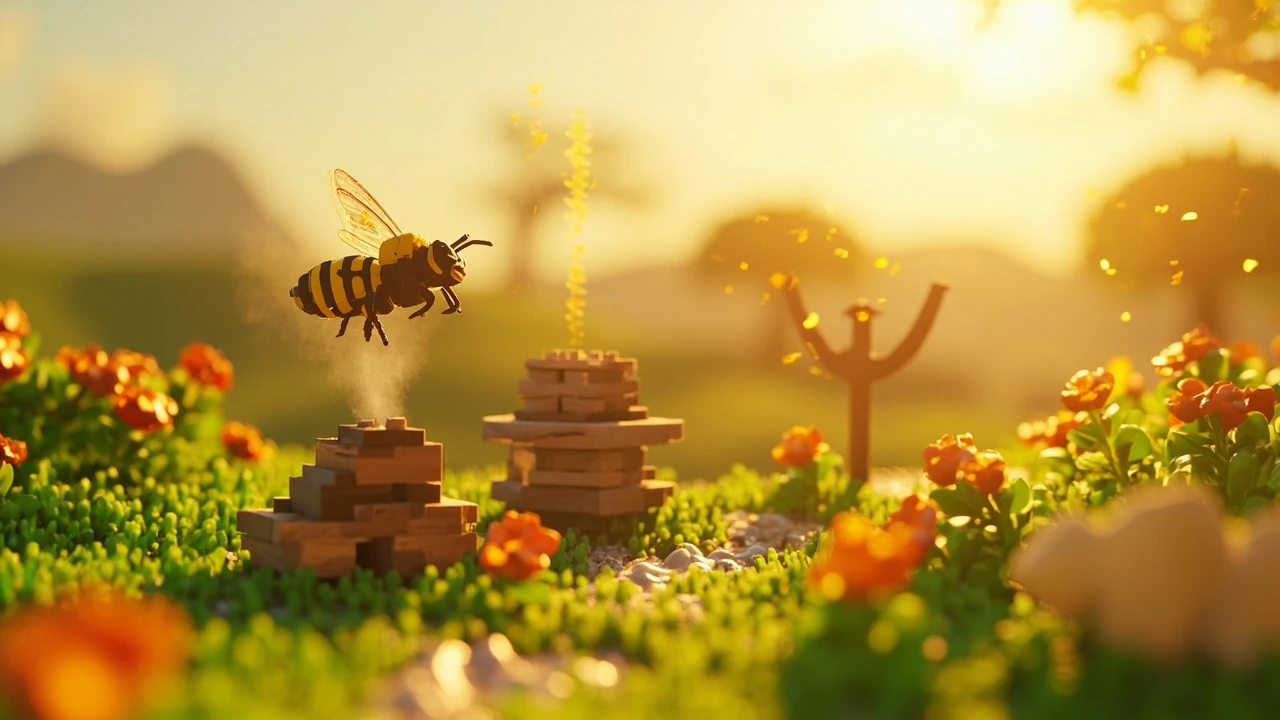
Minecraft bee: how the mob actually works in survival and on servers
Bees arrived in Minecraft with the 1.15 update and quickly became one of the most useful neutral mobs in survival, hardcore, and multiplayer farms. They generate honey, supply honeycombs for building, and passively pollinate nearby crops, which makes a single healthy colony worth more than a casual player might expect. The mob is also small enough to trap, lead, and transport, which is why bee farms are a common early-game engineering project on long-running survival servers.
What follows is a focused guide for survival players and redstone-leaning builders. It covers the biomes where bees actually appear, how nests generate, the rules for breeding and honey production, and the safest way to design a farm that scales without becoming a griefing target on a multiplayer world. Mechanics are described for current Java and Bedrock behavior, which have stayed aligned since the Caves and Cliffs refinement work and the 1.20 trails update.
Where bees spawn and how to find a wild nest
Bees are biome-locked, so the fastest way to locate a colony is to know which environments support them. The verified spawn list covers seven biomes, and understanding their distribution helps both single-player scouting and large-scale world-hunting on servers with custom world seeds.
- Meadows is the most reliable surface biome for finding a nest because flowers and bee-friendly trees are densely packed.
- Plains and Sunflower Plains frequently host nests near the edges of flower fields.
- Flower Forests, regular Forests, Birch Forests, and Old Growth Birch Forests all support nests in their tree canopies.
- Oak and birch saplings planted within two blocks of a flower have a small chance of growing into a tree that places a nest on its trunk, which is the most common artificial source.
When you spot a lone bee in the wild, its home is never far. A flying bee will not travel beyond about 22 blocks from its nest, so searching outward in a spiral from a single sighting is usually faster than walking randomly through a biome. This range is also useful for designing farms: bees released near a new hive will return to it as long as the hive sits inside their working radius.
Bees, nests, and the difference between a nest and a beehive
There are two related blocks, and confusing them is one of the most common sources of wasted time in early farms. A bee nest is the natural block that the world generates attached to trees; it is what wild bees use as their home. A beehive is the player-crafted equivalent, built from planks and honeycombs, which behaves identically for honey production but can be placed exactly where a builder wants it.
This distinction matters for transport. A silk touch tool is the safe way to relocate a wild nest: when all three resident bees are inside, breaking the nest with silk touch drops the block with the bees still stored. Without silk touch, the block is destroyed and the bees swarm out angry. Crafting a beehive is slower but does not require you to find a wild nest first, which is the cleaner path on servers where world exploration is limited.
Bee behavior during the day and at night
Bees are neutral mobs, not passive ones, which means the player’s approach changes their state. During the day and in clear weather, bees follow the player if the player holds a flower, and they can be led with a lead the same way cows and many other mobs can. They leave their hive one at a time, fly to a flower, collect pollen, and return home. A returning bee spends about two minutes inside the hive processing pollen into honey. After roughly five round trips, the hive reaches a honey level of five, which is the overflow state that allows safe harvesting.
At night, and during rain, bees stop working and stay inside the hive. This is the single most important behavior for farm design: in any normal overworld location, the colony has natural downtime. The verified community workaround for that downtime is the Nether, where there is no day-night cycle and no rain, so a well-placed colony works continuously. A builder trading away the safety of an overworld farm for raw output should weigh that decision against the cost of maintaining a small Nether-side operation and the risk of ghast fire on public servers.
Breeding bees without filling the world with swarms
Two adult bees can be bred by feeding any flower to both of them, producing one baby bee. After breeding, there is a roughly five-minute cooldown before the same pair can breed again, and the new bee grows into an adult over a similar window. The hard cap that most players run into is the hive capacity: a single nest or beehive holds exactly three bees, and any extra bees on the server simply leave in search of another empty home.
For a small base, a single three-bee colony is usually enough. For a serious honey or honeycomb operation, a bank of hives placed in a row, each holding its own three bees, is the standard pattern. Because the cap is per hive, the design problem becomes a layout problem: how many hives, spaced how far apart, can a build support without overcrowding the area and inviting lag from too many particles and pathfinding updates.
Harvesting honey without getting swarmed
When a hive reaches the overflow level, attempting to harvest by hand triggers an attack response from every bee inside. The two verified safe-harvest methods are campfires and dispensers, and the right choice depends on the build’s complexity.
- Place a campfire up to about five blocks beneath a hive. The smoke calms the bees, allowing a player to use bottles or shears without taking damage.
- Use a dispenser loaded with bottles or shears and trigger it with redstone. This avoids exposing the player to bees at all and is the safer option on a server where other players may walk through the farm.
- Use shears to extract three honeycombs, which feed back into crafting more beehives, candles, and waxed copper. Use glass bottles to extract honey bottles, which can be eaten or crafted into honey blocks for sliding redstone contraptions.
Honey bottles are also a stack-friendly early food source because honey is one of the few Minecraft foods that can be eaten instantly and restores a modest amount of hunger without the saturation penalty of most sweet foods. Honey blocks, by contrast, are mainly used as slime-block-adjacent movers in redstone and as a sticky surface for crowd control in player-built arenas.
Crop pollination: the underrated secondary output
A bee that has pollen on its back will pollinate any crop it flies over, accelerating growth in the same way bone meal does, but continuously. For a wheat, carrot, potato, or beetroot farm, placing a row of beehives next to the field and routing bee flight paths across the rows can noticeably increase yield, especially on long-running servers where the farm is meant to feed many players. The trade-off is space: bees in pollination mode spend less time producing honey, so a builder has to decide whether the build’s goal is honey throughput or crop throughput.
For most survival worlds, the practical answer is a small split: a dedicated honey block in the base or in the Nether, plus a separate pollination setup near the main crop farm. The two do not need to share hives, and keeping them apart reduces the chance that a player harvesting honey accidentally walks into the crop area and angers a worker bee mid-task.
Nether honey farm design: when continuous output is worth the cost
For additional context, Because bees only stop working at night and in rain, the Nether is the most efficient environment for raw honey production. A typical layout is a small dirt platform with a few flowers, surrounded by several beehives, lit to prevent mob spawns, and placed close enough to a portal that resupply and maintenance are easy. The build does not need to be large; a 5×5 platform with four beehives on the corners is enough to keep one player fully stocked in honey bottles and honeycombs.
| Design element | Overworld farm | Nether farm |
|---|---|---|
| Work cycle | Stops at night and in rain | Continuous, no downtime |
| Safety for the player | High when harvest path is clear | Lower if a ghast targets the platform |
| Best for | Pollination and casual honey use | Bulk honey and honeycomb production |
| Build complexity | Low, single campfire per hive | Medium, needs light, paths, portal |
| Server impact | Low, idle at night | Steady entity and pathfinding load |
For servers, the entity and pathfinding load is the real concern. Bees that never sleep are constantly active, which means a Nether farm on a shared realm is a continuous performance cost. Most server operators accept this for a small farm but will throttle or move extremely large builds, so the right size is usually a handful of hives, not a wall of dozens.
Common failure modes in bee builds
Most bee-related problems on a survival world come from the same small set of causes, and recognizing them early keeps a build from turning into a griefing hazard for other players.
- Harvesting a hive without a campfire or dispenser, which angers three bees per hive and can cascade across a row.
- Placing hives too close to a public path, which forces traveling players to walk through a swarm.
- Breeding without checking the cap, so extra bees wander off and end up nesting in awkward places like the inside of a wall or above a drop.
- Building a Nether farm in an open area without light, which invites ghasts and blazes to target the platform.
The most reliable fix for each of these is a layout pass before the build is finished: keep the harvest face of the hive blocked from players, place hives inside a small fenced compound, and route redstone so the dispenser, not the player, does the dangerous part of the work. A two-minute setup pass saves a lot of respawns later.
Engineering a redstone-safe dispenser harvest
For builders who want a fully hands-off honey line, a dispenser behind each hive wired to a clock or to a button is the standard pattern. The dispenser loads either glass bottles or shears, and the trigger fires it into the front face of the hive. Because the dispenser does not anger bees, no campfire is needed for this specific loop, which simplifies the visual profile of the build and removes a small fire hazard in wooden bases.
| Component | Role in the harvest loop | Common pitfall |
|---|---|---|
| Dispenser | Delivers bottles or shears into the hive face | Wrong facing wastes items into the wall |
| Redstone clock or button | Triggers the harvest on demand | Too-fast clock overflows the dispenser |
| Hopper rail under the dispenser | Collects the harvested items | Missing filter mixes honey with bottles |
| Lighting around the build | Keeps mobs from blocking the loop | Dark corners attract creepers on servers |
The clock speed matters more than the wiring. A dispenser that fires more often than the colony can refill will simply waste bottles or shears into an empty hive. The verified cycle is two minutes inside the hive per bee, so a manual button press is usually the right level of automation, and a slow clock is the right level of automation when the player is offline for long stretches.
Bees and the Wither: a verified combat trick
One specific player tactic that has circulated since bees were added is the idea of using a swarm of angry bees to defeat the Wither boss. The mechanic is real: a Wither that targets a player near a beehive can shoot the hive, which angers every bee inside and turns them on the Wither. The damage is real, the Wither can be brought down faster than with conventional gear, and the trick is repeatable as long as there are stocked hives in the arena.
The trade-off is build cost. A safe Wither trap with bees needs a sealed room, multiple hives, a way to keep the bees alive between attempts, and a means of containing the Wither spawn so it does not destroy the arena. For a single player in a casual world, the cost is rarely worth it. For a multiplayer server running Wither-based loot farms, the bees can be a useful accelerator as long as the operator is willing to maintain the colony.
Multiplayer considerations for shared bee builds
On a multiplayer world, a bee farm is a public utility, and treating it as one avoids most of the conflicts that show up in moderation tickets. A few rules of thumb keep a shared build useful.
- Place a sign at the entrance stating whether the hive line is public, members-only, or owner-restricted, so visitors know what they can take.
- Use dispensers rather than campfires, so the harvest can be done by any player without taking damage from a missed campfire placement.
- Cap the colony at a size that the server can handle, because a 200-hive megabuild is a real performance cost on shared hardware.
- Keep a buffer chest of honeycombs and honey bottles so the build remains useful even if the colony is briefly disrupted by a server restart.
For server operators specifically, the relevant tradeoff is between throughput and tick time. A small farm is essentially free, a medium farm is a noticeable cost, and a huge farm belongs behind a permission gate so that only the players who want the lag are the ones who benefit from the build.
Java versus Bedrock: where the mechanics align and where they differ
Since the parity work that followed 1.17 and 1.18, Java and Bedrock have stayed close on bee behavior, but a few small differences still affect builders who switch between the editions. Honey production timing, hive capacity, breeding cooldown, and the silk touch rule for moving a nest are the same in both editions. The visible differences are mostly in the bee model itself, the particle effects, and in redstone timing for dispenser-based harvesters, where Bedrock’s redstone behaves slightly differently and may need a one-tick repeater adjustment for clocks that work in Java.
For a player who only plays one edition, this is mostly invisible. For a server operator running cross-play, the practical advice is to test the redstone timing on a creative world in the actual edition the server is running, because a Java-tuned dispenser loop on a Bedrock realm is a common source of “the build worked at home” support tickets.
Performance, server impact, and why small farms scale better
Bees are not a free mob. Each one runs an AI loop, has a pathfinding job, and emits particles. On a single-player world this is invisible. On a busy server, a wall of hives is a measurable line item in the tick budget, and operators occasionally need to ask a player to scale a megafarm down. The trade is real: more hives means more honey, but also more entities to update every tick.
The cleanest pattern is a small number of well-placed hives, ideally in the Nether or in a bee-friendly overworld biome, with redstone automation handling the harvest. A handful of hives, run consistently, will out-produce a sprawling build that the server throttles or that other players grief. The goal is steady output, not peak output.
Frequently asked questions
Do bees spawn in every biome?
No. Bees spawn only in Meadows, Plains, Sunflower Plains, Flower Forests, regular Forests, Birch Forests, and Old Growth Birch Forests, and they always appear near a nest. The easiest biome to search is Meadows, which has the highest density of flowers and bee-friendly trees.
How many bees can one hive hold?
Exactly three. Any extra bees produced by breeding will leave in search of an empty hive, which is why a serious honey operation needs multiple hives, not a single overloaded one.
How do I move a wild nest without killing the bees?
Wait until all three resident bees are inside, then break the nest block with a silk touch tool. The nest drops with the bees inside, and the block can be placed at the new location. Without silk touch, the bees swarm out angry and the nest is destroyed.
Is the Nether really the best place for a honey farm?
For raw throughput, yes, because the Nether has no day-night cycle and no rain, so bees work continuously. The trade-off is safety from ghasts and the small but steady performance cost of a colony that never sleeps. For most players, a small Nether farm beats a giant overworld farm on output per square block.
Can bees actually defeat the Wither?
Yes, in a controlled build. A Wither that targets a player near a populated hive can shoot the hive, angering every bee, and the resulting swarm deals real damage to the boss. The build cost is high, so this is mostly useful for server-scale Wither farms rather than solo runs.
Do bees help with crop growth?
Yes. A bee carrying pollen will pollinate any crop it flies over, accelerating growth the way bone meal does. A row of hives near a wheat, carrot, potato, or beetroot farm can noticeably increase yield, at the cost of slowing the colony’s honey output.
What is the safest way to harvest honey automatically?
A dispenser wired to a redstone clock or a button, loaded with bottles or shears, is the cleanest automated harvest. It does not anger bees, so no campfire is required for the dispenser path, and it works for any player who presses the button.
Why does my bee farm lag the server?
Each bee runs AI, pathfinding, and particle logic every tick. A small farm is essentially free, but a build with dozens of hives and hundreds of bees is a real performance cost. The simplest fix is to scale the build down, move it to a less-trafficked area, or convert part of the line to a dispenser-based automated loop that needs fewer active bees.
Do Java and Bedrock bees behave the same way?
Yes, the core mechanics are aligned. Spawn biomes, hive capacity, breeding cooldowns, the silk touch rule, and the campfire harvest mechanic all work the same in both editions. The visible differences are mostly cosmetic, plus small redstone timing differences for dispenser-based harvesters that a builder should test on the actual edition the server runs.
How long does it take to fill a hive with honey?
A returning bee spends about two minutes inside the hive processing pollen. After roughly five round trips, the hive reaches the overflow level of five and is ready to harvest. With three bees working in parallel, a freshly placed hive reaches harvestable state in a few real-time minutes under good conditions.