New Era of Sports Simulation: The Death of the Canned Animation
Let’s just admit that the entire sports simulation genre ran on a massive bluff for twenty years. A user hits the tackle button, two character models smash together, and the system frantically checks a math table to pull up a pre-recorded video file that roughly fits the scenario. The catch was always the geometry. Whenever a runner hit a gap at an unexpected angle, the engine panicked and forced the collision anyway, resulting in that classic, awful visual of linebackers magically gliding through the turf to snap into a predetermined tackle animation.
That arcade-style era of gaming is officially dead in 2026. Electronic Arts finally abandoned the visual illusion with Madden NFL 26, ripping out scripted resolutions in favor of procedural kinematics. The foundation of this shift relies on complex, continuous math rather than static art files.
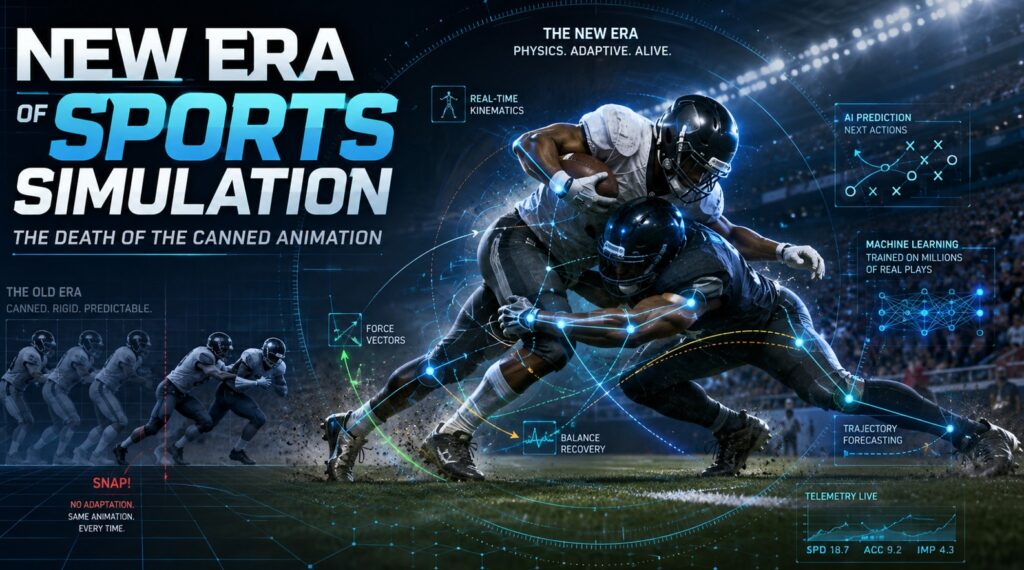
An entirely new physics solver takes over the exact millisecond a defender makes contact. The engine calculates mass, velocity, and the ball carrier’s center of gravity on the fly. We are talking about driven ragdoll systems actively overriding the animation state machine, so players react authentically to directional force. A glancing blow from a linebacker triggers an immediate query to a pose-to-motion database. The system then mathematically stitches together a stumble recovery that aligns perfectly with the runner’s real-time trajectory.
You can’t just memorize tackle animations anymore, because the game literally generates them dynamically based on user-controlled entry angles. Deep reinforcement learning policies actually teach the AI to dynamically fire specific virtual muscles. It applies precise joint torques to the digital skeleton in real-time.
We are no longer watching an animation play out; we are witnessing the brutal, desperate human struggle to maintain balance when a 250-pound safety launches at your kneecaps.
Exorcising the Finite State Machine in Games with Sports Simulation
The visual upgrade means absolutely nothing if the players on the field still think like robots from 2005. Think about how braindead digital defenders used to be under the old Finite State Machine architecture. The cornerback essentially stood in his flat zone waiting for an invisible trigger. Once a receiver crossed a hard-coded line on the grass, the code abruptly ripped the defender out of his zone drop and forced him into a mindless chase sequence. Frankly, it was a maintenance nightmare that led to highly predictable exploit hunting. Human players figured out exactly how to bait those transitions and break the game’s logic by week two of a release cycle.
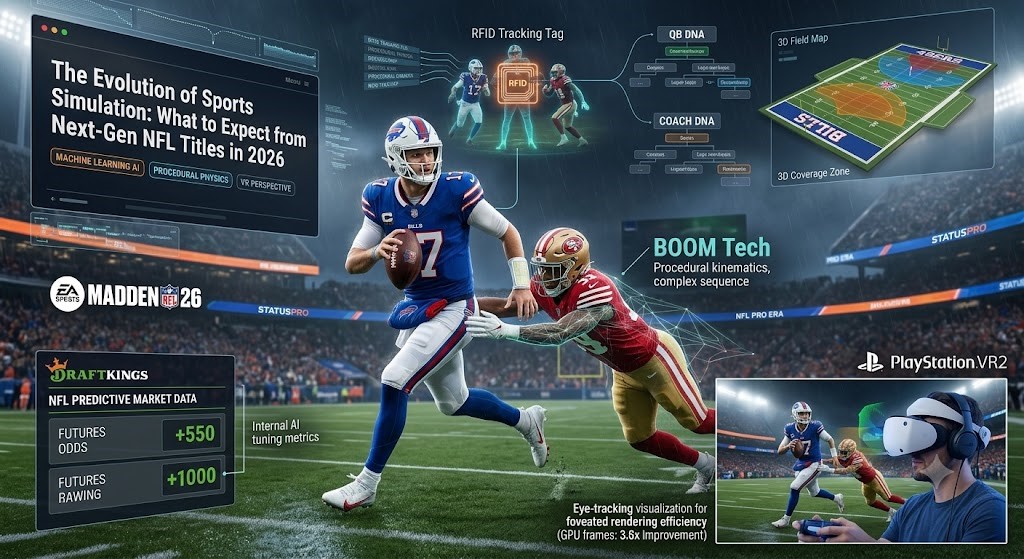
Developers have aggressively pivoted to machine learning to solve this behavioral plateau. They threw out the hard-coded logic trees entirely. Virtual agents now live inside simulated environments. Their only goal is maximizing specific reward functions. The computational grind is staggering, with neural networks routinely running millions of iterations overnight. That massive workload finally bridges the gap between theoretical algorithms and realistic, chaotic football behavior. The results manifest as systems like ‘QB DNA’ and “Coach DNA”, which process thousands of real-world play calls into dynamic logic matrices.
A digital quarterback no longer relies on a random number generator to force a ball into double coverage. The neural model constantly evaluates pass rusher proximity and receiver separation against a specific 50-trait behavioral profile. Look closer and you will see analysts deploying Graph Attention Networks combined with Temporal Convolution.
Players act as nodes on a graph, and the AI dynamically assigns mathematical weights to the importance of surrounding players to predict optimal trajectory paths in real-time.
Telemetry and the Vegas Calibration
A neural network requires an obscene amount of data to actually learn the nuances of professional football. The NFL’s Next Gen Stats system feeds this beast directly. RFID tags embedded inside player shoulder pads capture location, speed, and acceleration ten times per second on every inch of the grass. Virtual receivers literally learn to run routes by analyzing the kinematic footprints of their real-world counterparts. The reality is, historical tracking data alone cannot sustain a live-service product.
Studios need to balance the game so that elite teams exhibit the exact same dominance virtually as they do on opening Sunday. That specific challenge requires heavy predictive modeling. Quantitative analysts inside game studios directly scrape the futures market on DraftKings NFL – treating the sportsbook as an absolute ground truth to calibrate internal algorithm weights. If a specific edge rusher is heavily favored by the oddsmakers to break the sack record, engineers manually reduce the frame-delay on his block-shedding algorithms. The market consensus actively dictates player awareness, situational confidence metrics, and dynamic franchise progression logic.
When the Carolina Panthers are massive long shots to win their division, the AI is explicitly tuned to exhibit lower algorithmic confidence in high-pressure passing situations. Analysts even use player proposition odds to fine-tune individual physics modifiers, ensuring a highly projected rookie receiver gets better spatial interpolation on contested catches.
This is not just a football simulation anymore; it is a complex behavioral market mirroring real-world financial and statistical expectations.
Broken Bones and Server Rollbacks
Physical toll is arguably the most overlooked variable in digital sports history. A full seventeen-game season requires acknowledging that humans actually bleed, bruise, and get tired.
Modern titles have finally integrated localized damage and fatigue trackers that carry real weight. A running back absorbing multiple physics-driven hits to the lower body will experience a brutal, algorithmic degradation in his maximum top speed by the fourth quarter. You have to manage workloads and substitutions just like a real head coach.
Systemic weather algorithms now interface directly with the physics and AI engines instead of just acting as pretty visual shaders.
Heavy snow dynamically alters the vision cones and spatial awareness algorithms of defensive backs, severely limiting downfield passing efficiency.
Rain heavily modifies the coefficient of friction on the digital turf, actively increasing the probability of catastrophic slips during sharp cutbacks.
Network architects face a massive hurdle when trying to synchronize all of this physics-heavy chaos across an online multiplayer connection. Traditional lockstep netcode is entirely useless for this level of real-time fidelity. Engineers have shifted entirely to predict-rollback frameworks powered by highly deterministic engines like Jolt Physics. The local client instantly predicts the outcome of a user’s input and renders the physics locally without waiting for server confirmation.
If the server eventually disagrees due to network latency, the client’s physics engine rapidly rewinds the simulation to the exact point of divergence in milliseconds. You never even see the lag.
The Foveated Gridiron in Sports Simulation
Console simulations are pushing macroscopic fidelity to the limit, but the extended reality space is attacking the sport from a terrifyingly microscopic perspective. StatusPRO’s NFL PRO ERA strips away the abstraction of buttons and joysticks entirely. You have to physically diagnose offensive formations, scream pre-snap adjustments into your headset, and step into defensive gaps yourself.
The average time-to-throw in the professional league hovers around 2.5 seconds, and the VR simulation holds you strictly to that unforgiving clock.
Consumer hardware should technically melt when rendering this level of chaotic, physics-driven fidelity inside a virtual reality headset at a mandatory ninety frames per second. The saving grace for the industry is dynamic foveated rendering. Hardware like the PlayStation VR2 uses internal infrared cameras to track your pupils in real-time. The rendering engine aggressively targets maximum shading power exactly where you are looking, while actively downgrading the peripheral resolution where your biological eye cannot process detail anyway. This single architectural trick yields up to a massive 3.6x improvement in GPU frame times.
We are rapidly approaching a hardware threshold where the processing power frees up enough overhead to map full-body kinematics perfectly. The next phase of sports simulation won’t just ask you to memorize a playbook or exploit a zone defense. It will measure your actual, physical panic under the stadium lights.
Did you like this post? Please support by sharing it across your social media! YaninaGames is here to deliver the best game-related content for game devs and gamers!