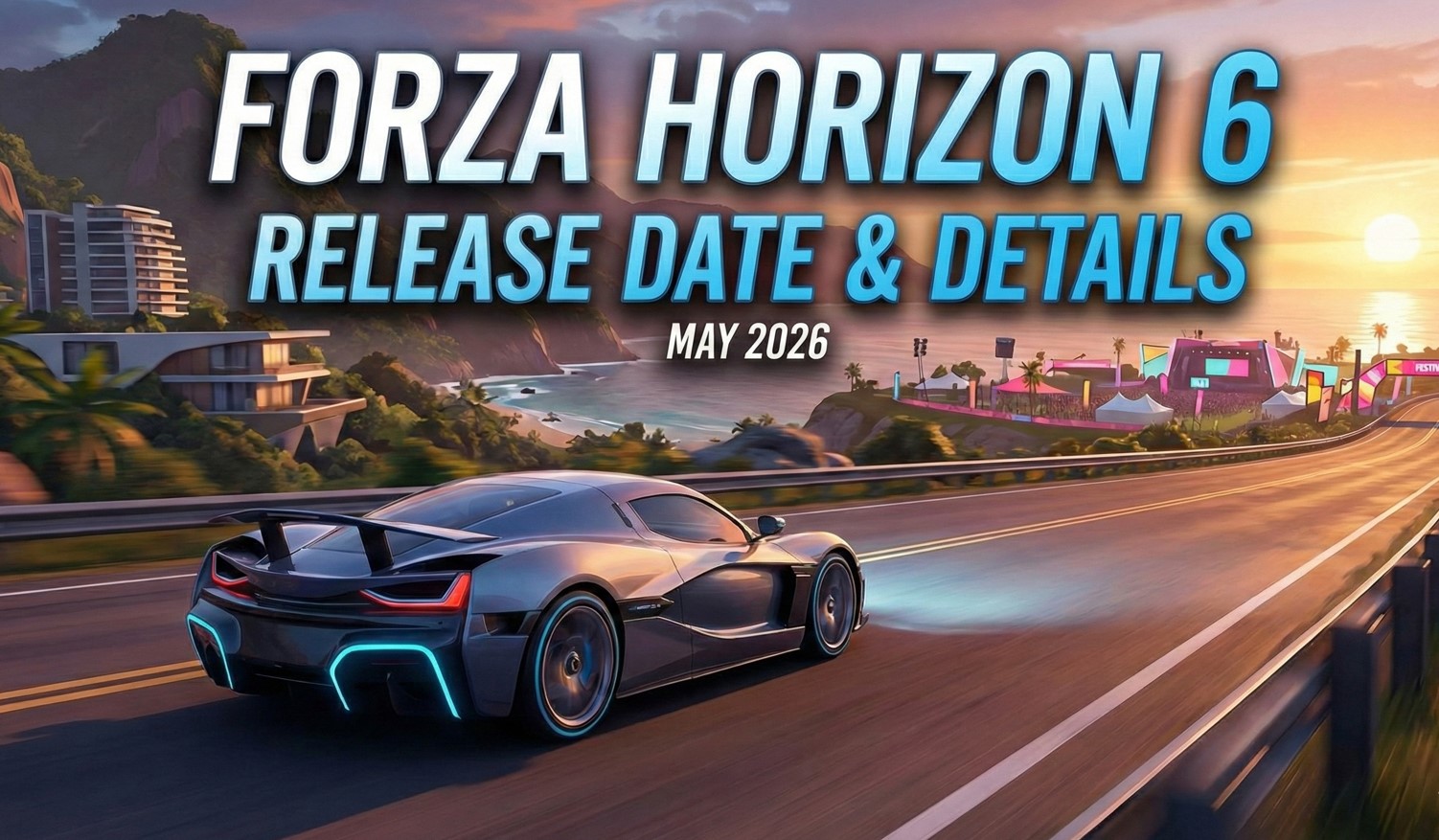
Forza Horizon 6 Release Date Confirmed: Japan, New Drifting Physics, and May Launch You know what? I did not expect them to do it. The Forza in Japan rumors were rumors in years past. We would get some grainy leaked map on Reddit, shake our heads, and resume racing in Mexico. But the truth is, the new Xbox Developer Direct made us all wrong. Playground Games did not simply release a trailer but rather a bomb. We finally have the Forza Horizon 6 release date. We have a location. And sure, there are some drastic alterations to the gameplay cycle that do sound quite grounded. You may wish to take your seat had you feared this would be, but another reskin. The cat is out of the bag. Forza Horizon 6 release date is set on May 19, 2026. I know, it’s weird, right? We are so accustomed to getting our Horizon dose in October or November. A spring release is different, but perhaps it is just what the series needs. Unless you are like me and you simply cannot wait, there is a way of getting in. The Premium Edition will allow early access since May 15, 2026. It is a four-day head start to construct your garage before the servers are overwhelmed. And this is the other giant news that has left me with a double-take: it is releasing on PlayStation 5 later this year. Yeah, you read that right. It goes to Xbox and PC players first in May, but the exclusivity period appears to be shortening. The Latest Details About Forza Horizon 6 On January 22, the presentation was full. To be honest, it was not a marketing pitch but more of a thank-you note to the fans who have been crying out to see Japan since Horizon 3. The biggest takeaway? You are not the Superstar anymore. In Horizon 5, all people treated you like a king the moment you got off the plane. It was entertaining, and somehow unearned. In Forza Horizon 6, you begin as a nobody. You’re a tourist. You come to Japan with literally nothing but a wish to see the car culture. You have two friends, Jordy and Mei, who serve as your mentors. Mei is a car manufacturer, and Jordan is a car enthusiast. They base the narrative, causing it to seem more of a journey with friends than a list of business occasions. Edition Forza Horizon 6 Release Date Perks Price (Est.) Standard May 19, 2026 Base Game $69.99 Deluxe May 19, 2026 Car Pass $89.99 Premium May 15, 2026 Early Access, Car Pass, VIP, 2 Expansions $109.99 The Place: Japan is Bigger Than We Think Hold on, I was concerned with the size of the map. Japan is dense. It is a nightmare for developers to recreate that in an open-world racer. But Playground Games asserts that it is their largest map. They were referring to Tokyo in particular. Not only a couple of blocks, but they also said the Tokyo city area was five times greater than the FH5 Guanajuato. That is insane density. We are speaking of multi-layered highways, narrow lanes to drift, and neon-infused areas that really seem different. But it’s not just city streets. The following is what also attracted my attention to the gameplay reveal: Mountains. We observed narrow technical difficult tracks along Fuji Mountain. This is what the drifters have been screaming at. The streets are narrower, less accommodating. Docks. This is an industrial area that seems to be ideal for playing around in a Gymkhana fashion. Rural Hokkaido. They displayed a few snowy and open fields and cherry blossom avenues. It makes it the visual contrast we require in order to have the neon not overpowering. The designers also discussed verticality. Mexico had a volcano that was largely a single large slope. Tokyo resembles a maze of vertical spaces. Garages, overhanging highways, and underpasses – it will turn out to be a playground for all those who love technical driving. The Rumors Around Forza Horizon 6 Release Date and Launch An insider leak a few weeks ago had placed the Forza Horizon 6 release date in May. Many of us rejected it due to the history. However, in retrospect, it is understandable. Playground Games has long been silent. Fable is arriving in Fall 2026, and thus, they had to separate these two titans. The decision to launch Horizon 6 in the first half of the year will allow it space to breathe before Fable will be able to take up the marketing cycle of the holiday. On top of that, the month of release is May, so the in-game Summer coincides with the time of year in the real world. Think about driving in a virtual Japanese summer, and you are perspiring in July. It fits. New Confirmed Features: The Estate and The Journal This is where it becomes interesting. One feature that they incorporated was The Estate. It is founded on the Japanese Akiya -Abandoned homes. In the last games, you simply purchased a house, and it was all. It was a fast-travel point. In Horizon 6, you purchase a plot of land that is already abandoned or an old house, and you literally renovate it. The garage space, possibly even the layout, can be customized. It provides you with an excuse to use credits on other things instead of automobiles. Then there’s “The Journal.” Being a tourist, the game would like you to record your trip. It is based on stamp collection in train stations in Japan. You discover murals, landmarks, or secret car meets, and earn a stamp in your journal. It is a little bit for completionists; it will be an addiction. The following were some of the tweaks in the gameplay: Real Tire Wear: Not only in simulation mode. Your tires literally appear to be battered after prolonged burnout. 540-Degree Steering: The wheel animation is at last doing what your hands are doing. Drifters,
How to Get Avada Kedavra in Hogwarts Legacy?
How to Get Avada Kedavra in Hogwarts Legacy – The Dark Spell in PG-13 Game When you are neck-deep in the world of wizards and need the final dark magic, you have likely gazed at the symbol of the Avada Kedavra on your spell list and wondered what the secret to unlocking it was. You need not fret, we are going to take you through all the tricks and quests and all of the hidden secrets you need to acquire to obtain the so-called Killing Curse and use it just as a pro. We cover every single flick of the wand to the ultimate battle with the boss. You will find out about all the ways of how to get Avada Kedavra in Hogwarts Legacy. Getting Avada Kedavra in Hogwarts Legacy: The Formal Way The initial move towards acquiring Avada Kedavra is being aware of the formal progression system. Hogwarts Legacy rewards the player upon accomplishing major milestones, mastering advanced spells, and gaining the favor of the Dark Arts Council. The trip usually proceeds in the following way. Requirement Milestone Outcome Wizarding Academy Full core courses and select Dark Arts major talent Basic dark spells are available to you. Complete the Cursed Chamber challenge Complete the Darkest Dark Quest Unlock Rictus and Petrificus Totalus. Final Ritual Master Avada Kedavra in a controlled environment Full command of the Killing Curse. Key Points: You have to major in Dark Arts when you are still young. Reputation at the council may be increased through avoiding friendly fire and saving NPCs when on a dark quest. The last rite is in a secret chamber under the Forbidden Forest – ready for severe combat. In this questline, the Dark Arts Council guides the player through the various factional divisions. The Dark Arts Council Questline In this questline of Hogwarts Legacy, the player is taken through the different divisions of the faction by the Dark Arts Council. Reaching the council is not a straight-up affair and is a process of several side quests that challenge your wits and magic casting ability. A brief overview of what to expect is given below: Quest 1: “Whispers in the Hall” – Find and interpret the whispers that give a clue to the location of the council. Quest 2: “Trial of the Betrayer” – Find a way to persuade a former member of the council to give away his secrets. Quest 3: “Blood Oath” – Perform a blood- binding ceremony to demonstrate your loyalty. The expert tip: Have your inventory topped with Healing Potions and Invisibility Cloaks. Dark investigations may be vicious and you may have to withdraw before you are overpowered. How to Get Avada Kedavra in Hogwarts Legacy – The Quickest Way to Use It After you have the spell crack, the next thing that you need to do is to use the spell in a battle, but you need timing and precision. The following is a summarized cheat sheet: 1) When to Use: Immunable final bosses to other spells. Enemies with high value that are not avoidable. 2) Activation: Hit the dark-spell button (key default on PC: Z) and point at the target. The spell burns a lot of mana, and hence should be used sparingly. 3) Combo Potential: Combine Pair Avada Kedavra with Rictus in order to confuse the enemy prior to killing them. When you successfully kill, your mana bar refills partially, use it to your advantage. Avada Kedavra is a spell that can be learned through the following tips. Training Grounds Practice The game provides a safe area where you can practice the spell without losing the health of your character. Upgrade Your Wand – A wand that has the affinity of Dark Arts is able to provide more power to spells and lower the cost of mana. Go with the Council – Remaining with the moral code of the council is a sure way to maintain a good reputation, which means you can easily get access to higher spells. This is how you can equip Avada Kedavra in the most effecient way (use quick-access spell slots): Slot 1: Avada Kedavra. Slot 2: Petrificus Totalus. Slot 3: Rictus. Mana Conservation Tips Precast with Healing Potions. Also, you should use spells to counteract health loss with spell: Banish. Remember that Dark beings are susceptible to Avada Kedavra. Muggle-based foes are resistant to being debuffed, though. In-Game Mechanics That Affect Avada Kedavra in Hogwarts Legacy The game has a strong foundation of mechanics that determine whether Avada Kedavra will hit its target. Knowing these can help you not to waste mana and leave a vital kill. Mechanic Effect Example Dark Atmospheres Enhance accuracy and potency of spells Stormy corridors of the castle Enemy Shield Certain bosses possess magical shields that prevent Avada Kedavra The Dark Lord’s shield Human Faction Standard magical resistance and adaptability Human adversaries Despite all the right steps, there are roadblocks that hit some of the players. The following is a troubleshooting guide in a nutshell: 1) Issue: Avada Kedavra does not seem to be on the list of spells. Solution: Make sure that you selected the Dark Arts specialization and finished the council quests. 2) Issue: Mana drainage is excessive. Solution: upgrade your wand or spend money on the skill tree of mana efficiency. 3) Issue: Timing of spells is unnatural. Solution: Train in the training field and change your setting of the aim sensitivity. Community Resources If you still have issues of getting to know how to get Avada Kedavra in Hogwarts Legacy, then consider using the help of the global gaming community through such sources: YouTube Tutorials – Find Avada Kedavra Hogwarts Legacy to find step by step videos. Discord channels – Have real-time assistance in Hogwarts Legacy Discord. Reddit Threads – It can be found in subreddits such as r/HogwartsLegacy, which frequently carry guides and screenshots. FAQ Do I have to own a particular wand to use Avada Kedavra? Dark Arts affinity wand increases the power of spells, but
The Role of a Protagonist in Narrative Games
The Protagonist Is the Beating Heart of Narrative Games You know that feeling? You lay the controller aside, the credits are rolling, and you simply sit there. Staring at the black screen. Your chest feels tight. You are not only grieving about the end of the game, but a friend. The strength of a good lead is that. We need to talk about this. Good narrative games do not involve the protagonist being a cursor or a floating gun in the air. They are the anchor. They are the prism through which we look at the world. The protagonist either builds or destroys the story, no matter whether it is a quiet ship in which we pour ourselves or a rattle-tongued lady with a tragic history. As part of the YaninaGames team, I have played games with buttery smooth gameplay, where headshots were popping, movement was crisp, and I still dropped out midway through. Why? I did not mind the guy I was playing. When the character is as personality-wise as a wet cardboard box, the stakes are a non-entity. However, present me with an untidy, imperfect, with-which-I-can-relate human being (or alien, or robot), and I am there. I will break the stiff levers to find out what will become of them. The Empty Vessel vs. The Movie Star It is this old controversy in the gaming design of narrative-focused video games. Is the player provided with a blank slate or a defined character when it comes to the protagonist? Consider Half-Life and Gordon Freeman. The guy doesn’t say a word. He is a physicist and has a crowbar and a terrible day. Valve did that on purpose. They wanted you to be Gordon. It will break the immersion if he begins to make jokes or to complain about the smell in the sewers. You are the main character in that case. His reactions are your reactions. Then consider Arthur Morgan of Red Dead Redemption 2. You can’t really project yourself onto Arthur. He has a history, voice, a very particular way of saying boah. You are not being yourself; you are acting like him. And honestly? That was more of a blow to many. It was like watching a fantastic interactive film in which you were the one who accidentally pulled the trigger by seeing his arc, his redemption. It’s a tricky balance for devs. When they tip over to the side too much, the player becomes disconnected. Press too much on the other, and the gamer gets the feeling that he is only watching a cut scene with quick-time events. The Trade-off Between Silent and Defined Protagonists Feature Silent Protagonist (The Vessel) Defined Protagonist (The Star) Immersion Level High self-insertion; you feel like you are physically there. High narrative empathy; you feel for them, not as them. Storytelling Style World reacts to you; exposition mostly comes from NPCs. Character drives the plot with their own personal motives. Emotional Impact Comes from atmosphere, music, and player agency. Comes from character growth, acting, and dialogue. Famous Examples Link (Zelda), Chell (Portal), Doom Slayer. Geralt (Witcher), Joel (The Last of Us), Kratos. How Does a Strong Protagonist Fix Weak Stories in Games? Here is a hot opinion: a fantastic character can rescue a rubbish plot. A very serious question – can you recall the specifics of the plot of Uncharted 1? Probably not. It was a treasure, some curse, bad guys in helicopters. Standard B-movie stuff. But you know Nathan Drake. You recall his playfulness, his OH crap moments and his connection with Sully. The protagonist has the pacing. As the story winds, their character keeps you entertained. It is like spending time with a humorous friend; you do not even mind whether you are merely going to the store, but it is amusing due to the company. I have recently played Forspoken, and that was harsh. The conversation – I just pushed the stuff with my mind! – was alienating and disturbing. In case the protagonist is irritating, the player begins to play against him/her. It is a death sentence to a narrative game. You begin wishing that the boss would hit you right now so that the conversation can end. On the other side, see Control. It is a nightmare of the Oldest House, a nightmare of weird and bureaucracy into which Jesse Faden is thrown. The story is very disorienting – astral planes, Objects of Power, a janitor who could be a god. But Jesse? She grounds it. She responds just like we would respond: This is strange, yet I have a job to do. Her inner monologue is the thing that connects the confusion of the player with the lore of the game. The Illusion of Choice We enjoy believing that we are in control. “I chose to save the village!” Did you, though? Or did the game designer allow you to press A? The king of this is Mass Effect. Commander Shepard is an odd amalgamation. She (or he) is described as cool, but not too specific as to allow you to navigate the ship. Paragon or Renegade. The brilliance in this is that the main character changes depending on your mood. One day, you are a saint who rescues kittens and makes peace. The second, you are kicking reporters and hanging up on the Council. It is a unified experience in that the game makes you believe that Shepard is merely a stressed person who is complex. However, the reality is that at times the decisions are smoke and mirrors. The denouement is about the same. However, we have made the character say the line, and so we own it. It is here that the magic works. The emotional hit is doubled when you feel that the character is your own. You are not watching a tragedy; you are acting in one. Why Does the Video Game Protagonist Need to Suffer? Nobody likes a perfect hero. They’re boring. It is not easy to write

Lisa in Genshin Impact: Fresh Builds After Recent Updates
Lisa in Genshin Impact Has Quietly Become Worth Your Time Look, I get it. You most likely dismissed Lisa in Genshin Impact many years ago. She is picked up by most players free in the early game, tweak with her lightning attacks perhaps an hour, and never brought back again once they pull literally any other Electro character. However, the point is as follows – and I am telling you this as honestly as I can – Dendro reactions essentially provided Lisa with a second life, and in case you have not re-examined her arsenal since such updates, you are missing out on some unexpectedly good gameplay. She will not still dethrone Raiden or Fischl in the meta rankings. Let’s be real about that. However, with the Dendro element shaking up the reaction game and the new sets of artifacts providing the Electro characters with more freedom, Lisa is no longer the forgotten starter character but a fairly decent person in the right teams. Particularly, when you are into Hyperbloom or Aggravate comps. The catch? She needs investment. Such as, real resin and material commitment. Her conductive stacks mechanic is eccentric, her energy needs can be harsh, and her hold ability exposes you to an unreasonable amount of time unless you are particularly alert. But when you have her humming in a good turn? She has the ability to pull her weight. How Does Lisa Work After the Recent Genshin Updates? Before we discuss builds, however, we should deal with the elephant in the room. Lisa’s kit is a nightmare for new players. The description of her skills in HoYoverse was not written in straightforward English. The conductive status is her bread and butter – the little purple digits that appear when her enemies are zapped by her elemental prowess. One punch and you will stack enemies. Keep it down a few seconds and she releases this huge lightning burst that strikes more depending on the amount of stacks you have accumulated. Seems to be a simple thing, right? Well, but this is where it gets funky. Every enemy struck leaves its own local stacking radius, i.e., when you nail yourself, you can tap three stacks on several opponents with a single tap. And her burst Lightning Rose – is this a constant AoE field which continues to zap things even when she is not on the field? In addition, it debilitates enemy DEF by 15 percent, which is actually a very nice support choice, should you be running characters who require that debuff. Her energy is the biggest issue that most people are facing. The girl requires approximately 160% Energy recharge to maintain her burst at all times and that is assuming that you have good particle generation in your team. Get her C1 constellation, and the requirement is reduced dramatically. C4 is where she truly begins to shine with reaction teams, as it gives her an addition of lightning bolts to her burst to increase personal damage and Electro use. What Makes Lisa Good in 2026? Honestly? Hyperbloom team and Aggravate team. Lisa, when she was dropped, was a reaction driver with this whole new identity of Dendro. Her normal attacks are Electro always, her bursts remain doing passive application, and she does not tie up field time when you are using her as a sub-DPS. Match her with Nahida, Xingqiu, and boom – you have yourself a Hyperbloom setup with the ability to push 20k damage per reaction once you have her Elemental Mastery stacked appropriately. Aggravate is the other route. Put a few Crit stats in with some reasonable EM and put her in a Quicken team with people like Alhaitham or Tighnari and see the purple numbers go up. She will not outperform dedicated DPS units, but will have a useful amount of damage and utility with her DEF shred. And even when you are homesick? Taser comps still work. In Hydro, add Kokomi or Xingqiu, in VV shred and grouping add an Anemo character such as Kazuha, and have Lisa be the driver of the reactions. It is not radical and is entertaining and active enough to most of the content of the overworld and even the lowest floors of the Abyss, which do not require hypercarry to play. Best Weapons for Lisa in Genshin Impact Right Now Alright, weapon time. Lisa’s a catalyst user, which means you’ve got options but also some tough competition since other catalyst mains probably want the same gear. 5-Star Options Weapon Why It Works Best For Kagura’s Verity Stacks damage bonuses with skill usage; perfect for Lisa’s tap-skill spam playstyle Personal damage builds, Aggravate teams Lost Prayer to the Sacred Winds Movement speed bonus plus escalating elemental damage – great if Lisa’s on the field frequently On-field DPS, general use Skyward Atlas Straightforward ATK and elemental damage boost; creates seeking clouds that add extra hits Burst-focused builds, simpler rotations The truth is that Kagura is her most honest better in slot in case you are serious about maximizing her damage output. The stacks are in line with the way you are already playing her – tap skill, stack, unleash. Lost Prayer is your second place, particularly good to go with when you want to explore, as the speed of the movements is not harsh, and the damage increases with the duration of her activity. 4-Star Options: The Widsith: Standard catalyst. Random buffs are annoying, however, when you get the EM or ATK boost, it is concrete. Great for quick-swap teams. Mappa Mare: Craftable and available. EM substat ensures that it is all reaction-oriented. Honestly underrated. Another craftable is the Hakushin Ring. Increases elemental damage of the team by reactions. Operates when running multi-element comps. To the vast majority of players, there is no better choice than Mappa Mare unless you have been fortunate to get one of the 5-stars. It is free to make, the EM scaling assists Hyperbloom and Aggravate teams and can be refined without

Joker’s Updates: Hunting Down Balatro’s Cards in Night City
The Joker’s Updates Quest That Nobody Expected When CD Projekt Red released Update 2.2 of Cyberpunk 2077 in December 2024, most people were excited about the photo mode improvements and the fact that Johnny Silverhand is now riding shotgun in your car. Hiding in that patch was, however, something that no one expected to find: a treasure hunt as full-blown as Balatro, that decidedly addictive poker roguelike that swept 2024. And honestly, Joker’s updates turned out to be one of the best crossovers I have ever witnessed in a long time. The entire affair starts with a text message by a person identifying himself as Jim B. No journal entry. No quest marker. Only some mysterious message and a bit of blurred photos that make you go on a hunt of Joker graffiti all over Night City. As though CD Projekt Red was choosing to reward those players who take time to observe their environment rather than simply go by the direction. Pretty genius if you ask me. What’s the Deal with Balatro and Cyberpunk Anyway? Now, before we proceed to the hiding places of these cards, I wish to make a second detention. You may be asking yourself what a cold-blooded indie game has to do with the AAA’s chrome-plated noir of Night City. It turns out that this crossover began several months ago when the creator of Balatro LocalThunk introduced face cards in his game that were themed after Cyberpunk, including one with Geralt of The Witcher on its face and another with Johnny Silverhand himself. Maria Mazur, a quest designer at CDPR, is a big fan of Balatro. The team ran with the idea of paying her back. That is why we now have Jimbo (Balatro mascot) on the walls around Watson, Westbrook, and all the places in between. The partnership for the “Joker’s updates” collaboration is organic, as both games have this strange vibe to them they both deal with the taking of risks, choices, and making them, at times, all go terribly wrong. On top of that, the two development teams are obviously admiring each other’s work, and it makes the entire process seem less like a corporate marketing gimmick and more like two musicians playing off one another. Joker’s Updates Quest – How Jim B’s Scavenger Hunt Actually Works in Cyberpunk 2077? Ok, now that you get hit by Jim B, you are on your own. No glowing pathway brings you here and there. You have to learn the photos he mails, determine the landmarks, and find these pixel-art Joker’s updates (cards) yourself. And this is what makes this quest different: No note taking up your journal. Cards never appear out of order – jump forward and you are dead meat. At every place, there is a hint that is cryptic and alludes to Night City landmarks. You literally have to search rather than use GPS coordinates. It is retro gaming style in a contemporary open world, and I am on board. The quest does not talk down to you and leads you step by step. The Joker’s Updates – All 10 Joker Card Locations (In the Right Order) Shut up, I am going to save you hours going round Night City like a lost tourist. But honestly? The best part is to find these out on your own. Nevertheless, when you get stuck or simply need to get this done in the most efficient way possible, the following is the full list. Card 1: Bus Riding (North Oak, Westbrook) You start with the Columbarium, the futuristic cemetery where you can pay your respects to Jackie. Go to the bus stop in front. The Joker is painted on one of the columns, and the card is sitting on a bench next to him. The hint by Jim B speaks of a rainy bus stop that overlooks the city, and this fits perfectly well. It is a small place where most players are likely to pass without taking a second thought. Card 2: Golden Joker (North Oak Roundabout) Go north of the first card until you come to a roundabout where there is this garish golden statue in the center. The type of art installation that shouts out corporate money. The card is hidden behind the statue on the concrete stand. Easy pick when you are where you are. Card 3: Lucky Cat (Misty esoterica Little China) Now we’re heading to Watson. You know about the shop of Misty in the beginning of the game, right? Enter and seek the shelf with those beckoning cat figures. The Joker card is frightening among them. It was not the same experience I had with this one due to all the memories connected to that shop. V and Jackie strategizing their big score, discussing how they will make it to the major leagues… yeah. Card 4: Edgerunner (Badlands, Wind Farm) Time to leave the city proper. Race to the wind farm in the Badlands, that entire place that David Martinez and the Edgerunners crew had their time. The card is on the ground, not far away, near some of the storage containers, with those great turbines whirling around. The clue talks of it being windy and near mountains, and that is the Badlands in a nutshell. Card 5: Roof by Delamain (Vista del Rey, Heywood) This one’s trickier. You must climb up the Delamain HQ building. Parkour with the AC units and garbage bins to reach the top and then go to the north-west corner of the building. Find the yellow wall that has the face of Jimbo painted on it. There the card lies on the ground. And just be careful not to fall off in the process of climbing. The view is good, but the landing is not. Card 6: Splash (Wellsprings Waterfront) Travel to Cannery Plaza in Wellsprings, and go to the water. There is a dock ladder and a Joker graffiti on the ground close by. The next part is the fun part:

How Is Game Development Different From Software Development?
Game Development vs. Software Development: Why It’s a Different Beast Ever looked at a glitch in Skyrim where a mammoth falls out of the sky and thought, “How does that even happen?” If you’re a coder coming from the world of banking apps or web dashboards, game development can feel like stepping into a parallel dimension. In the world of standard software, if 1 + 1 doesn’t equal 2, you have a critical failure. In video games? If 1 + 1 equals 2.00001, your sniper shot misses, and the player throws their controller at the TV. Honestly, it’s a wild ride. We usually think of coding as this monolithic skill – if you know C++, you can build anything, right? Well, yes and no. While the syntax might look the same, the mindset behind game development is fundamentally different from building enterprise software. It’s the difference between building a safe, reliable bridge and building a rollercoaster that looks dangerous but is perfectly safe – and also has dragons. The YaninaGames team breaks down why making games is so weird, wonderful, and technically demanding compared to your average app. The “Real-Time” Pressure Cooker This is the most obvious contrast between game development and software development at the very beginning of the process. When the software is standard, it tends to be event-driven. You get a banking application, and it waits on your phone. It will do nothing until you press the button Check Balance. It’s re-active. It generates a request, accesses a database, waits until a response is received, and displays it on your screen. Suppose that can happen in 200 milliseconds or 2 seconds, you may be annoyed, however, the app will still work. Games don’t have that luxury. A video game is a real-time simulation. It doesn’t wait for you. The game loop is running continuously, most of the time 60 times per second. The computer must: Check if you pressed a button. Physics of that jumping character, calculate it. Determine whether or not the enemy AI notices you. Make us hear the stamp of your boots on the ground. Create the whole world, light and shadows on the screen. And when any of that is too long, then the game stutters. The frame rate drops. The “illusion” breaks. In a typical software, optimization is usually a thing that comes afterwards, when things have slowed down. Optimization is an inseparable aspect of air in game development. You are always racing the clock, attempting to cram costly mathematics into a very small budget of milliseconds. The Math That Makes It Move You have heard people say, when will I ever apply trigonometry in real life? It is used by game developers every week on Tuesday. And Wednesday. And pretty near every hour of the day. You have to have logic and database skills in case you are creating an inventory system in a warehouse. You need to know SQL. You have to know about data integrity. However, it is unlikely that you need to be aware of the dot product of two vectors in 3D dimensions to know whether a crate fits on a shelf. In games, everything is math: Linear Algebra. This is used to move objects in 3D space. Trigonometry. This is necessary in the calculation of angles, paths, and rotations. Physics. Modeling of gravity, friction, and collision. When Mario is jumping, it is a parabola. When you drift a car in Forza, that is a complicated friction calculation which is performed dozens of times a second. You can’t simply say to the computer, “move the car left. You must provide a force vector to the tires, determine the friction coefficient of the asphalt, and allow the physics engine to determine where the car actually goes. It’s messy. It’s chaotic. And it’s brilliant. Why Does Game Development Require A Different Mindset? Utility is generally the finished product of standard software. Does it work? Will it address the problem that the user has? When I am using a spreadsheet, I want it to compute my taxes correctly. It does not matter to me whether it feels good or not, provided it is accurate. The end goal of a game is fun. It is an emotive, vague, subjective goal. You can write the most efficient code in the world that is clean, and yet the game can be a dull, dead thing. Game devs must be engineers and part psychologists. We take weeks to get the feel of a jump, gravity, air control, and landing friction to suit us. That puts a strange strain on the process of game development. With enterprise software, you are given a spec. Save the form. You build it. Done. Making the combat feel punchy is frequently the spec in games. What does that mean? It is like creating a prototype, testing it, finding out it is bad, discarding it, and creating another one. It depends on iteration in game development. You are always trying to find the fun, and this results in a lot of wasted code – code that was required to determine what did not work. The Content Pipeline Nightmare Let’s talk about assets. A web application may contain a few icons, a few JPEGs, and a logo. You can have terabytes of data in a contemporary AAA game. Textures, 3D models, animations, audio files, shaders, level data. Controlling this pipeline is work in itself. The code has to talk to the art. When the artist creates a 3D model of a goblin, the programmer must ensure that the bones within that model are in line with the animation system that the code is programmed to handle. If they don’t match? You have those comic terrors with the arms of a character twisted out the wrong side. This interdisciplinary mess is not common in other disciplines. A bank backend engineer does not have to spend much time explaining to a sound designer why an explosion sound effect is consuming too much

Kingdom Hearts 4: What We Know So Far
Kingdom Hearts 4 Is Coming! Eventually… Kingdom Hearts 4 will be released at some point. If you are like us, you might have re-viewed the 20th-anniversary trailer several times until your eyes are swimming, trying to spot a hidden Mickey in a puddle or Sephiroth in a window. The journey of KH4 has been weird since the 2022 announcement. There were prolonged periods of silence, some bewildered interviews with Tetsuya Nomura, and the tragic cancellation of the mobile game Kingdom Hearts Missing-Link in May 2025. It is now 2026, and the hype train is once more on the tracks. It is not merely another sequel with the transition to Unreal Engine 5 and a significant shift in the style of the art, and it is a soft re-invention of everything we know about the series. This is what YaninaGames had discovered about the tale, modifications to the game, and the Kingdom Hearts release date that is difficult to pinpoint. Kingdom Hearts 4 and the beginning of the Lost Master Arc. The Dark Seeker Saga is complete. Xehanort is dead (this time hopefully permanently). Here we pass into the Lost Master Arc. It is as though it were a scene in an anime where the protagonist has matured, the music is a bit melancholic, and the conflict is intimate. The most significant one is the setting: Quadratum. Nomura has pointed out that it is not a different world, such as Agrabah or Arendelle. To Sora, Quadratum resembles a very realistic Tokyo (and Shibuya in particular). However, to the inhabitants of Quadratum, the Disney world and the Keyblades are a fairy tale. It is a fantasy world within their reality. This is an interesting meta-story in the narrative. We found Sora lying asleep in an apartment in Minami-Aoyama on a couch. He does not resemble a cartoon as much as a Final Fantasy character. His hair is not as spiked, his shoes are not clown shoe-sized, and the lighting is very real, courtesy of Unreal Engine 5. But there is a twist. Donald and Goofy appear to be in the Underworld, searching how to revive Sora. The contrast between their cartoon appearance and the realistic appearance of Sora indicates that Kingdom Hearts 4 may be a blend between two visual aesthetics, depending on the reality you are experiencing. What Kingdom Hearts 4 Gameplay Feels Like? You have played Kingdom Hearts 3 and know that the fighting is a bit airy. It was glamorous and occasionally like a movie to fight rather than fight. Based on the bits we have witnessed, such as the May 2025 screenshots published following the cancellation of Missing-Link, the fight in Kingdom Hearts 4 is more compact, dense, and realistic. The difference this time is as follows: The “Scrap and Build” mechanic. There is a new button in the UI in the screenshots titled Build. We do not know everything, but fans assume that it allows Sora to modify the environment in Quadratum, perhaps build cover or walls on the battlefield. Reaction Commands back. Thank god. The triangle-button or Y prompts that rendered Kingdom Hearts 2 movie-like are returning. We have seen in the trailer Sora lassoing a giant Heartless and swinging around a building. The series is made of that big, high-energy action. Parkour and movement. Sora was running on rails and climbing walls in smooth motions that can be compared to Spider-Man games. The Flowmotion of Dream Drop Distance appears to be more accurate and less disorganized. Kingdom Hearts 3 vs. Kingdom Hearts 4 Gameplay Feature Kingdom Hearts 3 Kingdom Hearts 4 (Confirmed/Likely) Engine Unreal Engine 4 Unreal Engine 5 Visual Style Consistent “Pixar-like” shader Hybrid: Realistic (Quadratum) & Classic (Disney Worlds) Combat Focus Keyblade Transformations & Attractions Reaction Commands & Environmental Interaction (“Build”) Hub World None (World Map) Quadratum (Sora’s Apartment/Shibuya) Mobility Flowmotion & Wall Running Parkour & Grappling Hook mechanics Beloved Characters in Kingdom Hearts 4 Returning We can not discuss the release of Kingdom Hearts 4 without mentioning the characters in the game. We are sure that Sora comes back, but the other cast remains unknown: Strelitzia: She wakes up Sora in the apartment. Unless you played the mobile games (and who had the time?), she is a Keyblade user of the olden days who was killed. Her appearance here indicates that Quadratum is some kind of afterlife or a consolation to the lost hearts. Riku: The trailer depicts him strolling around a city resembling the one depicted in Verum Rex in the Toy Story universe in KH3. He is seeking Sora, of course. The Foretellers: These are new bad guys who are masked. They were already demonstrated in the KH3 ending and appear to be spectators in the shadows. Playable Mickey Mouse: The May 2025 update showed a screenshot where Mickey was a playable character. Whether this is a brief introductory scene or the King will be playable in full is unknown, but it is gigantic news in any case. Who Is Likely to Show Up: Yozora. The enigmatic leader of Verum Rex. He defeated Sora (who had lost the final boss in ReMind) and instructed him to save Sora. He plays the central role in the entire fiction vs. reality plot. The Master of Masters. The mad-caped man who began it all. He is certainly concealed in Quadratum. Final Fantasy Characters. Nomura has not spoken much. Leon, Cloud, and Yuffie were the favorites who were desired back by fans after being cut in KH3. The realistic environment is a sufficient reason to introduce Final Fantasy XV or Strangers of Paradise characters. The Elephant in the Room: The Star Wars Rumor In the trailer, we should discuss the AT-ST. A quick shot shows a forest. In the corner, fans could see the foot of an AT-ST walker of Star Wars. It looked just like Endor. Star Wars is owned by Disney, thus it is legal. Does it fit? Absolutely. In case Kingdom Hearts 4 aims at a realistic appearance in Unreal

How to Turn a Small Game Concept into a Finished Project?
A Small Game Concept – Your Game Dev Start Many developers have issues with turning even a small game concept into a finished project. We, as the small game dev team at YaninaGames studio, have observed such cases on many occasions, when small projects fail not due to a poor idea, but because it was not structured well at the beginning. We have been searching for years to find what works and what silently kills small projects. And you know what? One method works every time to turn a small game concept into a finished project. Even the smallest ideas surviving are handled as actual products of the first week. Hard limits, clear reference points, and early decisions not only fail to prevent creativity but safeguard it. It is that change that usually determines whether a game will be completed or not. Testing a Small Game Concept With Competitive Online Comparisons You need to ensure that your small game concept is grounded before you start taking it seriously. The use of intuition alone can help to scope ambiguity and poor positioning in numerous occasions. The trick here is to look past the games and realize how saturated digital markets provide choice in environments where a large number of products of similar types compete to get attention. We regularly use comparison platforms, where you can visit the website to see what features and player incentives top online games offer and how those options are structured to attract engagement and retain players. The analysis of this structure has enabled us to know why certain games are popular and what rewards appeal to players. The ideas are applicable even when you are not playing a casino-style game. Obvious value, clear design, and fun features are important even for the smallest game; additional complexity can (and eventually will) drive the players away. Molding a Small Game Concept That Includes the Player’s Behavior Once you become sure about the small game concept, you should begin planning with achievable boundaries. You need to enumerate what the game should possess to run and what can be delayed or eliminated. This is the period of restraint rather than ambition since we have witnessed small games go down the drain when they ape the big studio formula they cannot sustain. Contemporary players want to see what is going on in the initial few minutes, and thus, you have to pay attention to basic controls, straightforward feedback, and progress that makes sense immediately. You should establish hard constraints on the playtime, the number of features, and the scope of updates. Also, take into consideration the way the game will be presented on the platform it is selected on. Store pages are rewarding to a simple, refined feature list, but longer, incomplete lists are less rewarding. Including observed player behavior around modern gaming trends, such as session length and engagement preferences, including crypto integration and seasonal trends, can save you months of trial and error later in the process. When you begin to construct the game, create only what is necessary to play the game to the end. Cut off any unnecessary game concepts, mechanics, and elements. Instead, focus on graphics polish, sound, and additional modes – but only after the major systems have been tested to work well. You should count game loops as progress and not the number of new features during this time. Each new item should render the game more understandable or predictable. When a feature is not beneficial to the primary loop, put it aside or remove it. It is better to test sooner than other people, as even rough builds present issues when new players test them. Observe the points at which users pause, repeat, or cease playing. To our team, these behaviors are more significant than opinions. We use usability testing principles from the Australian Government’s Digital Service Standard as a reference for digital product testing and service design. Their emphasis on clear navigation, predictable feedback, and accessible interaction applies to games just as much as it does to other digital services. Aligning our development process with these standards has helped me avoid preventable friction and improve the user experience well before release. Making a Small Game Project Ready to Release and Support We discovered weak assumptions that were not clear earlier on before we released. Validation of store rules, platform requirements, and legal procedures is time-consuming, and we will do them early, before the final build. To prevent confusion, prepare assets in advance, write and read descriptions, and lock version control. You should also provide post-release early support. Even minor games require fixes and minor updates, and thus, make a pre-decision of what is going to be supported and for how long. Early expectations discourage vague promises that are time and energy wasters, and keep players trusting us. The Game’s Launch and Project Closure It is not the end once you get to release your small game. The project closure is as significant as the game completion. You need to complete documentation, store assets, and write down the lessons learning during the game development process, which accelerates and enhances the following project. The majority of the unfinished games do not get released because of the decisions being delayed or avoided. We’ve noticed that serious consideration of every idea, early and definite decision, and maintaining clear boundaries between a small game concept and release work well. By the way, you can play a vital role in our growth by sharing this post on social media and adding it to your bookmarks to keep our latest updates close at hand. We are always open to new possibilities, so if you are looking to join forces on a creative or commercial level, please write to the YaninaGames team directly. Let’s connect and build something remarkable together.

Game Testing and QA Challenges in Probability-Driven Systems
New Challenges for Game Testing and QA Specialists Modern games are driven by randomness. Probability is utilized in loot boxes, gacha pulls, critical hits, and matchmaking. This also renders them difficult to test. Normal QA assumes that the same input will yield the same output, but random systems do not. The game testing niche faces many new challenges, though. Probability-driven systems in games like Genshin Impact do not provide the same results as they used to. A system may operate according to the rules and still be perceived as broken, unfair, or manipulated by players. If random bugs pass through testing, the damage extends beyond code problems. They may lead to money wastage, dissatisfied gamers, and mistrust. The following text will be useful for QA engineers, game developers, and designers who have to deal with systems that are heavy in RNG. You will get a realistic picture of game testing. Understand better the common issues that come with verifying and safeguarding such probability-driven systems before the problems are noticed by the players. Why Are Random Systems Especially Difficult in Game Testing? Random systems are not in line with the way testers are accustomed to working. Most QA relies on certainty. You do something and anticipate a particular result in game testing. Random systems don’t. A test can be repeated many times and yield varying results, and all of them could be correct. This is where perception becomes critical. A system can be mathematically sound and still feel unfair. Anyone who has spent time playing online pokies has experienced long dry streaks followed by sudden wins and patterns that feel suspicious even when they are not. Gamers tend to determine whether something is fair or not by their emotions rather than by the numbers. QA teams should consider this difference. These systems are far more difficult to find bugs in. A bug, an edge case, or a simple misfortune may be an unusual outcome. It is complicated by such factors as random number settings, the condition of the player, timing, and changes in the server. The process of debugging becomes more of a guessing game than an answer. The size of the system is the major challenge. Uncommon issues may not manifest in small tests but may manifest quickly when millions of people play the game. The issue is not only technical, then. The probability of game testing is not about the occurrence of a single failure but about the probability of a large number of failures occurring. It demonstrates that the system can be fair in the long run even though some outcomes may be unfair. Importance of Trials in Game Testing When we do game testing for projects involving chance, we have to carry out numerous experiments since small experiments do not often reveal what is happening. In statistics, larger samples provide more accurate figures and reduce random errors. With an increase in sample size, results stabilize. This assists us in determining whether the design is in line with the chance outcomes. As we do many thousands or millions of trials, the results are brought nearer to our expectations. That is according to the law of large numbers. It is important for systems that have random rewards, matchmaking, or loot. Equity is only realized when a large number of people are put to the test. The fact that many simulations can be run also allows QA to identify large differences between actual and expected chances. Those disparities are concealed in small tests but become evident when numerous tests are performed. In the case of chance systems, large simulations are necessary. Discovering Statistical Anomalies Identification of statistical anomalies involves the identification of instances where random systems are not operating within expected boundaries. A little variation is healthy, but excessive variation or unjust variation is a sign of trouble. Examinations such as chi-square compare the observed to the expected. In case of excessive differences, the test raises a red flag. This assists teams in distinguishing between normal chance and real bugs. Control charts also help in game testing. They overplot outcomes with time to identify trends that are outside the norm. Such charts are used in quality control and provide early warnings. When combined, these tools allow QA to discover concealed issues prior to the players noticing them. Automated Checks of Results Automated checks allow the system to self-check when a large number of tests are done. Tools do numerous tests and compare them with what we expect instead of humans doing so. Automation reduces human error and makes repeated testing feasible. Scripts can run continuously, providing rapid feedback and detecting regressions early in the development process. Notable changes that are particularly significant include changing loot tables, random number formulas, or matchmaking rules. Property-based testing goes a step further to establish rules that ought to always be true. To ensure that those rules remain correct, the system makes numerous different inputs. The approach is effective in identifying edge cases that are not detected by normal test cases. Automation does not eliminate human judgment, but it significantly increases the amount that can be tested and makes it consistent. It allows the QA to concentrate on the interpretation of the outcomes rather than conducting manual inspections. Best Practices of Game Testing: Logging and Telemetry Good logging and telemetry allow us to observe the behavior of probability-driven systems in gacha games based on chance in actual play, not in tests alone. Important things such as random seeds, results, player state, and timing are recorded in clear logs. Telemetry collects such data on a large number of players to allow teams to analyze real-world trends with time. This information is quite helpful to verify the assumptions made in testing. It demonstrates whether actual outcomes are equal to anticipated opportunities, which means that it is simpler to look into player grievances. In the absence of good telemetry, teams are usually forced to make guesses as to whether there is a real problem or merely a

Universe Football Codes (January 2026)
Active Latest Universe Football Codes (January 2026) You know what? Finding a sports game on Roblox that actually feels like the real deal is tough. Usually, you get janky physics or characters that look like cardboard boxes sliding around a green square. But then you stumble onto NFL Universe Football (formerly Ultimate Football), and honestly, it hits different. We’re talking about a game that secured an official NFL partnership – yeah, for real – bringing legit jerseys, realistic stadiums, and gameplay that actually requires skill. Below, we’ve pulled together the absolute latest list of working NFL Universe Football codes for January 2026. Plus, we’ve thrown in a full guide on how to actually use them (because the game has a tricky 4-hour rule you need to know about) and some tips on how to spend that cash wisely. Whether you’re grinding to become the next legendary QB or just trying to look fresh with some drippy cosmetics in the Park, you’re going to need resources. And let’s be real, nobody wants to spend hours grinding for a single pack if they don’t have to. That’s where codes come in. They are basically the devs’ way of saying “thanks for playing,” giving you a shortcut to coins, packs, and limited-time items. Active Universe Football Codes (January 2026) Here is the fresh batch of Universe Football codes. These were checked and verified as of early January 2026. The devs went pretty hard for the holiday season, so there are a lot of Christmas-themed rewards still lingering. Grab these before they vanish. Code Reward XMASEMOTES25 Christmas Emote Case 2025 XMAS25 Christmas Effect Case 2025 XMASSKINS25 Christmas Skin Case 2025 CHRISTMAS2025 10,000 Coins CHRISTMASEVENT 10,000 Coins & Cosmetic SEASON3 10,000 Coins PACKS 10,000 Coins CLXRSAVESTHEDAY 10,000 Coins HAPPYTHANKSGIVING25 Special Rewards THANKSGIVING25 Special Rewards ENDZONE Special Rewards RANKED Special Rewards Note: Codes like “CHRISTMAS2025” usually drop heavily around the holidays and expire a few weeks into the new year, so speed is key here. Expired Universe Football Codes These Universe Football codes are basically relics of the past. I’m listing them here just so you don’t waste your time typing them in and wondering why nothing is happening: HAPPYHALLOWEEN HALLOWEEN25 SEASON2 TRADEHUB ANTICHEAT 2XWEEKEND ADMINABUSE SEASONONE NFLHYPE AUGUST25 How to Redeem Your Universe Football Codes (And the 4-Hour Rule)? Okay, let me explain this part because it trips up a lot of new players. You might fire up this Roblox game, find the button to activate Universe Football codes, type in “SEASON3,” and… get an error. It’s super frustrating, right? The thing is, Universe Football has a strict anti-cheat measure. To stop bots from farming free items and ruining the game’s economy, you must have at least 4 hours of playtime before you can redeem a single code. If you’ve put in the time, here’s how to claim your loot: Launch the Game: Open NFL Universe Football on Roblox. Open the Shop: Look for the shopping bag icon on the left side of your screen. Find the Tab: Click the “Codes” tab at the top right of the shop menu. Enter the Code: Type the code exactly as shown above (watch out for caps!). Redeem: Hit the green checkmark. If you haven’t hit that 4-hour mark yet, don’t sweat it. Just jump into some casual Park matches, practice your QB throws in the lobby, or hang out in the trade hub. The time flies when you’re actually playing, and those rewards will still be waiting for you once you cross the threshold. Mastering the Gridiron: A Quick Guide So, you’ve got your coins. Now what? Universe Football isn’t just about buying the most expensive pack and hoping for the best. It’s a competitive game with deep mechanics. Let’s break down how to actually get good and use those resources effectively. Understanding the 6v6 Gameplay Unlike typical 11v11 simulations, this game thrives on a 6v6 format. This makes every single player on the field crucial. If you mess up a route or miss a block, there’s nowhere to hide: Offense: You usually have a QB, a Center, and a mix of Wide Receivers (WR) and Running Backs (RB). The meta right now leans heavily on speed, so using your coins to upgrade your speed stats or buy gear that boosts agility is a smart move. Defense: Man coverage is common, but in higher-ranked lobbies, you’ll see complex zone defenses. Investing in a character build with high “Jump” and “Hands” stats is essential for defensive backs who want to snag interceptions. The OVR (Overall Rating) Grind Your OVR is basically your status symbol. It dictates how fast you run, how far you throw, and honestly, whether people will pass you the ball in a pickup game: XP Farming: The fastest way to level up isn’t just playing matches – it’s playing well. You get XP for catches, tackles, and touchdowns. The QB Gauntlet: If you want to practice without the pressure of a live game, hit up the QB Gauntlet in the practice area. It helps you refine your aim mechanics (which are skill-based, not auto-aim) and earns you a bit of XP on the side. Using Codes for OVR: While codes give you coins, you can use those coins to buy “XP Boosts” or packs that contain high-stat gear. This gear directly contributes to your performance, helping you earn XP faster. It’s a cycle: get coins -> buy gear -> play better -> get more XP. The Economy: Packs vs. Trading This is where the game gets surprisingly deep. Universe Football has a fully functioning economy, largely driven by the “Trade Hub.” Opening Packs For most beginners, this is the way to go. You spend your code money on “Pro Packs” or positional packs. These give you a random assortment of players/cards (which are essentially skins/stats for your character). It’s a gamble, sure, but pulling a “Legendary” or “Mythic” card feels amazing. The Trade Hub Once you have some rare items, you might want to