Is Apple Arcade Worth It Now? Start With the Credit Column
Subscription questions get answered badly because people answer them emotionally. Either it’s a steal or it’s a scam, and whichever camp the writer sits in decides the review. Let’s not do that. Let’s do a ledger instead. Credits on one side, debits on the other, a break-even calculation in the middle, and a verdict that changes depending on who’s asking. Because the honest answer here genuinely does depend on which kind of person you are. Here’s what you’re actually buying, and some of it is better than the sceptics allow.
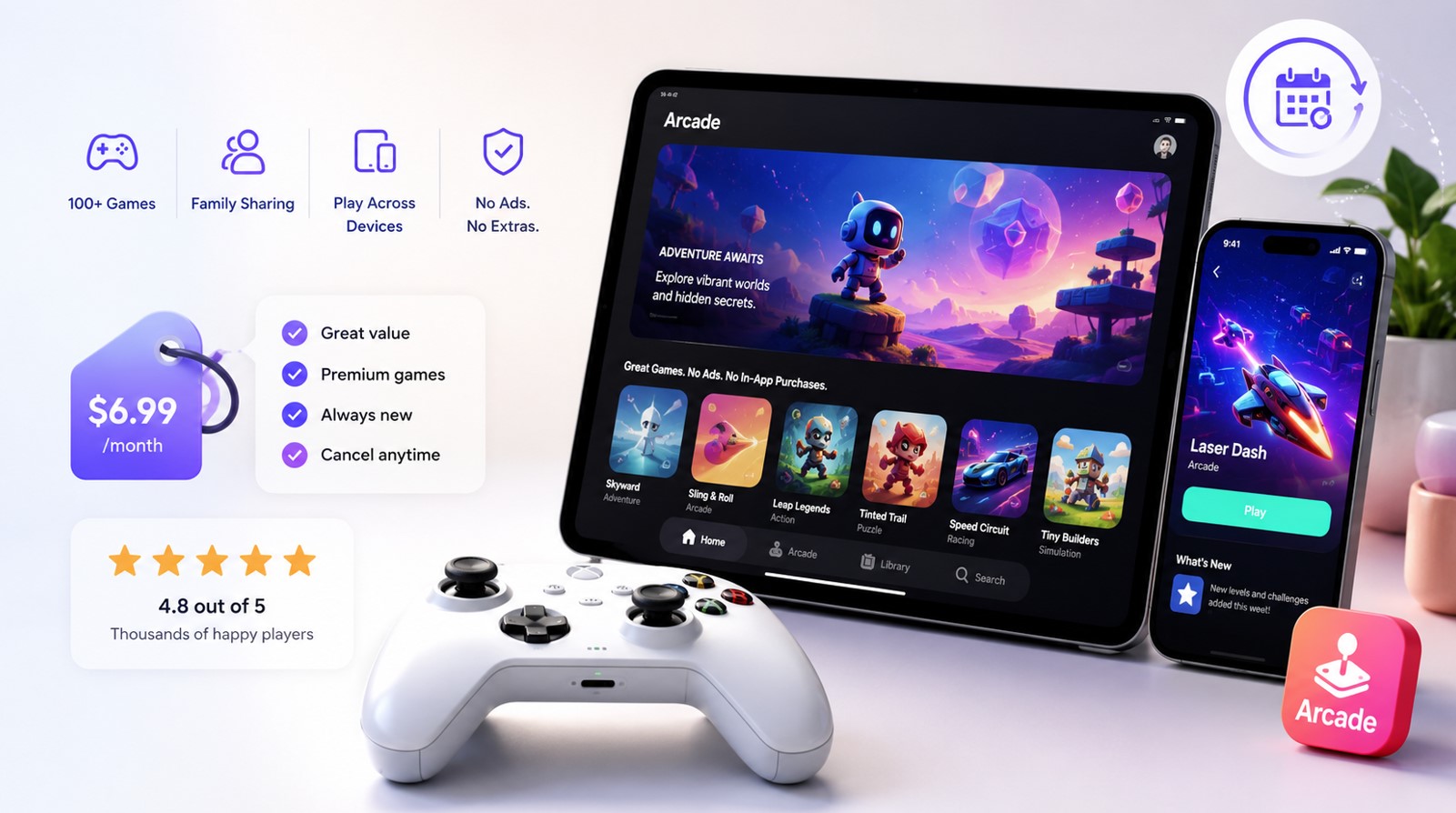
No ads. No in-app purchases. Ever. This is the load-bearing feature and it’s easy to undervalue if you haven’t opened the free App Store charts recently. Every game in the catalogue is complete – no energy timers, no gem bundles, no rewarded video between levels. When the service launched, reviewers described it as an antidote to the exhausting free-to-play glut, and that framing has aged well. If anything, the mobile store has got worse since.
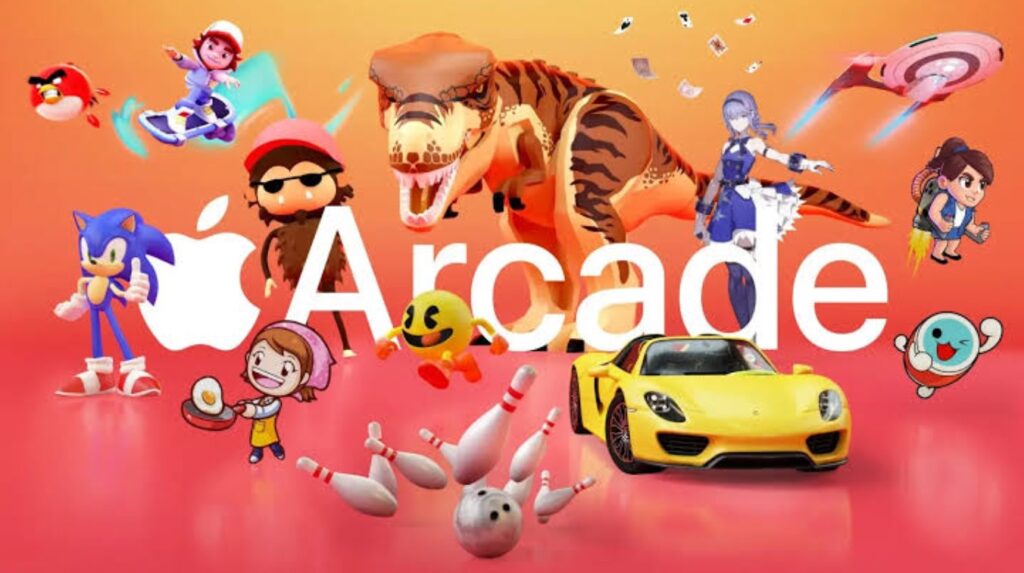
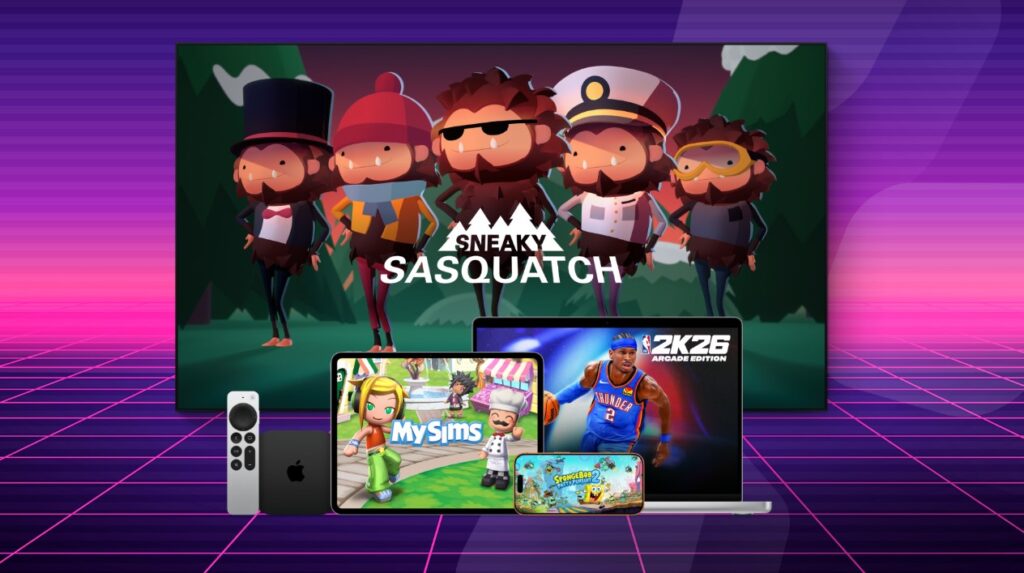
Over 200 games, spanning genuinely different registers. Football Manager Touch, NBA 2K Arcade Edition, Disney Dreamlight Valley Arcade Edition, Sonic Dream Team, Hello Kitty Island Adventure, Sneaky Sasquatch, Bloons TD 6, Don’t Starve, Monument Valley 2, Downwell. That’s not a shovelware pile. There are real mobile games in there that people pay full price for elsewhere.
It works across your devices. iPhone, iPad, Mac, and Apple TV, with progress carrying between them. Controller support is broad.
It shares across a family group. One subscription, everybody in the household. For a family with two kids and an iPad each, the per-person maths changes dramatically.
Games get updated. Apple pushes regular content updates across dozens of existing titles rather than just adding new ones and letting the back catalogue rot.
And it includes the “plus” versions of games you’d otherwise pay for. Titles from the App Store Greats and Timeless Classics categories are the ad-free, IAP-free editions of paid or freemium games – and in some cases the Arcade version is the only one that still runs on modern hardware, since some originals had broken with iOS updates.
That’s a real product. Now the other column.
The Debit Column
It costs more than it used to. Apple raised the monthly price from $4.99 to $6.99 – a 40% increase – as part of a broader round of subscription hikes that also pushed TV+ up by nearly 43%. That’s the number sitting behind most people asking this question in the first place.
Games leave. This is the one that catches people out, and it’s structural rather than occasional. There’s a “Leaving Arcade Soon” section, and titles do get retired. When a game goes, you get roughly two weeks to keep playing it if you already had it downloaded, after which launching it returns a “No Longer Available” message.
The reason is contractual. Apple signed three-year deals with developers back in 2019, and as those expired, some simply weren’t renewed. So the catalogue isn’t a library you’re borrowing indefinitely – it’s a rotating lineup, and anything you love can be pulled.
The developer picture is bleak. This is the part that should weigh on a long-term decision. A mobilegamer.biz investigation gathered accounts from multiple studios, and the language was stark – one developer described “the smell of death” around the service.
The specifics: upfront payments to buy a game for Arcade have declined since late 2020, as have per-play bonus payments. The bonus pool is calculated on “qualifying sessions,” a metric nobody outside Apple can define, which one source called a black box. One studio had months of glowing feedback before Apple withdrew interest without warning over a strategy change and then stopped answering emails. Another developer’s prediction was that payments would keep decreasing until they were pennies.
Alongside that, the greenlighting strategy reportedly shifted away from original games toward established family-friendly IP.
And the financials underneath are shaky. Reporting from The Information indicated Apple Arcade shows weak financial performance and would likely be unprofitable without its inclusion in the Apple One bundle. Insiders put first-year subscribers at around 2 million, roughly a quarter of whom were on free trials.
Is Apple Arcade Worth It Now? Run the Break-Even
Right, the maths, because this is where the argument actually resolves.
Annual is the move. The monthly price went up; the annual plan sat at $49.99 through the increase, which works out to about $4.17 a month. If you’re subscribing at all, subscribe yearly – the monthly rate is a 68% premium for the privilege of flexibility.
| What you spend | What it gets you |
|---|---|
| $49.99/year (annual Arcade) | 200+ games, ad-free, all devices, whole family |
| $6.99/month (monthly Arcade) | Same, at $83.88/year |
| $49.99 spent on the App Store | Roughly 5-8 premium mobile games, owned permanently |
| $0 | The free charts, with all the ads and timers that implies |
The break-even is genuinely low. Two or three games you’d otherwise have bought outright, and the annual plan has paid for itself. Football Manager Touch alone tends to cost most of that on its own.
But – and this is the part the value calculation misses – owning five games beats renting two hundred if you only ever play two. The subscription only wins if you actually rotate through the catalogue. If you’re the sort of person who finds one game and plays it for eighteen months, buying it outright is both cheaper and safer, because nobody can take it off you when a contract lapses.
So the real break-even isn’t about the money. It’s about your habits.
The Structural Question Nobody Wants to Ask
Here’s the tangent that I think matters more than the price.
There’s a difference between “is this good value this month” and “should I build my gaming life around this.” The developer reporting, the catalogue removals, the reliance on Apple One for profitability, the shift toward safe family IP – none of that stops the service being decent value today. All of it suggests the trajectory isn’t upward.
Apple has been building out a dedicated gaming hub across its platforms, which reads as a commitment of some kind. But commitment to a storefront isn’t the same as commitment to funding original games, and the developer accounts point at the latter drying up.
I’d frame it this way: subscribe if the current catalogue justifies the current price. Don’t subscribe on the assumption that it’ll keep getting better, because the people making games for it don’t appear to believe that.
And whatever you do, don’t get attached. A few habits worth adopting:
- Take the free trial first. A month free for new subscribers, or three months with a new Apple device. Actually use it to test whether you rotate games or fixate on one.
- Check the “Leaving Arcade Soon” section before you sink forty hours into something.
- Buy outright anything you’d genuinely miss. If a game becomes a fixture, owning a copy elsewhere removes the risk entirely.
- Do the Apple One maths. If you already pay for Music, iCloud, and TV+ separately, the bundle may make Arcade effectively free – and that bundling is exactly why the service still exists.
- Set a calendar reminder before renewal. The service is easy to keep paying for and forget about, which is the business model working as designed.
Is Apple Arcade Worth It Now for You Specifically?
The verdict changes completely by user type, so here it is broken out.
Families with kids: yes, clearly. This is the strongest case by a distance. Ad-free and IAP-free is not a nice-to-have when children are involved, it’s the whole point – it removes the entire category of “my kid spent £80 on gems” from your life. Add family sharing across multiple devices and the annual price becomes trivial per head. The recent shift toward family-friendly IP that disappoints indie fans is, for this group, a feature.
Lapsed mobile gamers: yes, probably. If you gave up on phone gaming because the free charts became unplayable, this is the fix. The library is curated, the games are complete, and the barrier to trying something is zero.
Apple One subscribers: yes, trivially. You’re already paying for it. Use it.
Indie enthusiasts hunting originals: increasingly no. If your reason for subscribing was the flow of interesting original commissions, that’s the exact thing the reporting says has been cut back. The back catalogue still holds gems, but the pipeline isn’t what it was in 2019.
Single-game players: no. Buy the game. You’ll spend less and nobody can revoke it.
Console and PC players looking for a second platform: probably not. Game Pass and PS Plus operate at a different scale and price point, and Arcade isn’t competing for that slot.
FAQ
How much does it cost now?
$6.99 a month or $49.99 a year, following a price increase that took the monthly plan up from $4.99. The annual plan works out to roughly $4.17 a month.
Are there really no ads or in-app purchases?
Correct. Every title in the catalogue is complete, with no advertising, energy timers, or paid add-ons. It’s the service’s defining feature.
Can games be removed?
Yes. There’s a “Leaving Arcade Soon” section, and once a title is retired, you have about two weeks to play it if it’s already downloaded; then it stops working.
Why do games get removed?
Contracts. Apple signed three-year deals with developers around the 2019 launch, and some of those weren’t renewed as they expired.
Is the service in trouble?
Developer accounts collected by mobilegamer.biz describe declining upfront and bonus payments since late 2020, cancelled projects, and opaque payment metrics – with one developer calling it “the smell of death.” Reporting also suggests it leans on Apple One for viability.
Can my family share one subscription?
Yes, it shares across a family group, which makes the per-person cost very low for households with several devices.
Is there a free trial?
New subscribers get a month free, and buying a new Apple device typically comes with three months.
The Final Tally
So, is Apple Arcade worth it now? On the ledger as it stands, yes – for families, for anyone who’s given up on the free charts, and for anybody already inside Apple One. Two or three games you’d have bought anyway covers the annual price, and the absence of ads and microtransactions is worth real money in a market where those things have got genuinely oppressive.
The caution isn’t about value, it’s about direction: the developers making the games describe a service being quietly wound down rather than built up. Subscribe for what’s in the catalogue today, take the trial first, and buy outright anything you’d be sorry to lose.
P.S. If this gave you an actual answer rather than a shrug, passing it along is the simplest way to keep our small team writing pieces that read the developer reporting as well as the marketing page. Bookmark it too, since subscription pricing and catalogue policies both move faster than most people check, and you’ll want the break-even maths handy at renewal time. And if creative or commercial collaboration is what brought you here, the T-Minus team is always glad to hear from you directly.