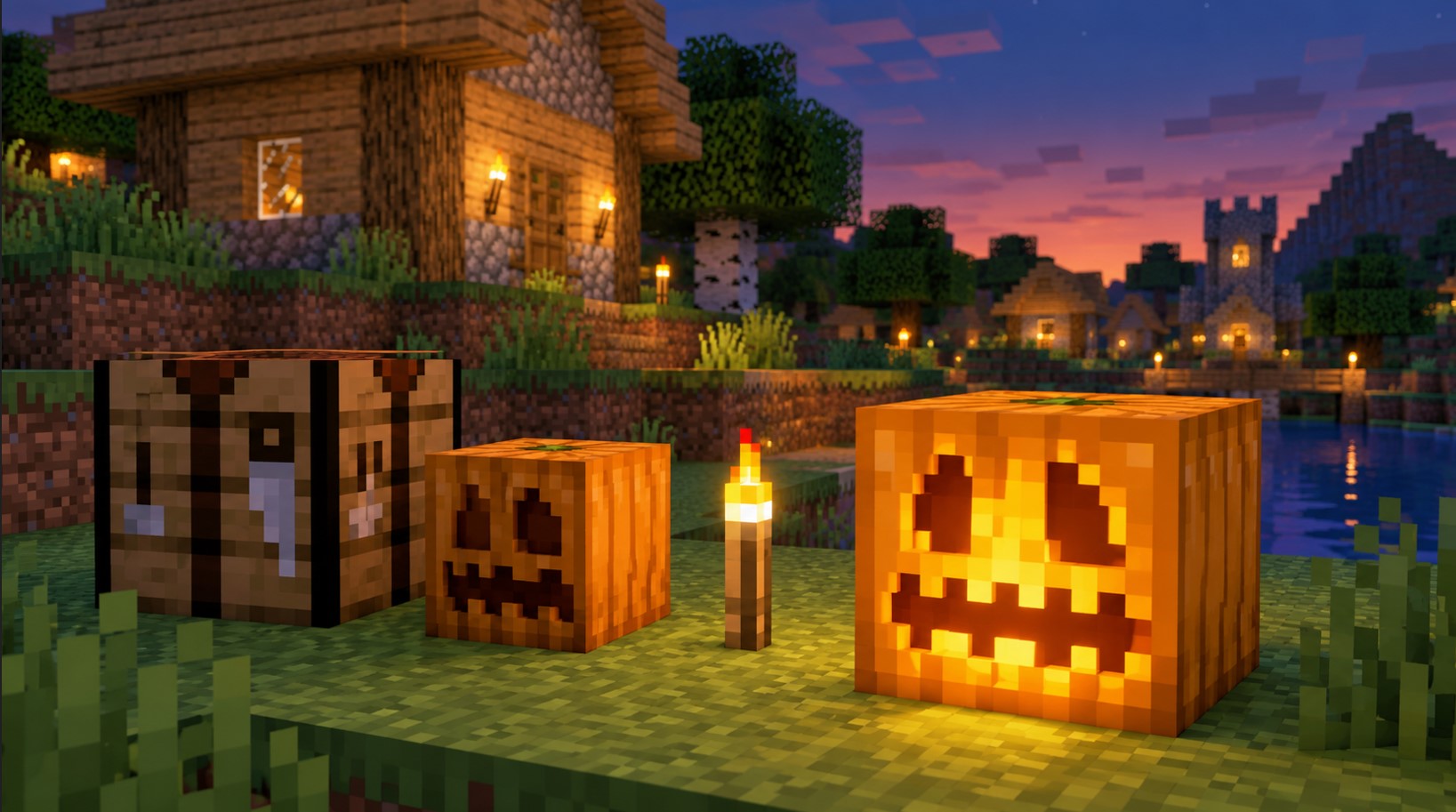
Minecraft Jack-o-Lantern Recipe: One Line, Then the Part Worth Reading
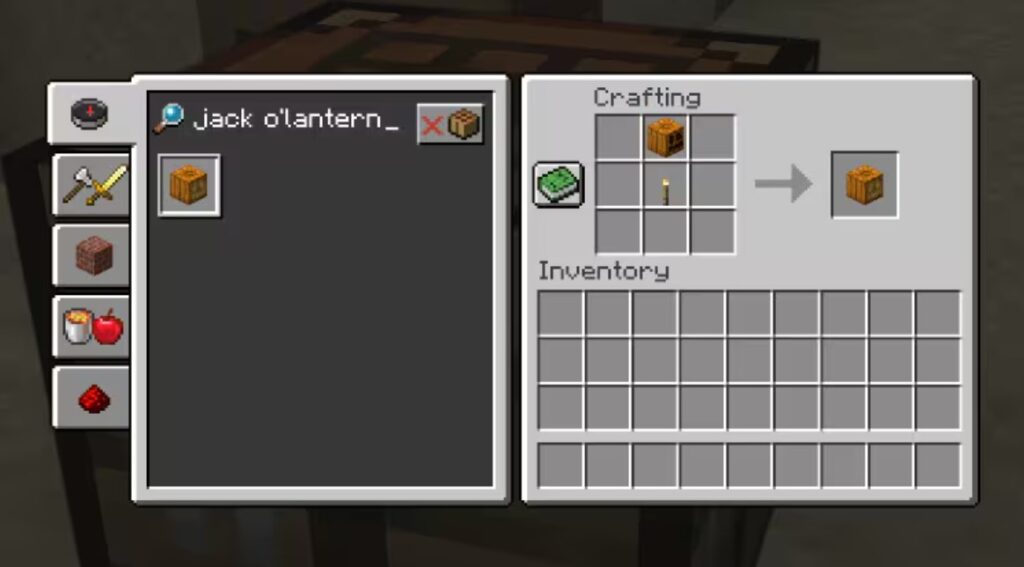
Carved pumpkin plus torch. That is the whole recipe, it fits anywhere on the crafting grid, and it takes about four seconds. Which leaves the interesting question, because Minecraft has roughly a dozen ways to produce light and most of them are easier to mass-produce than this one. Glowstone comes in stacks. Sea lanterns look better. Froglight exists. The Minecraft jack-o-lantern survives anyway, because it does six things that no other block in the game does, and at least two of them are jobs rather than decoration. One of those jobs got considerably more interesting with the arrival of copper golems.
So here is the recipe, then the six properties, in order of how likely you are to need them.
| Step | What You Need | Result |
|---|---|---|
| 1 | A pumpkin, grown or found | The raw block |
| 2 | Shears, applied to that pumpkin | Carved pumpkin, plus seeds |
| 3 | Carved pumpkin + torch, anywhere on the grid | Jack o’lantern |
Three steps, and only one of them trips people up.
Getting the Carved Pumpkin Right
The recipe fails for most new players at step two, because a plain pumpkin will not craft into anything. It has to be carved first.
Shear it. Equip shears, aim at a placed pumpkin, and interact. The pumpkin becomes a carved pumpkin, and you get seeds as a bonus – four pumpkin seeds in Java Edition, one unit in Bedrock, which is one of those small edition differences worth knowing if you are following a tutorial made on the other platform.
Two other ways to obtain a carved pumpkin without growing anything:
- Shear a snow golem. It drops its carved pumpkin head, which is both a source and a slightly grim piece of game design.
- Find one generated. Carved pumpkins appear in Woodland Mansion rail rooms and as part of the scarecrows at pillager outposts.
And jack o’lanterns themselves generate naturally, already lit, in the pumpkin piles found in taiga villages – worth remembering if you pass through one early and need light before you have shears.
What the Minecraft Jack-o-Lantern Recipe Gives You That a Torch Doesn’t
Property one and property two, which are the reasons to carry a few on expeditions.
It emits light level 15 and works underwater. A torch placed underwater breaks instantly. A jack o’lantern does not care. For lighting an ocean monument, a flooded ravine, a shipwreck or any underwater build, it is one of the simplest bright options in the game – no conduits, no sea lantern farming, no glowstone trip to the Nether.
It melts snow and ice. This is a side effect that experienced players treat as a tool. A jack o’lantern placed in a snowy biome clears snow layers around it and will thaw ice, which makes it the cheapest way to keep a doorway, a path, or a farm plot clear in a tundra without repeatedly shovelling. Place a few along a route through a snowy taiga, and the route stays walkable.
Neither of those is unique to the jack-o’-lantern in isolation – other light sources manage one or the other. What is unusual is getting both from a block you can craft from a plant you grow and a torch.
Making the Supply Renewable
Worth covering before the golem section, because one jack o’lantern is a decoration and twenty is a lighting system.
The block has been renewable since Beta 1.8, and the loop closes on itself in a way that is easy to miss. Shearing a pumpkin in Java Edition returns four pumpkin seeds alongside the carved pumpkin – so every pumpkin you carve pays for several more. Plant those seeds, wait, carve the results, and the supply compounds without ever needing to find another wild pumpkin.
Torches are the other half of the recipe, and they are effectively free once you have coal or charcoal, which means the only genuine bottleneck is farm space.
Two repeatable sources that do not require a farm at all:
- Snow golems. Build one from two snow blocks and a pumpkin, shear it for the carved pumpkin back, and you have a reusable head. It is a fiddly loop rather than an efficient one, but it works when you are far from your crops.
- Taiga villages, where jack o’lanterns generate already lit in pumpkin piles. Early game, those piles are the fastest light source in the biome.
Bedrock players should note the shearing difference again here: one unit rather than four seeds means the self-sustaining loop is slower on that edition, and a dedicated seed supply matters more.
Property Three: It Builds Golems, and That List Just Got Longer
This is the jack o’lantern’s actual job, and the one that makes it structurally important rather than decorative.
Three golems in the game are built by placing blocks and then topping them with a carved pumpkin or jack o’lantern:
- Snow golem – two snow blocks stacked, topped with the pumpkin.
- Iron golem – four iron blocks in a T shape, topped with the pumpkin.
- Copper golem – a single block of copper, topped with the pumpkin.
The pumpkin must be placed last. This is the single most common reason a golem fails to appear, and it catches people constantly: build the body first, place the head last, or nothing happens. You can also build copper golems horizontally or upside-down, which is a pleasant bit of flexibility the others do not share.
Either a carved pumpkin or a jack o’lantern works for all three. The jack o’lantern version costs you one extra torch and leaves the golem permanently glowing, which is genuinely practical – an iron golem lit at level 15 is an iron golem you can find at night.
The Copper Golem Is the Reason This Block Matters Now
Worth its own section, because it transformed the cheapest golem recipe in the game into something with real utility. A copper golem is a passive mob that moves items out of copper chests and into nearby wooden chests and trapped chests. It costs one block of copper and a pumpkin, which is close to nothing.
How it behaves:
- Empty-handed, it opens a copper chest and takes up to 16 of the first item it finds.
- Carrying items, it looks for a wooden or trapped chest that is either empty or already holds that item type.
- It cannot see chest contents until it opens them, so it works by trial rather than by plan.
- It ignores barrels, ender chests and items on the ground.
- It is passive and runs away when attacked.
That makes it a crude but free sorting assistant. Feed a copper chest with a hopper line, place a row of wooden chests nearby already seeded with one of each item type, and the golem will gradually distribute things into matching chests without any redstone at all.
The catch is oxidation. An unwaxed copper golem ages through four stages – unoxidized, exposed, weathered, oxidized – over roughly 21 to 23 in-game days. Once fully oxidized it has a chance each tick to become a copper golem statue, dropping whatever it was carrying and ceasing to work.
Three ways to deal with that:
- Wax it with honeycomb to stop the process entirely, which is what you want for a working golem.
- Scrape it with an axe to remove oxidation after the fact.
- Let lightning strike it, which also removes oxidation, and is a worse plan than the first two.
So the practical version is: build it, wax it immediately, and forget about it. An unwaxed golem is a three-week timer on your storage system.
The Minecraft Jack-o-Lantern Recipe Trap Nobody Mentions
Property four, and it is a genuine gotcha. Most light-level-15 blocks make the surface they sit on unsuitable for mob spawning, which is why players scatter them around bases. The jack-o’-lantern emits the same light – but it can still act as a spawning surface for mobs that ignore light level.
In practice, that means a jack-o’-lantern roof, a jack-o’-lantern platform, or a decorative layer of them across the top of a build is not automatically mob-proof the way an equivalent layer of glowstone would be. Anything that spawns regardless of light will happily appear on top of one.
For most players, this never comes up. For anyone building a farm, roofing a large structure, or wondering why something keeps appearing on a brightly lit surface, it is the answer.
Properties Five and Six: Facing and Physics
Two smaller behaviours that affect building more than they affect survival. It faces the player when placed. The carved face orients toward you at the moment of placement, which means the direction you are standing when you place it determines which way it looks. For a row of lanterns along a wall, stand where you want them looking and work backwards. There is no way to rotate one afterwards without breaking and replacing it.
Its physics are soft. Hardness 1, blast resistance 1, and an axe is the fastest tool for mining it. That low blast resistance matters near creepers and TNT – a decorative jack o’lantern wall does not survive an explosion the way stone does.
Pistons destroy it rather than pushing it, and sticky pistons cannot pull it. Anyone designing a redstone contraption involving these needs to know that before building the contraption.
And one difference from its own ingredient that surprises people:
| Carved Pumpkin | Jack o’Lantern | |
|---|---|---|
| Wearable as a helmet | Yes, with no armour value | No |
| Blocks enderman aggro when worn | Yes | Not applicable |
| Emits light | No | Yes, level 15 |
| Builds golems | Yes | Yes |
| Compostable | Yes, 65% chance | Not listed |
| Dispenser-equippable onto a player or mob | Yes | No |
That top row is the one to internalise. Adding a torch costs you the ability to wear it. If your plan involves walking through the End without angering endermen, you want the carved pumpkin, not the lit version – the mask effect that blocks enderman aggro belongs to the uncarved-looking original.
Where This Sits in the Current Game?
A short note on versions, since Minecraft’s numbering changed and tutorials age badly. The Minecraft game now runs on a 26.x numbering scheme, with 26.1, 26.2 and 26.3 having landed through 2026. Those updates have added a great deal – craftable name tags, sulfur and cinnabar block families, a poplar wood set, wool and concrete stairs and slabs in all sixteen colours, cushions, the straw bed – pushing the total craftable item count past a thousand.
None of them changed pumpkins, carved pumpkins, jack o’lanterns or light sources. The recipe you are reading is the recipe that currently works, and it has worked in essentially this form for a very long time.
For anyone working with commands or datapacks, the identifiers differ by edition: it is jack_o_lantern in Java Edition and lit_pumpkin in Bedrock, which carried numeric ID 91 before The Flattening.
Historically, the block arrived all the way back in Java Alpha 1.2.0 and became renewable in Beta 1.8 – meaning it has been craftable from farmable ingredients for the overwhelming majority of the game’s life.
FAQ
What is the jack o’lantern recipe in Minecraft?
A carved pumpkin plus a torch, placed anywhere on the crafting grid. The pumpkin must be carved first.
How do you carve a pumpkin?
Apply shears to a placed pumpkin. You get a carved pumpkin plus four pumpkin seeds in Java Edition, or one unit in Bedrock.
What light level does a jack o’lantern give?
Level 15, the brightest in the game, and it works underwater where torches cannot be placed.
Can you build golems with a jack o’lantern?
Yes – snow golems from two snow blocks, iron golems from four iron blocks, and copper golems from one copper block. The pumpkin or lantern must always be placed last.
Does a jack o’lantern stop mobs spawning?
Not entirely. It emits light 15, but unlike most light sources at that level it can still serve as a spawning surface for mobs that ignore light level.
Can you wear a jack o’lantern?
No. Only the carved pumpkin can be worn, and that version also prevents endermen becoming hostile when you look at them.
Do copper golems need maintenance?
Only if you want them to keep working. Wax one with honeycomb immediately, or it oxidises over roughly 21 to 23 in-game days and can eventually become a statue.
A Four-Second Recipe With a Long Tail
What makes this block worth more than a line in a crafting index is how much it quietly does. It is the cheapest permanent underwater light in the game. It is a snow-clearing tool in biomes where that is a daily chore. It is the head of three different golems, one of which now sorts your storage for free. It melts ice, it faces wherever you are standing, and it has been doing all of this since Alpha.
What it is not is mob-proof flooring, wearable headgear or piston-friendly, and knowing those three limits is most of what separates a player who finds the block charming from one who finds it mysteriously annoying.
So: carve a pumpkin, add a torch, and then put the result on top of a copper block and wax it before you forget. The golem will be shuffling items between your chests while you are off doing something else entirely.
Carving pumpkins this weekend? Share this, bookmark it, and go wax that copper golem before it turns into a statue – and if creative or commercial collaboration brought you here, the YaninaGames team is one message away.