The Rise of Voice AI Tools
In video games, excellent dialogue builds lasting worlds. Character voices traditionally took a long time to do at a high cost, requiring professional actors and extensive studio time. But all of that is now changing thanks to a new technology – voice AI tools. It is not a minor modification but a complete shift of the game developers’ work, particularly at the beginning of dialogue. Voice AI also allows developers to create and test character voices and scripts quickly, making a tedious and difficult task fast and creative. It allows teams to experiment and create superior games.
This new mode of working is benefiting both the small independent studios and large game houses. Having the possibility of creating quality voiceovers in a matter of minutes rather than weeks allows creative teams to experiment with various story arcs and personality types for characters without enormous expense. For instance, a Voice AI API can translate written words into emotive speech with astonishing precision, allowing developers full control over the sound of characters.
The Old Way – Big Problems for Game Developers
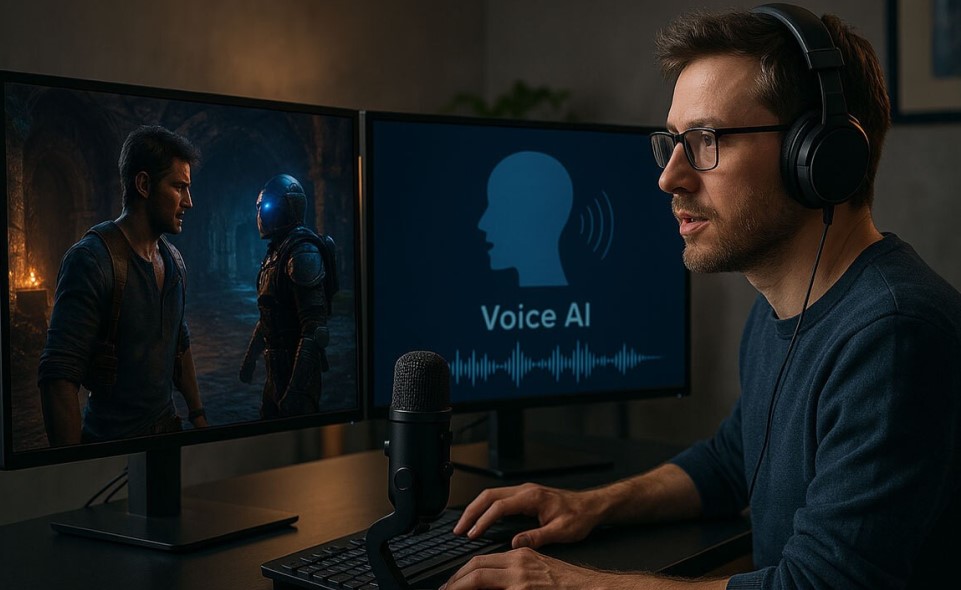
Life was difficult before voice AI when it came to creating dialogue for games. It was a stiff and slow process. It began with a script, followed by hiring voice actors, booking studio time, and waiting for the recordings. If one word had to be altered, the entire expensive procedure had to begin all over again. It meant developers would often just go with basic dialogue and could not test much.
The challenges game developers faced are:
- Expensive and Long Delays. It was prohibitively costly to hire voice actors and use recording studios on a rental basis, particularly for games that feature extensive dialogue. This was too much money for most small or independent game developers.
- No Creativity. Once a line of dialogue was recorded, it was difficult and costly to modify. This reduced creativity and prevented developers from experimenting with the narrative.
- Scale Trouble. Having dialogue for thousands of characters or localizing a game into multiple languages became an enormous undertaking. Every new character or language required a new cast of actors and recording sessions.
The New Way – Fast and Efficient Voice AI Solution
Voice AI addresses these issues by providing developers with a very powerful tool. It simplifies the process of writing dialogue, thus developers are able to concentrate on making the story and game more creative. This is important since it can generate a high volume of dialogue inexpensively.
The benefits of using voice AI in game dialogue prototyping are:
1) Quicker Production and Improved Testing
Speed is one of the largest advantages. With a text-to-speech engine, a developer is able to churn out a whole character’s dialogue script within minutes. This quick turnaround enables agile development and rapid testing. A writer can write a scene, receive the audio immediately, and test it in the game to determine if it is working.
If a tone is incorrect or a line must be tweaked, they simply revise the text and produce the new audio on the fly. This fast-loop, previously unimaginable, makes for much improved creative refinement. A developer can experiment with a cheerful voice for a character and then quickly switch it, with some mouse clicks, to a more somber voice to determine which works best in the story.
2) Lower Costs and Easy Scaling
Voice AI significantly reduces the cost of developing games. By eliminating the need for costly studio time and recurring fees for talent in the early days, game developers can spend their money on other significant aspects of the project. This allows small developers to develop games with rich, voiced dialogue that was out of their budget previously.
The technology is also easy to scale. A single voice AI model can generate unlimited dialogue in a large open-world game. It is easy to populate the game world with individual and realistic characters. It is a massive innovation in large projects since it allows developers to create more detailed and immersive worlds without significantly increasing costs.
3) Consistent Voices and Emotions
When people act, it can be difficult to maintain the voice of a character over the course of a large project since they can vary. Voice AI ensures that voice is never different. After selecting a voice, you will never hear it any differently on each line of dialogue.
Next-generation AI systems also provide a variety of emotional styles, so developers can tweak a line to be angry, sad, excited, or surprised. This degree of control over the voice of a character was previously achievable only through human actors.
Conclusion
The future of voice in gaming is not about replacing human actors. It’s about giving creators new tools. Developers will continue to use people to create significant components that require a considerable amount of emotion, but they will apply voice AI to testing, crowd dialogue, and interactive characters. Such collaboration will assist studios to create worlds that are richer, more detailed, and engaging than ever.
Voice AI is not a fad but a major tool that is rapidly becoming the new reality of game creation today.
The YaninaGames team hopes you’ve enjoyed reading this post. We will continue to post the content about new technologies used in game development. Please bookmark, follow, and share your favorite posts found on this blog. Make sure to contact us if you seek collaboration and a creative team of fellow game devs.