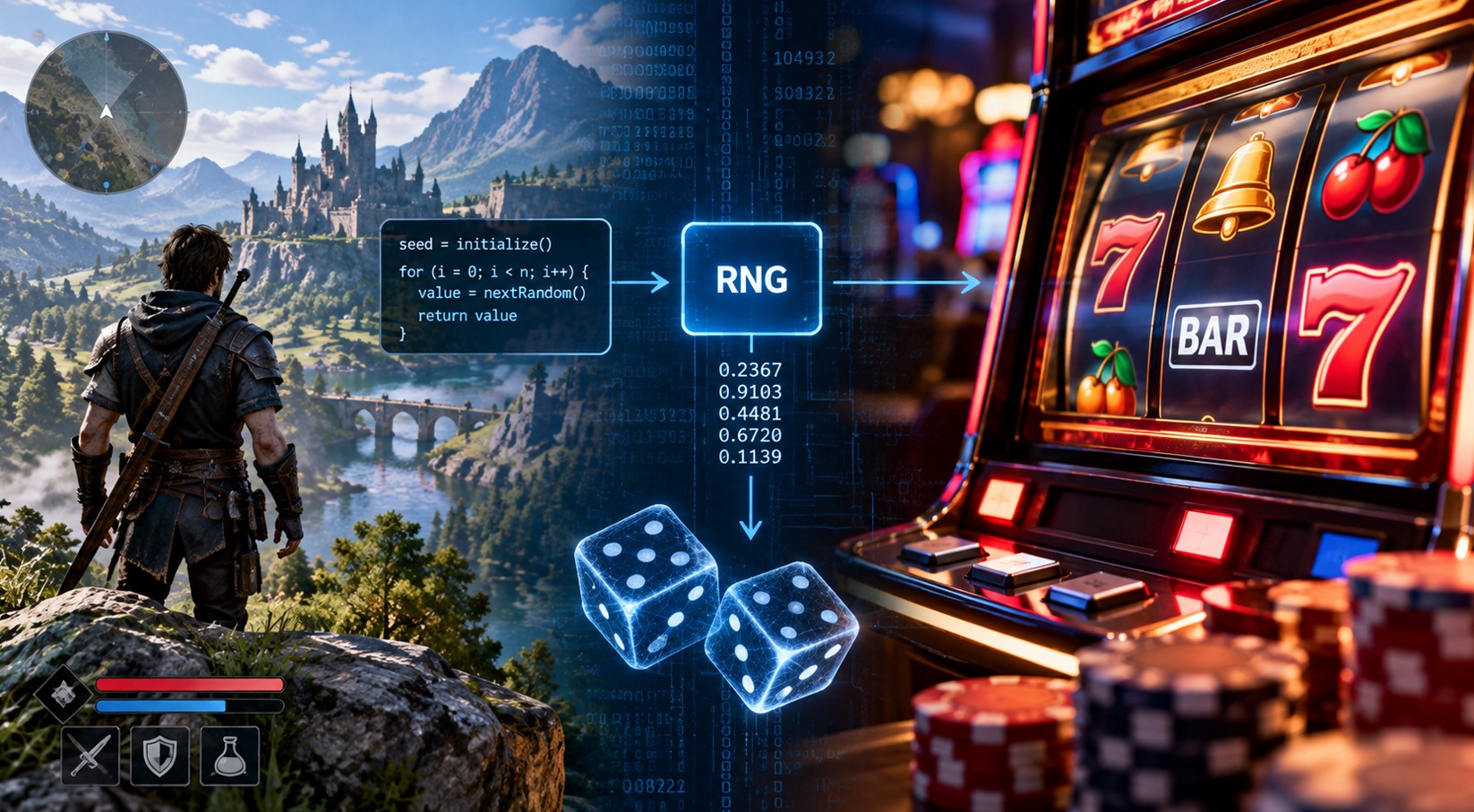
Certified Casino RNGs vs Video Games: The Key Differences
A video game might use a random number generator to position enemies or construct an unfamiliar landscape. In a digital slot machine, similar mathematics determines symbols and prize combinations. Both systems can rely on deterministic algorithms, yet the consequences of faulty output differ considerably. When money is wagered, the software must satisfy defined standards for statistical behaviour, security and the accurate calculation of results. Those safeguards, rather than a fundamentally different source of randomness, separate ordinary game RNGs from certified casino systems.
Why Video Game RNGs and Casino RNGs Serve Different Purposes?
Game developers often favour pseudorandom number generators (PRNGs) because their sequences can be reproduced. Entering the same initial seed allows a developer to recreate a procedural environment or investigate a software defect. Predictability under controlled conditions is useful in this setting.
Gambling software faces additional scrutiny because generated numbers determine financial outcomes. The distinction is relevant to platforms such as tooniebet, which offers more than 5,000 casino games to customers in Canada outside Ontario. Its catalogue combines digital casino titles with live-dealer formats, where cards, roulette wheels or other physical equipment may determine results independently of software RNGs.
A deterministic generator can meet gambling standards. Its suitability depends on secure initialization, resistance to prediction and accurate integration with the game’s mathematical model.
A Random-Looking Sequence Is Not Necessarily Unpredictable
An evenly distributed sequence is not necessarily secure. Someone who discovers a generator’s internal state may be able to calculate subsequent values even when earlier results appear statistically random.
The UK Gambling Commission addresses this distinction through Remote Gambling and Software Technical Standards, including RTS 7. GLI-19, developed for interactive gaming systems, establishes additional expectations concerning cryptographic strength and resistance to attacks.

Seeding is a particular concern. A generator initialized exclusively from the current time may expose enough information for an attacker to reconstruct its sequence. GLI-19 therefore prohibits time alone as an initialization seed and requires protections against identical starting states across games.
Statistical testing addresses a different question: whether generated values exhibit the expected distribution. A system can satisfy distribution tests while remaining vulnerable to prediction. Laboratories must therefore examine both numerical behaviour and the security properties of the software producing it.
These standards provide useful technical benchmarks, although adoption and enforcement depend on the gambling jurisdiction.
How Laboratories Test the Numbers and The Outcomes They Produce
A casino game does not display raw RNG output. Software converts generated values into reel positions, cards, symbols or other events. Errors introduced during conversion can alter the intended probabilities.
Consider a generator producing integers from 0 to 255, each with equal probability. Dividing those values into ten outcomes using the remainder operation leaves six outcomes with 26 possible inputs each. The other four receive only 25.
The original distribution was uniform. The conversion was not.
Known as modulo bias, this mathematical problem illustrates why laboratory assessments must extend beyond the generator itself. Different prizes can legitimately have different probabilities, but those probabilities must follow the game’s specified mathematical model.
GLI-19 testing procedures account for this by examining production-equivalent game functions, scaling methods and final results. Raw numerical output and the completed game’s behaviour may be evaluated separately.
Even a cryptographically strong generator cannot correct mistakes in symbol mapping, card selection or payout calculations.
Why Certified RNGs Can Still Produce a House Edge?
Fair randomness concerns whether outcomes follow their specified probabilities. It says nothing about whether those probabilities favour the person placing a wager.
Suppose a hypothetical game charges $1 and pays $9 on 10% of outcomes, returning nothing otherwise. Its theoretical return to player (RTP) is 90%, equivalent to an expected payout of $0.90 per dollar wagered. That percentage describes a mathematical expectation, not a schedule of winnings. A short sequence can produce results substantially above or below the theoretical return.
Volatility further affects how prizes are distributed. Two games with identical RTP figures might differ considerably in winning frequency and payout size.
This distinction matters when interpreting certified gambling software. Laboratory testing cannot eliminate the financial disadvantage built into a game’s payout mathematics.
In Canada, responsible gambling protections and legal requirements differ by province. Gambling is restricted to those of legal gambling age in their province or territory. Anyone who chooses to gamble should recognize the possibility of losing their entire stake, establish financial limits, and avoid treating gambling as a source of income.
Why an RNG Certificate Does Not Cover Every Game or Software Update
An RNG certificate must be interpreted according to its testing scope. A laboratory might assess a generator component, a particular game integration, or a specified mathematical configuration. Those findings cannot automatically be extended to unrelated products.
ToonieBet operates under Tobique Gaming Commission licence No. 0000050. An operator licence and independent certification of a particular game’s RNG are separate matters. Neither should be presented as evidence of the other without supporting documentation.
Changes made after testing also require attention. Modified payout tables, revised outcome mapping or replacement generator software can affect the validity of earlier assessments.
GLI-19 distinguishes laboratory certification from operational auditing, which considers the production environment, configuration controls and security procedures. British technical requirements also establish testing and reporting obligations for relevant game releases and major updates.
A meaningful certification claim therefore identifies the tested software, its configuration, the applicable standard and the scope of the assessment. The strength of the evidence rests on those particulars, not simply on the presence of a certification label.
P.S. YaninaGames ensures you receive the latest insights and news related to the world of video games. Please share and support this post if you’ve liked reading our blog. Any feedback is much appreciated.