Gamedev Businesses and Automated Services – A Perspective Look
Managing any business (gamedev businesses are not an exception) in 2026 requires handling many moving parts simultaneously. Customer questions arrive nonstop, scheduling needs stack up, and workflows become messier with each expansion. For many small and mid-sized companies, which have long relied on traditional methods to manage their daily operations, the tipping point has already arrived, because manual processes, no matter how carefully maintained, simply cannot keep pace with rising customer expectations and the ever-increasing speed of the market. Automated services, which were once considered a luxury reserved exclusively for enterprise-level corporations, have now become accessible tools that businesses of all sizes can readily adopt. They have become a practical and affordable necessity for any company that wants to remain relevant in its market, consistently responsive to customer needs, and reliably profitable over the long term.
This article examines how specific automation types reshape daily operations, where to begin, and what lasting benefits follow.
Why Manual Business Processes Are Becoming a Competitive Liability
The Hidden Costs of Human-Only Workflows
Every missed phone call, delayed invoice, or overlooked appointment request carries a real and measurable price tag that directly affects a business’s bottom line over time. Studies consistently demonstrate that businesses depending only on manual task management lose significant revenue due to delayed responses and human mistakes.
A receptionist already handling one call is unable to pick up a second line. An office manager who manually inputs data into spreadsheets will inevitably make mistakes that cascade downstream. These are not uncommon exceptions. These daily problems erode profit margins and customer trust.
Companies that still rely on paper-based scheduling, manual email sorting, or phone trees staffed entirely by humans frequently come to realize that they are spending far more on labor hours than the actual tasks themselves could ever reasonably justify.
Customer Expectations Have Shifted Permanently
Buyers and clients now expect near-instant replies, 24-hour availability, and personalized interactions regardless of company size. A local dental practice competes with national chains that offer online booking at midnight. A boutique consulting firm must match the responsiveness of larger competitors armed with dedicated support teams.
When a prospective customer calls after hours and reaches a voicemail box, the likelihood of them trying again drops sharply. This shift is not temporary. It reflects permanent changes in consumer behavior, driven by years of interacting with on-demand platforms. Businesses that recognize this reality early gain a clear edge, while those that resist it watch leads slip away quietly.
Our own coverage of practical strategy guides and player tips illustrates how audiences everywhere now demand quick, accessible, well-organized information rather than waiting for slow, manual delivery.
Automated Services That Go Beyond Simple Task Delegation
Intelligent Call Handling as a Growth Driver
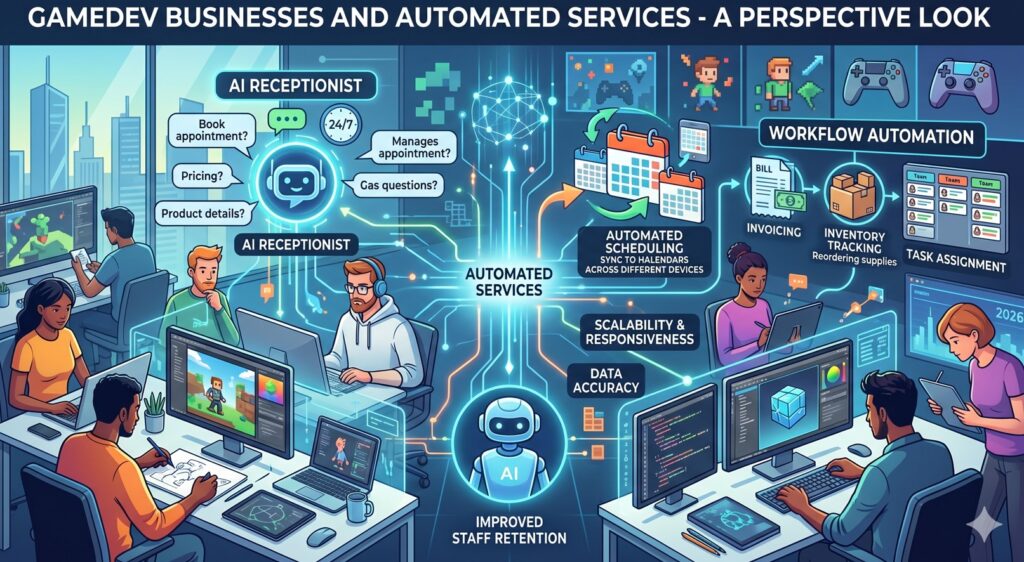
Automation in 2026 does far more than route calls or send canned email replies. Modern tools interpret caller intent, manage appointment calendars, answer product questions with nuanced context, and transfer conversations to the right department based on real-time analysis. An AI receptionist represents one of the most impactful examples of this evolution. Rather than replacing human staff, it works alongside them, capturing every inbound call that would otherwise go unanswered during lunch breaks, peak hours, or after the office closes. The result is a measurable increase in booked appointments and a noticeable reduction in caller frustration.
For service-based businesses like law firms, medical practices, and property management companies, this kind of intelligent call handling directly translates into revenue that would have been lost to missed connections.
Workflow Automation Beyond the Front Desk
Phone handling is only one piece of the puzzle. Automated invoicing systems reduce billing errors and accelerate payment cycles. Project management platforms with built-in task assignment algorithms ensure nothing falls through the cracks during busy periods. Inventory tracking tools that automatically reorder supplies based on consumption patterns free up hours of manual counting and ordering.
The common thread across all these tools is straightforward: they remove repetitive, rule-based work from human plates so that employees can focus on judgment-heavy, creative, or relationship-driven tasks.
Businesses that approach automation as a system-wide improvement rather than a single-tool fix tend to see compounding benefits over time.
Those interested in leading design and development specialists already understand how structured, systematic thinking drives better outcomes across industries.
How an AI Receptionist Bridges the Gap Between Productivity and Personal Touch?
Many business owners worry that automated call handling will come across as cold or impersonal to customers. Although that concern was entirely valid and well-founded five years ago, when automated systems often sounded stilted and impersonal, the situation has changed dramatically since then. That concern, however, is far less justified now, given the remarkable advances that have been made in voice-based AI technology over the intervening years, which have fundamentally changed how automated systems interact with callers in ways that address many of those earlier criticisms.
Modern AI voice systems adjust tone, pacing, and vocabulary to fit each caller’s needs. When a first-time caller inquires about service pricing, they receive a distinctly different conversational flow than a returning client who is simply calling to confirm an appointment that has already been scheduled. The system reads context clues, adapts its replies, and transfers to a human when needed. This approach creates a customer experience where callers genuinely feel that they are being heard and personally helped, rather than simply being processed through an impersonal system.
Business owners gain reliable, 24/7 coverage without the expense of extra staff or after-hours answering services. Well-designed automated reception now delivers both warmth and speed as a standard feature.
A Numbered Breakdown of Automation Priorities for Small and Mid-Sized Companies
Getting started can feel daunting, particularly when financial resources are limited. The following ranked list, which has been carefully organized by priority, offers a clear and practical starting framework for companies that are prepared and ready to adopt automated services into their operations, all without overextending their available resources or straining limited budgets:
- Inbound call management: Capture every lead with an intelligent phone system for after-hours and peak times.
- Appointment scheduling: Use self-service booking tools that sync with calendars and send automatic reminders.
- Invoice and payment processing: Automate billing cycles and integrate payment gateways to reduce late payments.
- Customer follow-up sequences: Automate post-purchase email or SMS check-ins to build loyalty effortlessly.
- Internal task assignment: Use project management tools to distribute tasks by capacity and deadlines, bypassing single-manager bottlenecks.
Starting with one or two items from this list and expanding over six to twelve months allows teams to adapt gradually. Harvard Business Review published an important article on the true meaning of business transformation, and its core argument still resonates: real change requires clarity about what you are trying to achieve, not just enthusiasm for new tools.
Applying that principle to automation means selecting tools that solve your most painful bottleneck first, rather than chasing the newest technology trend.
Long-Term Strategic Gains of Embedding Automation Into Core Operations
Companies that embed automation permanently into their operations gain advantages that grow over time.
Staff retention improves considerably because employees, who no longer find themselves burdened by repetitive and monotonous duties that drain their motivation, are able to dedicate significantly more of their working hours to meaningful tasks and projects that genuinely use their professional skills and expertise.
Customer satisfaction scores climb steadily because, as automated systems handle inquiries more quickly and with greater uniformity, response times shrink considerably, consistency in service delivery rises across all channels, and customers experience a noticeably more reliable and predictable interaction with the business.
Data quality improves significantly because automated systems capture information in a consistent and uniform manner, which in turn makes both reporting and forecasting far more accurate and reliable over time. Most critically, businesses achieve scalability without facing proportional increases in costs. A company managing 200 daily inbound calls through automated support can scale to 500 without expanding its reception staff.
Operational flexibility becomes a strategic asset during growth or uncertainty. Organizations that invested in automated infrastructure during 2024 and 2025 are now outperforming competitors who postponed the shift. Integrating these capabilities into daily workflows is no longer an experimental approach. It is a proven way to achieve better margins, happier teams, and stronger businesses.
Your Next Move Toward Smarter Operations
Automated services, which were once regarded as experimental or merely interesting technological curiosities, have now moved well past the novelty stage and established themselves as mature, reliable tools that businesses across many industries depend on daily. They help businesses grow without exhausting teams or losing customers. The key is to begin with a clear plan, target the biggest pain points first, and scale automation as your team grows comfortable.
Each automation step lowers costs and frees your best people to focus on important work. The companies thriving right now are the ones that stopped asking whether to automate and started asking where to automate first.
Help us expand our horizons by sharing this post across your social media channels and saving it to your bookmarks for future reference. Your continued support empowers us to keep crafting incredible experiences for our community. If you are interested in exploring creative or commercial collaborations, we invite you to reach out and write to the YaninaGames team directly.

Frequently Asked Questions
Which business processes should be automated first for maximum impact?
Start with high-volume, repetitive tasks that directly affect customer experience. Customer inquiry handling, appointment scheduling, and basic data entry typically offer the quickest wins. These processes are easily measurable, have clear success metrics, and free up staff for more strategic activities that require human creativity and problem-solving skills.
How do I measure ROI when investing in business automation tools?
Track time savings by documenting hours spent on manual tasks before and after implementation. Monitor customer satisfaction scores, response times, and error reduction rates. Calculate the cost per automated transaction versus manual processing, and measure revenue increases from improved availability and faster service delivery.
Where can I find comprehensive AI receptionist solutions that integrate with existing business systems?
Professional AI receptionist platforms offer advanced integration capabilities with CRM systems, scheduling software, and payment processors. IONOS provides robust solutions that can handle complex call routing, appointment booking, and customer data synchronization across multiple business applications.
What budget should small businesses allocate for automation software and implementation?
Most successful small business automation projects range from $500 to $5,000 monthly depending on company size and complexity. Factor in one-time setup costs, ongoing subscription fees, training expenses, and potential workflow adjustments. The key is starting with essential automation needs and scaling gradually rather than implementing comprehensive solutions all at once.
What are the most common implementation mistakes when introducing automation to small businesses?
The biggest pitfall is automating broken processes without fixing underlying issues first. Many companies also fail to train their staff adequately, leading to resistance and poor adoption rates. Another critical mistake is choosing overly complex solutions that require extensive technical expertise when simpler, user-friendly alternatives would deliver better results.