Best Minecraft Armor Enchantments That Actually Keep You Alive
Okay, so you’ve got a full set of Netherite armor. Congratulations – you’ve made it further than most players do. But here’s the thing: raw armor rating only takes you so far. A warden doesn’t care how shiny your chestplate is. Neither does a creeper that just snuck up behind you while you were mining. That’s where enchantments come in, and picking the right ones is honestly one of the more strategic decisions you’ll make in the game. There are dozens of best Minecraft armor enchantments floating around – some genuinely clutch, some situationally useful, and a few that are basically just padding. This guide breaks down which ones belong on your armor and why, without the fluff.
Why Enchanting Your Armor Is Half the Game?
Before getting into the specifics, it’s worth saying: enchanting isn’t optional if you’re pushing into the harder parts of the game. Speedrunners know this. Hardcore players know this. Even casual survival players who’ve died one too many times to a skeleton volley know this.
Minecraft’s difficulty curve gets steep fast – especially after 1.19 dropped the Deep Dark biome and the warden became a very real problem. Enchantments are your answer to that steepness. They’re the difference between a full health bar and a death screen.
The Tier List You Actually Need
Not all enchantments are created equal.
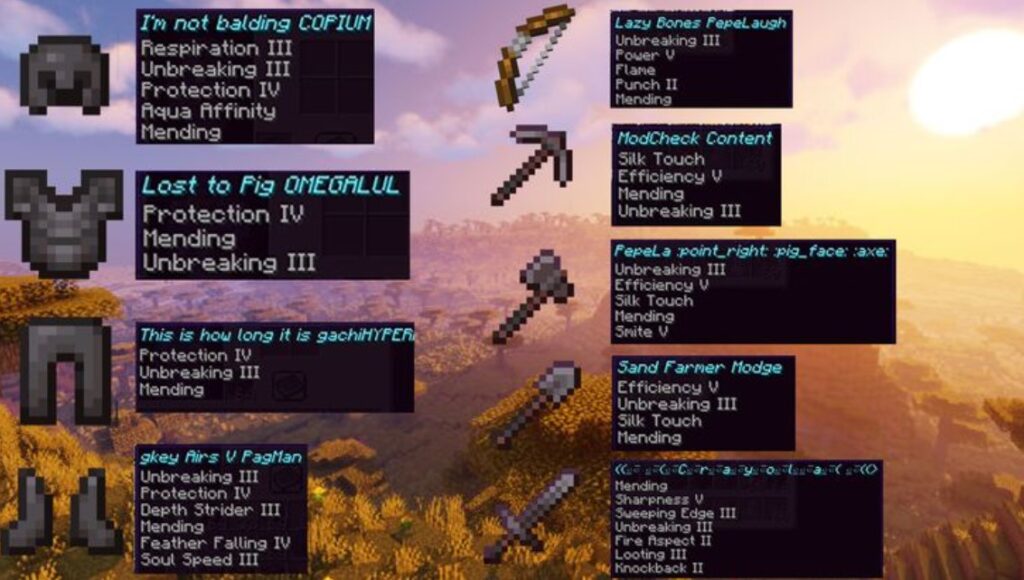
| Enchantment | Armor Slot | Max Level | Priority |
|---|---|---|---|
| Protection | Any | IV | Must-have |
| Mending | Any | I | Must-have |
| Unbreaking | Any | III | Must-have |
| Feather Falling | Boots | IV | High |
| Thorns | Chestplate | III | Medium |
| Depth Strider | Boots | III | Situational |
| Respiration | Helmet | III | Situational |
| Aqua Affinity | Helmet | I | Situational |
| Blast Protection | Any | IV | Niche |
| Projectile Protection | Any | IV | Niche |
This is the general hierarchy. But depending on your playstyle – Nether runs, ocean exploration, boss fights – that “situational” column shifts around a lot.
Protection IV: The One You Always Want
If you could only pick one enchantment for your armor, Protection IV wins every single time. It reduces incoming damage from almost every source by 16% per level on each piece – stacking up to 64% total across a full set at max level. That’s massive.
The thing that makes Protection so valuable compared to its specialized variants (Blast Protection, Fire Protection, Projectile Protection) is the breadth. You’re not going to know every threat before it hits you. A skeleton arrow, a creeper blast, a magma cube – Protection handles all of it. The specialized ones offer higher reduction for their specific damage type, but only for that type. Protection is reliable across the board.
For a full set of gear, stack Protection IV on all four pieces. It’s the foundation everything else builds on.

Mending: The Enchantment That Pays for Itself
Here’s where players often get tripped up. Mending doesn’t feel as exciting as something like Thorns, but it might be the most valuable enchantment in the entire game. Mending repairs your gear using XP orbs – meaning every mob kill, every ore mined, every smelted item keeps your armor alive indefinitely.
Without Mending, you’re either grinding repair materials constantly or watching expensive gear deteriorate. With it, your best armor basically lasts forever, assuming you’re playing and collecting XP regularly. On hardcore mode, this is basically non-negotiable.
The only downside? You can’t craft Mending – it only appears in loot chests, from fishing, or through librarian villagers. It takes some hunting to find, but once you have it, it changes how you manage gear entirely.
Unbreaking III: Simple but Necessary
Pair Unbreaking III with Mending and your armor’s durability is essentially a solved problem. Unbreaking increases the chance that a durability point isn’t consumed when the armor takes damage – at level III, it effectively multiplies armor durability by about four times.
On its own, Unbreaking is a solid temporary fix. But combined with Mending, it means fewer XP orbs are needed for repairs, which also means more XP goes toward your actual levels. It’s a small efficiency gain, but in long sessions it adds up noticeably.
Feather Falling IV: Boots That Save Your Life
Fall damage kills more Minecraft players than mobs do. That’s not a statistic I made up – ask anyone who’s had a base 50+ blocks up or built in the mountains biome. Feather Falling IV reduces fall damage by 48%, and when combined with Protection IV on the same boots, that reduction pushes even higher.
This enchantment is especially critical if you’re:
- Building or mining at height.
- Exploring mountain biomes or sky islands.
- Playing on servers where pvp knockback is a factor.
- Fighting the Ender Dragon near the end portal.
Basically, if gravity is a threat – and it always is – Feather Falling belongs on your boots.
Thorns: Satisfying but Situational
Thorns is one of those enchantments that feels powerful and is powerful, but comes with enough caveats that it doesn’t belong in the mandatory tier.
Here’s how it works: when an enemy hits you, Thorns has a chance to deal 1-4 damage back at level III, with a 15% proc chance per level. On a chestplate, that’s a 45% chance to deal reflected damage each hit. In melee-heavy fights, mobs effectively damage themselves attacking you.
The catch? Thorns accelerates armor durability loss. It chews through your gear faster than normal combat does. If you’ve got Mending on your chestplate, that offsets the issue – but if you don’t, Thorns will cost you gear faster than it’s worth.
Recommended only if your Mending situation is solid and you’re frequently in big melee fights – raids, mob farms, cave exploration.
Depth Strider vs. Frost Walker: The Boot Dilemma
These two enchantments can’t coexist on the same boots – they’re mutually exclusive – which means you’ll need to pick based on how you play.
| Enchantment | Effect | Best For |
|---|---|---|
| Depth Strider III | Near-normal movement speed underwater | Ocean exploration, underwater builds |
| Frost Walker II | Turns water to ice while walking | Crossing large water bodies quickly |
Depth Strider is the practical choice for most players. Ocean monuments, shipwrecks, coral reef biomes – underwater content is everywhere, and moving at full speed while submerged is genuinely game-changing. Frost Walker is more of a gimmick unless you’re specifically crossing oceans frequently or doing speedrun strats.
Honestly, Depth Strider wins this matchup in most playthroughs.
Helmet-Specific Picks Worth Knowing
The helmet slot has a couple of solid options that don’t apply to other armor pieces:
- Respiration III – Extends underwater breathing time significantly. At max level, you get an extra 45 seconds of air (plus a better chance of not taking drowning damage). Stack this with Aqua Affinity and you’re basically a fish.
- Aqua Affinity I – Removes the penalty for mining blocks underwater. Without it, breaking blocks while submerged takes five times longer. With it, you mine at normal speed. This is a single level enchantment, so it’s cheap to apply.
If ocean content is part of your game plan, these two together on a helmet make underwater sessions genuinely enjoyable instead of frustrating.
The Minecraft Armor Enchantments You Can Skip (Most of the Time)
Not every enchantment deserves your anvil use or XP:
- Curse of Binding – Literally a downside. Prevents removing the item from the armor slot. Only relevant in trolling scenarios.
- Curse of Vanishing – Item disappears on death. Hard pass for survival mode.
- Fire Protection – Useful in the Nether, but Protection IV covers enough of this that it’s rarely worth the slot.
- Blast Protection – Good against creepers and TNT specifically, but again – Protection covers most of this with more flexibility.
The specialized protection enchantments aren’t bad, but they trade versatility for slightly higher specific resistance. For most players, that trade isn’t worth it.
How to Actually Get the Best Minecraft Armor Enchantments?
Getting max-level enchantments on the right pieces takes some setup. Here’s the realistic path:
- Enchanting table – You need 15 bookshelves around it for level 30 enchantments. This is your starting point.
- Librarian villagers – By far the most reliable method. Reset their workstations by breaking and replacing lecterns until they offer the enchanted books you want. It takes time, but you can target specific enchantments this way.
- Fishing with Luck of the Sea III – A decent source of treasure enchantment books including Mending, though it’s random and slow.
- Loot chests – Dungeons, bastions, strongholds, and end cities all drop enchanted gear and books. Worth looting thoroughly.
The villager method is genuinely the most efficient if you’re not speedrunning. Set up a small trading hall with a handful of librarians, trade emeralds for books, and you can build your ideal loadout piece by piece.
FAQ
What is the single most important armor enchantment in Minecraft?
Protection IV. It reduces damage from nearly every source and stacks across all four armor pieces, making it universally useful.
Can you stack Protection with Blast Protection on the same piece?
No – Protection and the specialized protection enchantments (Blast, Fire, Projectile) are mutually exclusive on the same armor piece. You can mix them across different pieces, though.
Is Mending worth the effort to find?
Absolutely. It’s one of the harder enchantments to obtain since it doesn’t appear at the enchanting table, but it makes your gear last indefinitely when paired with Unbreaking.
Do Thorns and Mending work well together?
Yes – and this pairing is actually recommended. Thorns drains durability faster than normal, but Mending repairs it with XP gain. Together, they balance out nicely in active combat.
What’s the best enchantment for boots specifically?
Feather Falling IV is the top pick for most players. Combine it with Protection IV and Unbreaking III for boots that handle most situations well.
Can you get all the best enchantments on one armor set?
Yes, though it takes a lot of XP and anvil uses. The limit is enchantment conflicts (like Depth Strider vs. Frost Walker) and the general “too expensive” penalty that kicks in after too many anvil operations.
What enchantments should I prioritize first when starting out?
Protection IV first, then Unbreaking III, then Feather Falling IV on boots. Mending should follow as soon as you can trade with villagers or get lucky fishing.
Building the Perfect Set Takes Time – But It’s Worth It
There’s something satisfying about finally closing out a full set of maxed-out Netherite armor with every slot filled correctly. It doesn’t happen fast. You’ll spend time trading with librarians, running dungeons, fishing for books – and at some point you’ll accidentally use an anvil too many times and hit that “Too Expensive” wall. It happens to everyone.
But when it all comes together – Protection IV, Mending, Unbreaking III on every piece, Feather Falling IV on the boots, Aqua Affinity and Respiration on the helmet – you’ll notice the difference in every fight. Less panic. More options. The game stops feeling like it’s out to get you.
That’s what the best Minecraft armor enchantments actually give you: not invincibility, just enough breathing room to play smart.
You can really support our work by sharing this post on social media and saving it to your bookmarks. We are always looking for fresh ideas and exciting new partnerships. If you want to discuss a creative or commercial collaboration, just write to the YaninaGames team directly.