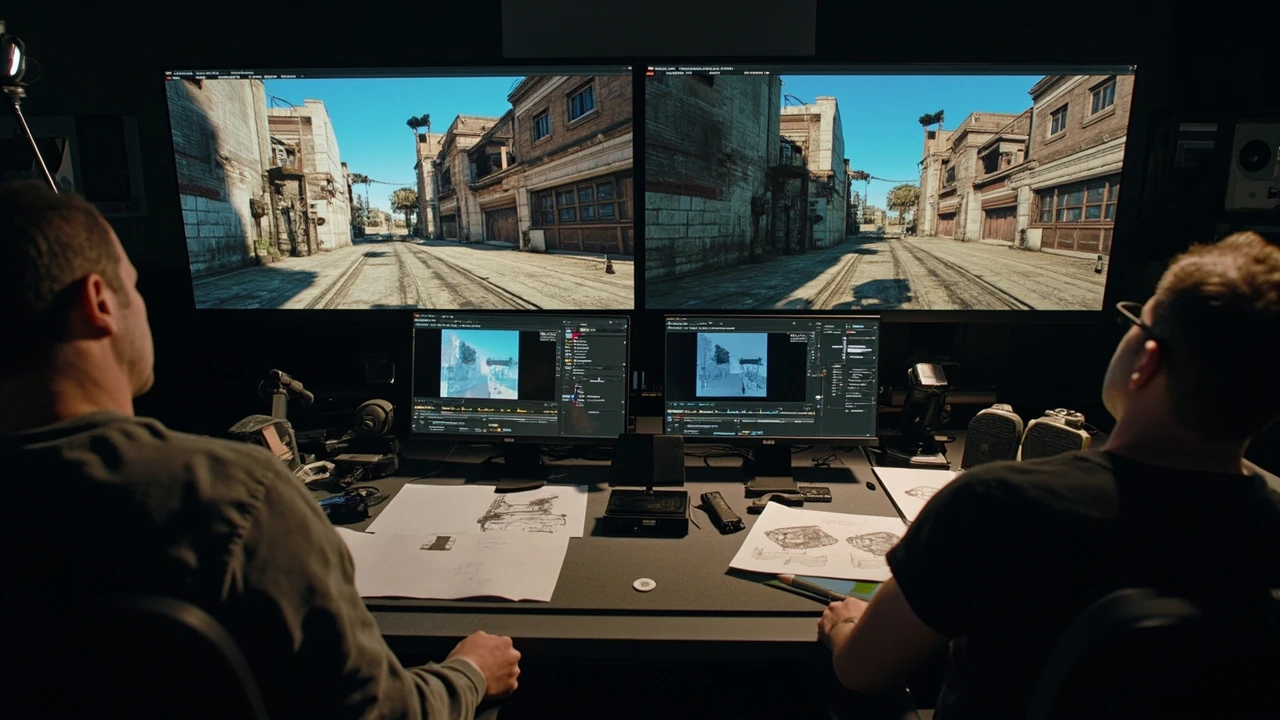
What does AAA meaning cover in game development?
The AAA meaning in game development usually describes a game made with a very large production budget, a substantial team, extensive content, and major marketing support. It is an industry label rather than a technical specification or a formal quality grade, so a game can be called AAA for its scale even if its reviews are mixed or its final sales disappoint.
For developers, the label is useful because it points to a particular production model. A AAA project usually depends on experienced specialists, coordinated departments, long development cycles, large asset volumes, platform support, quality assurance, and a publisher able to fund distribution. The term also describes player-facing expectations: advanced presentation, substantial content, broad platform availability in many cases, and a high degree of production polish.
The definition is not precise. A small team can create a technically impressive game, while a huge production can contain uneven design or weak performance. Budgets, team size, sales, graphics, and overall quality overlap, but they are not interchangeable. Understanding AAA meaning therefore requires separating production scale from the quality of the result.
Is AAA a formal classification?
No. Unlike a platform certification category or an engine feature, AAA is an informal term used by developers, publishers, journalists, players, and investors. There is no universal body that audits a game and awards an official AAA status.
The label usually combines several observable signals:
- Large development and marketing expenditure
- A sizeable, specialized production team
- Large quantities of content, assets, animation, audio, or levels
- Advanced technology and coordinated production systems
- Release across several platforms or a significant console launch
- Marketing and distribution on a major commercial scale
Because the term is contextual, expectations change over time. A game that seemed exceptionally ambitious in one generation can look modest against later releases. The same production can also be described differently by outlets, developers, and players who focus on different parts of the result.
This uncertainty is visible in a useful Hacker News discussion of what an AAA game means, which provides useful background for this point. Its contributors disagree over whether budget, graphics, polish, content, commercial reach, or technical ambition should carry the most weight. The disagreement is not a flaw in the label. It reflects the fact that AAA describes a bundle of production characteristics rather than one measurable quality.
Which factors shape the AAA label?
No single factor defines a AAA game, but the common indicators fall into four groups. A production may qualify strongly on one or more of them while remaining debatable on others.
| Factor | What it indicates | Typical AAA signal |
|---|---|---|
| Budget and team scale | The capacity to finance and coordinate production | Large specialist team, costly assets, broad internal support, sustained development |
| Technical presentation | The engine work, art direction, performance targets, and hardware ambition | Advanced rendering, animation, physics, effects, and platform optimization |
| Content and production depth | The amount of authored work and support required to maintain the experience | Large worlds, many levels, extensive modes, substantial voice or cinematic work |
| Commercial reach | The publisher’s confidence and distribution strategy | Major marketing campaign, multiple platform releases, prominent retail positioning |
The table should be used as a diagnostic tool, not a checklist for public labeling. A well-funded small project may look AAA in visual ambition but not in production scale. A huge project may have limited content but expensive technology. A successful indie game may have a modest team and narrow platform release while earning strong commercial results, yet few people would describe it as a AAA production.
How does AAA differ from AA and indie production?
AAA, AA, and indie describe different points on a production spectrum. The labels are most useful when they communicate relative scale, scope, and support requirements rather than artistic quality.
| Dimension | AAA production | AA production | Typical indie production |
|---|---|---|---|
| Capital | Large development and marketing investment | Meaningful investment below the largest commercial scale | Often lean budgets with more selective scope |
| Team | Broad specialist departments and substantial management | Mixed team with fewer or more generalist roles | Small or compact multidisciplinary team |
| Scope | Large content volume and multiple platform targets | Moderate content, often focused on fewer targets | Concentrated scope that can be shipped by a small group |
| Technology | Often ambitious custom or heavily extended technology | May use established technology with selective improvements | Often favors flexible engines, middleware, or off-the-shelf systems |
| Quality signal | High presentation and production values, but not guaranteed | Can be polished, technically strong, or critically successful | Can be polished, innovative, or critically successful |
These categories should not be treated as quality ladders. Indie games can deliver original mechanics, focused art direction, sophisticated design, and exceptional performance. AAA games can be technically impressive but bloated, confusing, or poorly paced. A useful developer-side lesson from the AAA discussion is that smaller teams can compete through gameplay, storytelling, accessibility, or a distinct visual identity instead of attempting to match the content volume of a major production.
What does AAA mean for a studio?
For a studio, becoming a AAA developer means taking on a different operating model. The central challenge is not simply hiring more people. It is creating a production system that can coordinate specialized work, integrate large asset volumes, maintain quality across platforms, and keep schedule and scope under control.
A studio evaluating a AAA project should consider four areas.
1. Production scale and financing
Large budgets create room for bigger teams, more assets, broader platform support, and deeper testing. They also create a fixed-cost structure. The studio must align scope with available funds rather than treating a desired feature list as independent of cost.
A practical review should separate recurring production costs from variable costs. Salaries, office space, engine licenses, middleware, localization, QA, certification, marketing, and platform-specific work all affect the final requirement. The content plan should then show which parts of the player experience consume the most people and time.
2. Department coordination
Large projects create dependencies. An animation change may affect gameplay timing, audio, cinematics, localization, and QA. A revised engine feature may affect tools and every discipline that relies on it. Clear ownership and stable integration rules are therefore part of the production design, not administrative work added afterward.
Studios commonly need documented interfaces between design, engineering, art, animation, audio, narrative, QA, and production. The important question is not whether every department has a wiki page. It is whether a change can be communicated, reviewed, implemented, and tested without depending on an informal conversation between two isolated specialists.
3. Content pipeline capacity
For additional context, AAA content is often produced through repeatable pipelines rather than one-off hero assets. A character needs a model, rig, materials, animations, states, audio, localization data, tests, and platform review. A level needs layout, lighting, navigation, encounter tuning, optimization, save data, and quality checks.
The quality of the pipeline determines how reliably the team can deliver that volume. Tools that automate repetitive validation can reduce human error, but they do not remove the need for editorial judgment. A pipeline should expose defects and uncertainty instead of hiding them behind a green build status.
4. Long-term support
A large launch creates a support burden after release. Bugs arrive across hardware configurations and operating-system versions. Players discover exploits that were absent from internal testing. Server capacity, patch deployment, localization corrections, moderation, and platform compliance can all require additional staff.
For live-service work, the ongoing operating cost may become more important than the launch. A studio should model the post-release team before committing to a service structure. The project plan must distinguish one-time content production from recurring obligations.
Does high production scale guarantee a high-quality game?
No. AAA resources increase the capacity for visual fidelity, breadth, polish, and testing, but they do not guarantee coherent design or strong performance. Large teams can also create communication problems, duplicated effort, inconsistent art direction, and expensive rework.
This is why budget, sales, and review score must be kept separate. A game can carry a very large budget and still be poorly received. It can have strong reviews and modest commercial performance. It can sell well while containing technical or design shortcomings. The labels answer different questions:
- AAA asks, in broad terms, what scale of production backed the game?
- Sales performance asks, how many units did players buy?
- Critical reception asks, how favorable were professional reviews?
- Player reception asks, how did the intended audience evaluate the experience?
No answer can be inferred from the others with certainty. A useful production review should therefore state the evidence behind each judgment rather than compressing everything into the label.
How can a smaller studio compete without becoming AAA?
A small studio does not need AAA budgets to compete. It needs a clear reason for its size and scope to create value. Trying to reproduce a large production’s feature count usually creates risk because the team lacks the specialists, pipeline capacity, and time to support that breadth.
A smaller team can instead concentrate on a distinctive core:
- Define one gameplay or presentation strength that the team can own more effectively than a larger competitor.
- Limit the number of platform, mode, and content variations until the core build is stable.
- Build reusable tools for the repetitive parts of production.
- Test risky assumptions early, using representative hardware and complete gameplay loops.
- Use scope cuts that remove duplication rather than damaging the central experience.
- Reserve enough schedule for polish, accessibility, localization, and platform edge cases.
For example, a team can compete through a sharply defined mechanic, a distinctive art style, a strong narrative system, or exceptional controller design. It can also win by reaching a platform or audience that larger publishers overlooked. The strategic choice is not “small versus AAA.” It is “which audience, experience, and business model can this team serve reliably?”
How do players and journalists use the term?
Players often use AAA as a shorthand for expected graphics, content, and polish. That expectation can overshadow the actual design of a particular game. A visually restrained title may still be an expensive production, while a technically spectacular one may have little content depth.
Journalists and publishers also use the term in different ways. Some apply it to production ambition before release. Others reserve it for games with broad platform launches and major marketing campaigns. Player communities may use it sarcastically, especially when a release is expensive but appears less polished than expected.
Clear writing should avoid presenting the label as an objective certification. A more accurate sentence names the relevant dimensions, such as budget, team scale, content volume, technology, or marketing. This also prevents a common category error: treating “AAA” as equivalent to “best,” “most profitable,” or “commercially successful.”
What should a game pitch or business case say about AAA status?
A pitch that labels itself AAA usually needs evidence, especially when the claim is used to justify a large budget or funding request. Teams can use the label as a positioning statement, but investors, publishers, and production leads will need details beneath it.
| Claimed signal | Useful supporting detail | Weak supporting detail |
|---|---|---|
| Large team | Planned headcount by discipline, leadership needs, and hiring schedule | A total headcount with no organizational detail |
| High content volume | Level count, mission structure, animation set, and production assumptions | A large number of assets with no reuse plan |
| Advanced technology | Engine features, technical risks, performance targets, and prototype evidence | Feature promises without a measurable target |
| Broad platform reach | Porting plan, certification path, performance tiers, and schedule impact | Listing platforms without ownership or cost |
| Commercial confidence | Audience model, pricing assumptions, comparable products, and marketing plan | Equating the AAA label with guaranteed demand |
The purpose is not to make the pitch sound grander. It is to expose the assumptions that determine whether the proposed scale is credible. A game that calls itself AAA but has no plan for platform optimization, content integration, or post-release support is using the label as marketing rather than as a production description.
How can teams evaluate a AAA project before committing?
The most useful evaluation compares the intended experience with the resources available to build and support it. Labeling alone provides almost no diagnostic information. A structured review can reveal where a plan depends on assumptions that have not been tested.
- Write the intended player experience. Describe the core loop, progression, content breadth, presentation targets, and platforms in concrete terms.
- Map the work. Connect features to required roles, tools, content, dependencies, and review gates.
- Prototype the highest-risk systems. Test performance, camera, controls, AI, procedural generation, networking, or content authoring as appropriate.
- Model the platform matrix. Include hardware tiers, operating-system versions, input methods, certification, and post-launch support.
- Test the content pipeline. Measure how long a representative asset takes from brief to shippable state.
- Define cuts in advance. Establish what can be reduced without breaking the central promise.
- Create an evidence log. Record prototype results, unresolved risks, changed assumptions, and the owner of each decision.
This process is useful for any scale, but it becomes more important in a AAA project because small changes can propagate across a large dependency graph. A production that detects a risky assumption during a prototype may absorb it. The same assumption found after content production may cost far more to change.
Frequently asked questions
What is the most common meaning of AAA in games?
The most common meaning is a game produced with a very large budget, a sizeable team, extensive content, advanced technology, and major promotional support. It is an informal description of production scale, not an official rating.
Does AAA mean a game has better graphics?
Not necessarily. AAA games often have advanced graphics, but the label also covers scope, content, team size, technology, and commercial reach. Technical ambition is only one part of the classification, and even strong graphics do not establish overall design quality.
Is every game with a large budget AAA?
No fixed budget threshold creates AAA status. Budget is one strong signal, but the size of the team, cost of assets, development duration, platform plan, and marketing effort also matter. The term remains subjective.
Is AAA the highest quality category of game?
No. AAA describes production scale, not a guaranteed level of quality. An indie or AA game can have stronger mechanics, writing, performance, or art direction. Reviews, sales, and player satisfaction are separate measures.
Can an indie game be called AAA?
Some commentators use the term loosely for any game that looks impressive. In production terminology, however, calling a small independent project AAA usually overstates its budget, team, content scale, or support infrastructure. The label is more credible when its financial and organizational claims are supported.
Does a successful AAA game need to sell millions of copies?
No universal sales threshold defines AAA status. Production cost, platform strategy, revenue share, marketing expectations, and business model all affect the break-even calculation. Strong sales and AAA classification are related in practice but are not logically equivalent.
What is the difference between AAA and AA?
AAA usually indicates a substantially larger production with greater budgets, specialist staffing, content volume, technology investment, and marketing. AA describes productions below that conventional scale. The boundary is fuzzy, and neither term implies a specific review score.
Can a small studio make a game that feels AAA?
A small studio can create a focused experience with a high level of polish and strong performance. Trying to match the raw content volume of a large studio is usually less effective. The better approach is to identify a distinctive player benefit that fits the team’s size and build the production system around it.
Why is the AAA label controversial?
The label compresses several different qualities into one term. People disagree about whether budget, graphics, content, polish, team scale, sales, or marketing should define it. Marketing can also make a label function as a status claim, which encourages disagreement and skepticism.
What should a developer do with the AAA label in a project document?
Use it for high-level positioning, then support the claim with concrete production details. Document budget assumptions, headcount, content plans, technology risks, platform requirements, and support costs. If those details are unavailable or uncertain, label the assessment as provisional rather than presenting it as a settled classification.