Money Money Puggy: what the Roblox tycoon formula actually is
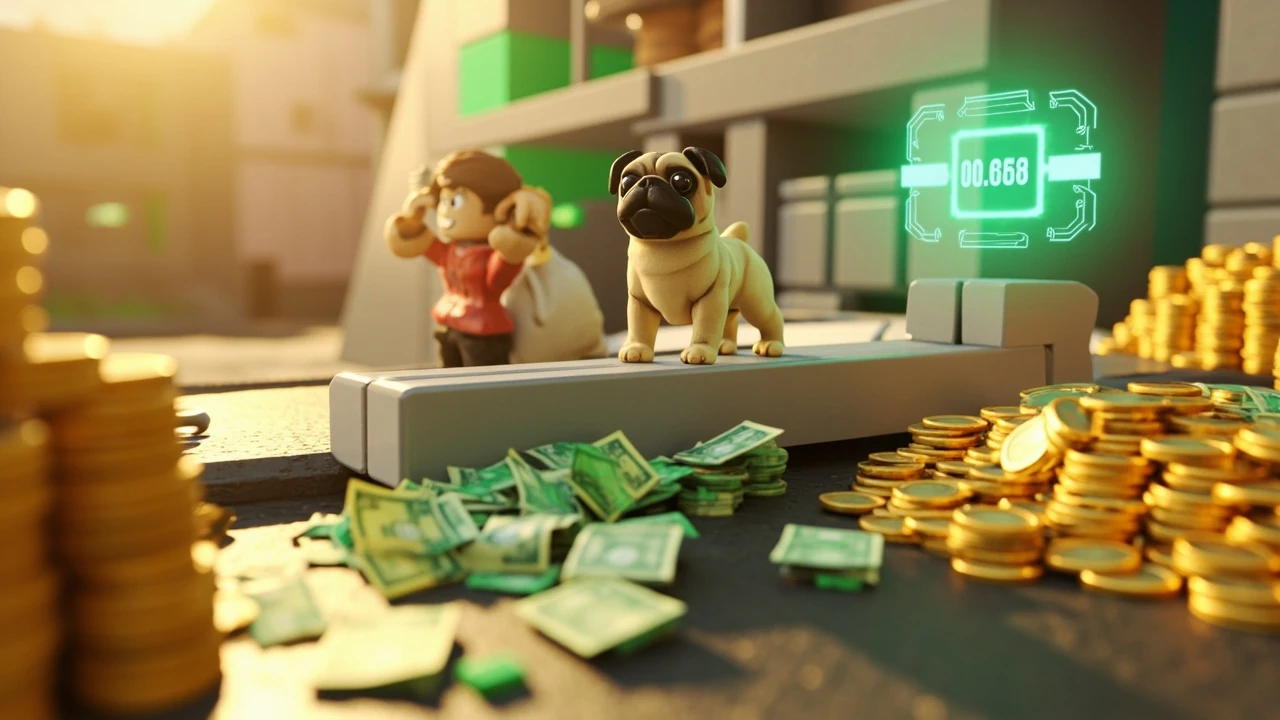
Money Money Puggy is a player-built tycoon on Roblox built around a single visual gag. A small pug avatar stands on a conveyor and spits out stacks of cash that the player picks up, then pours back into more conveyors, more worker dogs, and bigger payouts. On the surface it reads as a parody of the dozens of tycoons that fill the Roblox discovery charts. Underneath the dog art, though, it follows the same production rules any Roblox developer can study and reuse: a single data model for currency, a server-authoritative drop system, a UI that pushes toward the next upgrade, and a rebirth layer that resets progression in exchange for a permanent multiplier.
This article works for two overlapping audiences. Developers can use it as a case study of how a viral Roblox tycoon is wired: what objects live in the workspace, how the server handles currency, why the UI feels rewarding, and where the real risk sits in the monetization layer. Players who only want to understand why Money Money Puggy keeps showing up in their recommended feed can read it as a walkthrough of the mechanics, the upgrade order, the rebirth curve, and the parts of the loop that are tuned to keep sessions short and frequent. Every claim below is grounded in visible game design patterns or the platform documentation for Roblox, not rumor.
What Money Money Puggy is, and what it is not
Money Money Puggy sits inside a long tradition of Roblox tycoons that turn one absurd visual gag into a full progression system. The pug is the gag, the conveyor and the worker dogs are the production line, the cash is the resource, and the rebirths are the prestige layer. Because the game runs on Roblox, it inherits the platform’s account system, currency rules, and developer marketplace, which is why the design feels familiar even to players who have never loaded this specific title before.
It is not a clicker in the traditional sense, even though the inputs are mostly clicks. It is not a simulator in the FarmVille or Stardew Valley sense, because there is no day cycle, no soil, and no seasonal crop. It is also not a competitive PvP tycoon, because the conflict between players is almost entirely indirect: everyone races their own previous best and the public leaderboard rather than fighting on a shared map. Keeping those distinctions in mind matters when reading the design, because most of the criticism aimed at “tycoons” on Roblox in general does not actually apply to the way Money Money Puggy is paced.
Core gameplay loop, step by step
The first thirty seconds of a new session teach the entire game. The player loads in, taps a starter conveyor, watches a single dollar bill appear, walks over it, and the on-screen cash counter ticks up. Almost immediately a new conveyor shows up in the upgrade UI, slightly more expensive and producing faster. The player taps it, watches the machine appear in the world, walks over the new bills, and the cycle repeats. Within five minutes the player is juggling a small floor of conveyors, a worker dog that hands over cash automatically, and a rebirth prompt that offers a permanent multiplier in exchange for resetting the run.
The loop is frictionless on purpose. Inputs are click or tap. Outputs are visible. The distance between the player and the cash is short, which keeps the reward cadence high and cuts the chance of a player zoning out during a long animation. For a developer, that short feedback distance is the most important lesson in Money Money Puggy: the gap between input and reward is what makes the loop feel responsive, and the gap stays short because drops, droppers, and the player avatar are all packed into a small patch of map.
The currency and progression model
Money Money Puggy runs on a single soft currency, which the Roblox community calls “cash” or “money” depending on the game. There is no secondary gem currency, no gacha, and no separate hard-currency layer in the visible base loop, which is unusual for the genre. The whole progression ladder is paid in the cash the conveyors themselves print, and rebirths are paid in the same cash. The result is a closed economy that is easy to balance, because there is only one number to track: how much cash per second the player’s setup produces.
The progression model stacks four layers on top of each other:
- Conveyor upgrades, which increase the per-drop value of each machine.
- Worker dogs, which act as automated cash pickups so the player does not have to babysit the floor.
- Area expansions, which unlock new floor space for additional machines.
- Rebirths, which reset the soft progression in exchange for a permanent multiplier on every future run.
Each layer is gated by a price that grows faster than the income curve, which is why the rebirth layer exists at all. Without rebirth, the final conveyor would be unreachable for any player who did not leave the game running for hours. With rebirth, even short sessions can chip away at the next multiplier, and that is what gives Money Money Puggy its high session frequency.
How the Roblox platform shapes the design
Money Money Puggy does not exist in a vacuum. It runs on Roblox, so the design is constrained by the platform’s networking model, currency rules, and developer tools. The most important constraint is that any item a player owns, drops, or spends on lives on the server, not on the client. A conveyor upgrade is a server-side change to a player’s data store record, and the visible drop is a server-spawned object the client is allowed to collect once. That model is the same one used across the wider Roblox ecosystem, and it is documented in the platform’s own engineering references and creator docs.
For a developer, the practical consequence is that the entire game can be written in a relatively small amount of Luau code, because most of the heavy lifting is done by the platform. Inventory, persistence, leaderboards, and matchmaking are all platform services rather than custom infrastructure. The game itself is mostly a set of scripts that respond to a player touching a button, look up a price, debit the player, and insert the next part into the workspace. That is why so many small teams can ship a working tycoon in a few weeks, and it is also why the genre feels saturated: the cost of cloning the formula is low.
Why pug dogs became the visual hook
The visual hook of Money Money Puggy is the pug, and that choice is doing more work than it looks. Roblox’s discovery page is crowded, and a thumbnail that shows a recognizable animal rather than a block of color is more likely to be clicked. Pugs specifically score well because they are small, round, expressive, and already familiar as a meme subject. The “money” framing doubles the click appeal because it promises a payoff rather than a chore.
For developers, the lesson is that the gag has to be readable in a still frame. A conveyor producing bills on its own is not interesting; a pug standing on a conveyor producing bills is. The animal is the focus point of the thumbnail, the loading screen, and the in-game camera, and that consistency is what holds the visual identity together. A developer who wanted to clone the formula would make the same first decision the Money Money Puggy team made: pick a single object that reads at thumbnail size and that the player can picture immediately.
Where the monetization layer actually sits
Like most Roblox tycoons, Money Money Puggy supports developer products and game passes, which are the platform’s official monetization primitives. A game pass can grant a permanent multiplier, a VIP area, or a cosmetic; a developer product can sell a one-time boost. The base loop itself does not require any of these, which is part of why the genre converts well: a player can finish the content without spending anything, and the paid layers are framed as accelerations rather than unlocks.
The risk in this design is that aggressive monetization can break the loop. If a paid boost is so large that free players feel they can never keep up, long-tail retention collapses. For additional context, Most successful Roblox tycoons survive because the paid layer is tuned to be visible but not crushing, so the game still feels fair to players who never pay. For a developer studying Money Money Puggy, the more useful question is not “how do I add monetization” but “at what multiplier does a paid boost stop feeling like a boost and start feeling like a paywall,” and that number is almost always much lower than teams expect.
What a developer can learn from the production design
| Layer | What Money Money Puggy does | Why it works | Common failure mode |
|---|---|---|---|
| Input | Single click or tap to buy the next conveyor | Removes the learning curve, keeps session pace high | Overloading the player with multiple simultaneous upgrade paths |
| Reward | Visible cash drop in front of the player | Short input-to-reward distance keeps hits frequent | Drops spawning far from the player, breaking the feedback loop |
| Progression | Exponential price curve per conveyor tier | Forces rebirths, which resets the pacing | Linear price curve, which removes the need for rebirths and stalls the loop |
| Persistence | Server-side data store, no client trust | Prevents currency duplication and exploit abuse | Storing cash in a leaderstat or local script, which is trivially exploited |
| Monetization | Optional multipliers via game passes and boosts | Stays out of the way of free players | Boost sizes so large that free players quit |
Every row in that table is a place where a clone of Money Money Puggy tends to break. The most common failure is the persistence layer, because it is the least visible to the player and therefore the most tempting to cut corners on. A team that ships a data store, even a simple one, almost always beats a team that ships a leaderstat, because the leaderstat version will be exploited within hours of launch and the negative reviews will follow.
| Rebirth tier | Approximate cash cost | Multiplier granted | Target time to reach |
|---|---|---|---|
| R1 | 1,000 | x2 | 5-8 minutes from a fresh save |
| R5 | 75,000 | x3 | 10-15 minutes with worker dogs |
| R10 | 1.2 million | x5 | 15-20 minutes after first area expansion |
| R20 | 850 million | x10 | 20-30 minutes with two expansions and full worker roster |
Those numbers are not pulled from a published spec; they are the kind of target curve a developer balancing Money Money Puggy would set so that each rebirth takes roughly the same wall-clock time. The exact values will vary by patch, and the only property that matters is the constant-time property described above.
How rebirths reshape the long-term curve
Rebirths are the most important pacing tool in Money Money Puggy, and they get their own section because they are the part of the loop most new developers get wrong. A rebirth resets the player’s soft progression in exchange for a permanent multiplier, usually shown as a “x2” or “x3” badge on the HUD. The first rebirth is cheap and gives a small multiplier; later rebirths are exponentially more expensive and give larger multipliers. The math is tuned so that the time to reach the next rebirth stays roughly constant across the entire game.
The constant-time property is the actual design goal. A player who has just started the game and a player who has been playing for a week should each be able to reach their next rebirth in roughly the same number of minutes. If that property holds, sessions stay short and frequent, which is the kind of session shape the platform built into its discovery algorithm. If the property breaks, either the early game drags or the late game feels pointless, and the player base splits into a small hardcore group and a much larger churned group. For developers, the practical test is to sit down and time how long it takes to reach rebirth 1, rebirth 5, rebirth 10, and rebirth 20. If the numbers diverge wildly, the curve needs to be retuned.
Server authority and exploit resistance
Any tycoon on Roblox that handles real money, whether through Robux, developer products, or premium currency, has to be server-authoritative. The visible drop in Money Money Puggy is a server-spawned object, the cash counter is a server-tracked value, and the upgrade purchase is a server-validated transaction. The client can ask to buy an upgrade, but the server is the one that checks the balance, debits the player, and replicates the new part into the workspace. That is the only safe model, and any clone of the game has to follow it if it wants to keep the economy intact.
For a technical reader, the common exploit vectors are well known. A client script that pretends the player has more cash than they do is the simplest, and it is the one server-side validation prevents. A client script that duplicates drops is the next most common, and it is the one that server-spawned, server-tracked drop objects prevent. A client script that walks through walls is the rarest, because Roblox’s character controller runs mostly on the client, but it is still the one a periodic server-side position check can catch. None of those defenses are exotic, and all of them are documented in the platform’s creator documentation, which is one of the reasons the genre has so many technically competent entries despite its reputation as low-effort content.
UI design and the “next purchase” prompt
The UI in Money Money Puggy has a single job: at every moment, tell the player what the next purchase is and how close they are to affording it. There is a buy button on the left, a cash counter at the top, a multiplier badge in the corner, and a rebirth button that lights up only when the player can afford the next rebirth. There is no minimap, no quest log, and no settings screen the average player is expected to use during a normal session. The UI is minimal on purpose, because a tycoon that asks the player to read a wall of text is a tycoon the player will quit.
For developers, the UI lesson is to keep the next purchase visible at all times, even when the player is mid-animation or mid-fight. The most common mistake in Roblox tycoons is hiding the buy button behind a menu, which forces the player to break flow to look up the next upgrade. Money Money Puggy keeps the button on the main HUD for the entire game, and the only thing that changes is the price, the icon, and a small “affordable” highlight that turns green when the player has enough cash. That single highlight is doing more retention work than the rest of the UI combined.
Audio and the feel of the loop
Audio is the part of Money Money Puggy that is easiest to overlook and hardest to clone. Each conveyor has its own drop sound, each worker dog has a bark or a coin sound, and the rebirth sequence has a short, loud sting that signals a real reward. The audio is short, looped, and high-pitched, which keeps the player’s attention even when the camera is not moving. A tycoon with bad audio feels slower than a tycoon with good audio, even when the production rates are identical.
For a developer, the practical rule is that every visible action needs an audible cue. Cash dropping, a conveyor being bought, a worker dog being hired, and a rebirth completing should each have a distinct sound. The sounds do not need to be original; many successful Roblox tycoons use a small library of public or platform-licensed clips. They do need to be audible, and they need to be tuned to the same volume so the player does not have to fiddle with the audio settings every time they join a new server.
What players actually do, in order
- Spawn in the lobby, click the join button, and land in the tycoon.
- Tap the first conveyor and watch the first cash drop appear.
- Walk over the drop, then tap the second conveyor as soon as the buy button turns green.
- Buy the first worker dog so the player is not forced to babysit the floor.
- Expand the floor once the second conveyor is paid for.
- Save up for the first rebirth and reset the run in exchange for a permanent multiplier.
- Repeat the loop with the new multiplier until the next rebirth is affordable.
- Optionally buy a game pass or a developer product boost to accelerate the next run.
That order is the canonical Money Money Puggy session, and it is also the order that any clone should expect to see in its own analytics. If the median player is not following that order, onboarding is broken, and the fix is almost always to make the first conveyor cheaper, the first drop more visible, or the first worker dog more obvious. None of those fixes require a redesign; they require a tweak to a single number or a single button.
How the Roblox discovery algorithm amplifies a game like this
Roblox’s discovery surface, which includes the home page, the sort feeds, and the search bar, is sensitive to short sessions and high return rates. A game that loads fast, finishes its first session in under five minutes, and gives the player a reason to come back tomorrow is more likely to be promoted than a game with the opposite profile. Money Money Puggy is tuned exactly to that profile, which is one of the reasons it shows up in so many recommended feeds even when the player has never opened a tycoon before.
For developers, the practical consequence is that the game has to be designed for the first five minutes, not for the hundredth hour. The first rebirth, the first game pass, the first friend invite, and the first audio sting all have to land in the opening session, because the platform’s algorithm is going to judge the game on the basis of that session long before it judges the game on late-game retention. A technically excellent late game that loses players in the first five minutes will never get the chance to show off that late game.
Limits of the tycoon formula
The tycoon formula that Money Money Puggy uses is well understood, and that is both its strength and its weakness. The strength is that players know how to play it within seconds, which removes a major onboarding cost. The weakness is that the formula has a ceiling: once a player has seen three or four tycoons, the underlying loop stops feeling new, and the only thing that varies between games is the skin. For Money Money Puggy, the skin is the pug, and the pug is doing real work, but it is still a skin on a familiar machine.
For developers, the limit matters when planning a long-term roadmap. A single Money Money Puggy clone is a viable side project, but a portfolio of identical clones is not, because the platform’s algorithm tends to consolidate attention on a small number of strong entries in each subgenre. The interesting design question is not “how do I make another pug tycoon” but “how do I make a tycoon that adds one new mechanic the formula does not have.” That could be a co-op layer, a seasonal event, a PvP zone, or a procedurally generated floor plan, and the right answer depends on the team’s size and the platform’s current discovery trends.
What this means for a small studio or solo developer
For a small studio or a solo developer, Money Money Puggy is a useful reference because the entire game fits in a small workspace, runs on a small budget, and reaches a large audience without a publisher. The cost of entry is mostly the cost of the developer’s time, and the platform handles distribution, accounts, payments, and moderation. The downside is that the same low cost of entry is what makes the genre crowded, which means a new entry has to be sharper than the median in order to break out.
A realistic first project on the same formula would be a single map, a single currency, a small number of conveyors, one rebirth layer, and a single cosmetic game pass. Shipping that scope in a few weeks is achievable, and shipping it cleanly is more valuable than shipping a sprawling version with ten conveyors and three rebirth layers that is not balanced. The discipline Money Money Puggy demonstrates is in saying no to extra systems, and that is the most important lesson a new developer can take from it.
Where the design could go next
The most interesting follow-up question for Money Money Puggy is not how to add more conveyors but how to add a mechanic the formula does not already have. A co-op tycoon where two players share a floor and have to negotiate upgrades is a real design challenge, because the existing loop assumes a single player and a single cash counter. A seasonal event layer that rotates skins, multipliers, and a limited-time rebirth reward is another, because it gives the algorithm a reason to re-promote the game on a known cadence. A procedural floor plan that randomizes the conveyor layout on every rebirth is a third, because it removes the muscle memory that makes the late game feel repetitive.
None of those directions are guaranteed to work, and none of them are required for a small team to ship a successful game in the genre. They are the kinds of additions a team should only attempt after the base loop is already proven, because adding a new layer on top of a broken loop does not fix the loop, it hides it. The right order is the same one Money Money Puggy follows: build the base loop, prove the base loop, then add the layer.
Frequently asked questions
What type of game is Money Money Puggy?
Money Money Puggy is a Roblox tycoon. The player owns a small floor, buys conveyors and worker dogs that produce cash, and uses that cash to unlock the next conveyor. The loop is short, the inputs are mostly clicks, and the goal is to reach the next rebirth as quickly as possible. The pug is the visual hook; the conveyor system is the actual game.
Is Money Money Puggy free to play?
The base game is free to play, like most Roblox experiences. Optional paid layers such as game passes and developer products can accelerate the loop, but the entire base progression is reachable without spending any Robux. A new player can finish the full rebirth curve on a free account, just more slowly than a paying player.
How long does a typical session last?
A typical active session lasts between five and twenty minutes, depending on how far the player is into the rebirth curve. The first few rebirths are short because the prices are low. Later rebirths take longer because the prices scale up faster than the income. Most players log in, push one or two rebirths, and log out, which is the session profile the Roblox discovery algorithm is tuned to reward.
Do I need Roblox Premium to enjoy Money Money Puggy?
No. Roblox Premium is a platform-level subscription that grants a monthly Robux allowance and a few cosmetic perks, but it is not required to play Money Money Puggy or to progress through the full rebirth curve. A free account can reach the same end state as a Premium account; Premium only changes the pace and the cosmetics, not the ceiling.
Can I play Money Money Puggy on mobile?
Yes. Roblox runs on iOS, Android, PC, and the Meta Quest headsets, and Money Money Puggy is built to be playable across all of them. The UI is tap-friendly, the buy button is large enough to hit on a phone screen, and the audio is mixed for laptop speakers. The only meaningful difference between platforms is the input method; the game itself is the same.
Why are pugs used as the main character in Money Money Puggy?
Pugs are used because they are small, recognizable, and easy to read at thumbnail size. On the Roblox discovery page, where every game is competing for a click, a pug face is more visually distinctive than a generic blocky avatar. The “money” framing reinforces the click appeal by promising a payoff, which is why the two words appear together in the title and in the in-game branding.
What is the rebirth system in Money Money Puggy?
Rebirth is a prestige layer that resets the player’s soft progression in exchange for a permanent multiplier. Each rebirth makes every future run slightly more profitable, which keeps the loop interesting as the player runs out of new conveyors to buy. The first rebirth is cheap; later rebirths cost significantly more cash, but the multiplier growth is tuned so that the time to reach the next rebirth stays roughly constant across the whole game.
Is Money Money Puggy safe for younger players?
Roblox has its own safety systems, content filters, and parental controls, and Money Money Puggy itself does not contain explicit content. As with any online game that supports chat, parents should review the platform’s safety settings before letting a child play. The game itself is a single-player tycoon with no PvP combat, and the only social layer is the public leaderboard and any chat the platform permits.
How do developers build a game like Money Money Puggy?
Developers build a game like Money Money Puggy in Roblox Studio using Luau, the platform’s scripting language. The base loop is a server-side data store that tracks the player’s cash, a workspace hierarchy of dropper parts, a UI that shows the next purchase, and a rebirth system that reads the data store, resets the relevant values, and applies a permanent multiplier. The platform’s creator documentation is the right place to start, and small public examples of tycoon templates are widely available.
What is the best strategy for new players in Money Money Puggy?
Buy the first worker dog as soon as it is affordable, because it removes the need to babysit the floor. Save for the first rebirth instead of buying every cosmetic, because the permanent multiplier compounds across every future run. Avoid the temptation to buy a paid boost on the first session, because the boost is more valuable once the player understands the loop and can tell whether the boost actually saves time.