Absolute Batman Joker as a game design problem
Scott Snyder and Jock’s reboot relocates Bruce Wayne, his myth, and his enemies into a harsher, less forgiving corner of the DC universe, and the absolute batman joker is one of the clearest examples of how the line demands more from a design team than a simple palette swap. The character no longer arrives as a showman prankster. He arrives as a structural pressure on the hero, the city, and the player. Any studio adapting this version has to plan around that pressure instead of recreating the cartoon villain most action games already know.
For a game production team, the page that follows is a working brief. It walks through what changes in the source material, what those changes imply for character design, animation, narrative systems, encounter pacing, and audio, and where the trade-offs sit when a project tries to honor the comic while still shipping something a controller player can engage with. The aim is to make the work of designing around the absolute batman joker concrete, so producers, designers, and writers have something to push back against rather than a generic villain checklist.
The reboot also changes the way the Joker is allowed to be read. Readers are not expected to bring twenty years of crossovers and retcons to the first issue, which means the first time the character appears in a game he is essentially a blank page with a familiar name. That is a different kind of design problem than the usual “how do we get the classic Joker right?” problem, and it punishes teams that try to answer it with the same animation set they have been using since 2008.
What the Absolute line changes about the Joker
The Absolute imprint keeps several of the recognisable Joker traits – a focus on chaos, a willingness to break people, a connection to Gotham’s decay – and strips away the bits that depend on a long-established status quo. The character is no longer a forty-year-old antagonist who has fought every Bat-family member and survived every storyline. The relative history is shorter, the social ties are weaker, and the first meeting with the hero has to carry more weight because there is less shared baggage behind it. Coverage of the redesign in the Absolute Batman press cycle frames the Joker’s return as a deliberate move from horror hints to a full reveal that reorganises the line’s emotional stakes.
For a game team, that shorter history is a design opportunity. The studio controls what the player has seen of the villain before the major set piece, and the studio also controls what the villain is allowed to do next. Three concrete differences matter:
- The villain’s status is not a fixed career arc. He can grow, fail, or change direction without contradicting decades of comic canon, which gives narrative designers room to write him as a developing threat rather than a finished archetype.
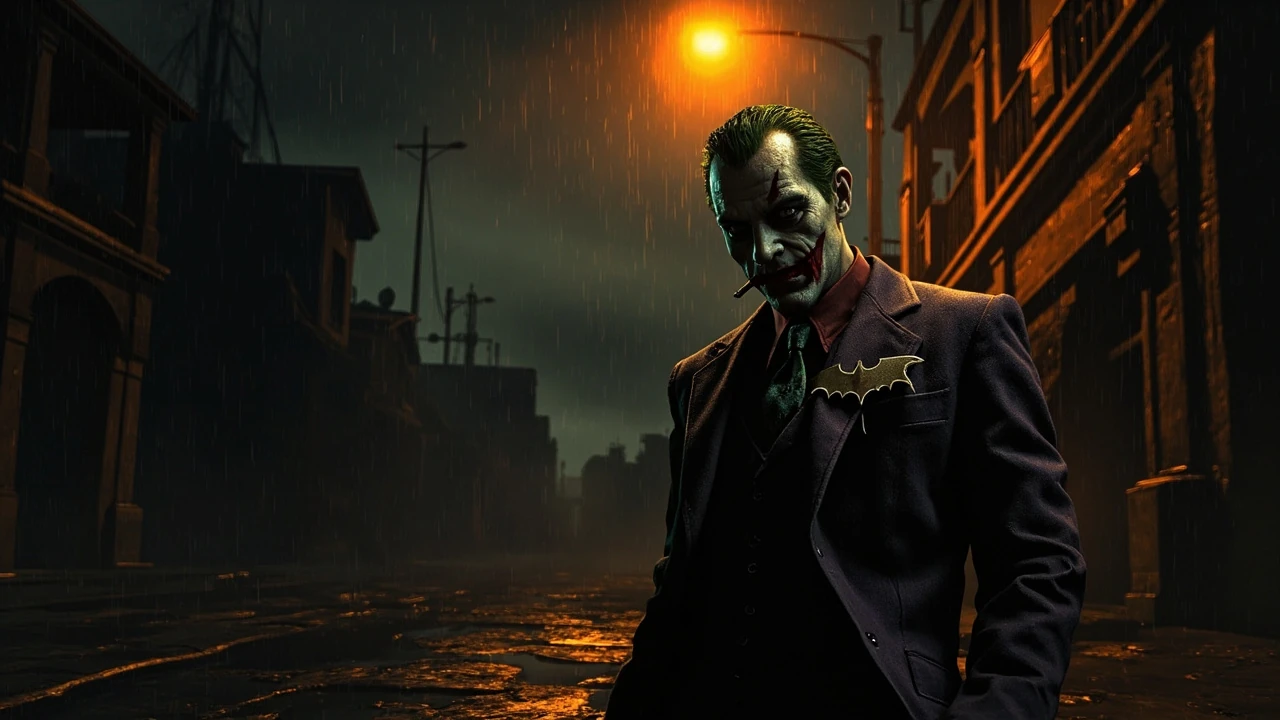
- The visual language is reduced. Bright purple suits and permanent grin makeup give way to more grounded silhouettes, which makes the character easier to render with realistic lighting and a stable performance capture pass.
- Connections to other rogues are lighter. The studio can decide which of the classic villains appear at all, instead of inheriting the full Gotham rogues’ gallery as a content obligation.
Those three points are the structural reasons the absolute batman joker reads as fresh. They also make the character much harder to translate into a game, because the recognisability that players expect is no longer carried by surface design alone. A studio that leans only on iconography ends up with a character that is technically on screen but not yet a presence in the world.
It is worth being specific about what “shorter history” actually buys a writer. A Joker who has only met Bruce Wayne a handful of times can be written as someone who is still figuring out the hero’s psychology. A Joker who has known Batman for forty years has to be written as someone who has already run the experiment several times and is back for another round. The first version is a live wire. The second is a seasoned saboteur. The comic is asking for the live wire, and a game that wants the same energy has to give the writing room room to keep the character in that mode without quickly handing him a master plan.
From comic panel to playable antagonist: what has to move
A villain that works on the page does not automatically work on a controller. The next table summarises the four areas a production team usually has to rework when the source material is a writer-driven comic rather than a pre-existing game franchise. The rows describe a category of work, the kind of question the team has to answer, and the failure mode that shows up when the question is ignored.
| Adaptation area | Core question for the team | Failure mode when skipped | |
|---|---|---|---|
| Character silhouette | What is the absolute batman joker’s on-screen read at 30 meters in motion? | Players cannot identify the threat until the cutscene starts, which kills the gameplay warning system. | The art team ends up with a character that looks right in marketing stills but disappears during actual fights. |
| Narrative voice | What does the villain actually want in the first 60 minutes of the campaign? | Quips feel random because they are not tied to a goal, and writer room revisions balloon. | Voice actors get rebooked halfway through production because the lines stop making sense after a script rewrite. |
| Encounter behaviour | How does the AI behave when the player is winning? | Encounters feel like standard goon fights and the villain’s presence does not register. | QA reports flag the boss as “unfun” and combat designers spend two months retrofitting telegraphs. |
| Audio identity | What sound or motif tells the player the villain has entered a scene? | The audio designer ends up layering licensed music on top, and the character never owns his own space. | The marketing trailer has to be rescored because the in-game audio is not recognisable enough to cut to. |
None of these are problems a single discipline can solve. The silhouette question is art and animation. The voice question is narrative and writing. The encounter question is combat design and AI. The audio question is sound design. Producers need to schedule all four in parallel instead of treating the villain as a final pass on a finished character model.
The second column of the table is the part that most often gets skipped in pitch documents. Teams describe a silhouette, they describe a voice, and they describe a music cue, but they do not put a question mark against any of them. A question mark is the smallest possible form of accountability, and it costs almost nothing to add. The difference between a pitch that ends in “and then we make him look great” and a pitch that ends in “we have to answer the four questions in column two” is usually the difference between a villain that ships and a villain that has to be rebuilt in post.
Silhouette, costume, and the readability problem
The absolute batman joker trades the colourful costume for something more muted, which improves cinematic reading but hurts the gameplay readability that action games depend on. A player in combat needs to identify a threat in under half a second, and a palette that reads as “drab man in a suit” is a recipe for mis-targeting. The art team has to build a costume that is grounded enough to look like the comic and exaggerated enough to read in motion. Three specific tools cover most of that gap.
- One strong silhouette element. A high collar, a wide-brim hat, a torn cape, or an asymmetric shoulder pad set the villain apart from civilian NPCs and from the player’s own Bat-suit. The element should be readable from a top-down camera and from a third-person over-the-shoulder camera. A silhouette element that only works on a 16:9 cinematic is a silhouette element that the gameplay team will end up ignoring.
- One anchor colour. The Absolute line keeps a small amount of green or red in the villain’s design, and the art team can lock that colour to a channel that is reserved for enemy UI, threat indicators, and audio cues. A single reserved colour removes the need for a giant clown mask to make the villain findable. It also gives the UI team a stable colour to use for objective markers, so the player stops confusing the Joker’s minions with random thugs.
- One motion signature. A walk, an idle, or a tell that the player can recognise. The motion signature is the cheapest readability tool because it costs almost no extra art once the animation budget is in place, and it survives any lighting condition. A lopsided stride or a hand that trails along a wall is enough to make the character feel different in a crowd of identical goons.
The order matters. Silhouette first, anchor colour second, motion signature third. Designers who try to lead with motion usually end up animating a character whose body is still hard to read in a static screenshot, and that is a problem for the marketing team as much as the player. Costume passes that start with the face tend to look great in screenshots and fall apart in actual combat, because the combat camera rarely gives the face the same screen real estate as the marketing renders do.
One practical test the art team can run is a “fifteen NPC lineup” check. Drop the Joker into a screenshot with fifteen other characters in similar palettes and similar costuming, and ask a teammate who has not been briefed to point him out. If the test takes longer than two seconds, the silhouette work is not done. The test is not a substitute for full readability testing, but it is a fast way to catch a costume that looks great in a render and disappears in a fight.
Narrative systems: writing a Joker without a script
Most Joker adaptations lean on improvisation. The villain is funny because he is unpredictable, the writing goes, so the script keeps his lines vague and lets the actor ad-lib. That trick falls apart in games, because the player is the one improvising. The studio has to write rules for the villain’s behaviour that hold up across thousands of player choices, and the writing room has to make those rules feel like a personality rather than a flowchart.
A useful pattern is to pick one obsession and one blind spot. The obsession is what the villain cannot stop doing, and the blind spot is the cost he refuses to pay. For the absolute batman joker, the comic positions the character around psychological pressure on Bruce Wayne. The game version of that pressure has three working options, and the team has to pick one before the script is written.
| Narrative focus | What the villain does | Gameplay hook | Cost to write |
|---|---|---|---|
| Personal corruption | Targets Bruce’s sense of self and offers a version of the mission that uses Gotham’s cruelest tools. | Choice moments where the player can accept or refuse the villain’s framing, with feedback across the next two missions. | High: requires a moral axis with consistent feedback across multiple mission branches and a clear visual language for each branch. |
| Institutional collapse | Undermines the city services and the support cast that the campaign relies on. | Resource loss between missions, with side characters becoming unavailable or compromised on a per-act schedule. | Medium: needs a state-tracking system and clear recovery beats so the player does not feel like the campaign is bleeding out. |
| Performative spectacle | Stages public events that force Batman into a visible role. | Set-piece levels that change camera rules, introduce crowd AI, or remove gadgets the player has relied on since the tutorial. | Low to medium: sits inside existing cinematic systems, but the level team has to commit to fewer large rooms and longer design reviews. |
Once the focus is locked, the writers can improvise around it without losing the player. The obsession gives every line a reason. The blind spot gives every setback a reason. The result is a villain whose dialogue can be rewritten per scene without the campaign losing its spine. A team that picks “personal corruption” in pre-production and then writes a script that is mostly “institutional collapse” with a few personal jokes sprinkled on top has not actually picked a focus, and the script will read as a mess no matter how many rewrites it goes through.
The blind spot is the underused half of the pattern. A Joker who refuses to pay a specific cost is much easier for a writer to push against, because every scene can ask whether the villain is willing to pay that cost this time. If the answer is always “no,” the character becomes predictable in a way the comic specifically does not want. If the answer is sometimes “yes,” the character becomes interesting, because each payment of the cost tells the player something new about the villain’s priorities. The blind spot is also the cleanest way to seed a sequel hook without the marketing team having to write it into a press release.
Encounter design: making the villain feel present
The single most common mistake in boss design is to give the player a unique attack on round one and a duplicate of round one on round two. The absolute batman joker will not survive that treatment, because his comic identity is built on escalation, not repetition. A workable encounter ladder has three rungs, and the design team needs to think about all three before the first greybox is in.
- Pre-fight presence. The villain is a force on the level before the player meets him. Civilians panic, a signature piece of environmental design is in ruins, or the audio motif plays whenever the player enters a new wing. The player is fighting the idea of the villain before any AI state is triggered. A level that does not show the Joker’s fingerprints before the encounter reads as if the boss has been dropped in from a different campaign.
- Direct fight. The encounter itself has two phases. Phase one tests the player’s general skill against a mobile, unpredictable enemy. Phase two introduces a specific environmental or narrative rule that the player has to recognise, like a hostage timer or a structural weak point that the villain has been protecting. The second phase is where most bosses get built and where most bosses get tuned wrong, because the team tries to teach the rule through failure rather than through a clear telegraph.
- Aftermath. The fight ends, but the world stays changed. A district loses a service, a supporting character is missing from the next hub, or the player’s equipment options are reduced. The aftermath is what makes the next encounter heavier than the last one. An aftermath that is just a cutscene is a wasted opportunity to make the campaign feel responsive to the player.
That ladder works because each rung maps to a different discipline. Encounter designers own the middle rung. Level artists and audio designers own the pre-fight rung. Narrative and progression systems own the aftermath. If any rung is missing, the encounter reads as a fight instead of a story beat. The most common production mistake is to staff the middle rung heavily and leave the other two on skeleton crews, which is how you end up with a boss fight that the player can describe in one sentence and forget in five minutes.
A second mistake is to treat the rungs as a fixed length. The pre-fight rung can be a single room or an entire district. The aftermath can be a single line of VO or a full mission. What matters is that each rung does the job it is supposed to do, and that the player can feel the transition between rungs without a loading screen telling them it is happening.
Animation, performance capture, and face work
The Joker has always been a face role. The character lives in the eyes, the grin, and the pauses between lines, and a flat capture pass turns him into a generic thug with a funny hat. The absolute batman joker is harder than the classic version, because the comic reduces the costume but raises the emotional register. The actor has to sell menace without the visual safety net of clown makeup. Three production decisions tend to make the difference.
- Shoot reference on set rather than in isolation. A capture session that runs the lines and the physical actions back to back catches the small body reactions that face work needs to anchor against. A capture session that shoots the lines on day one and the actions on day two loses the micro-expressions that the comic relies on for menace.
- Lock the eye rig before the voice is recorded. The Joker’s stare has to read through lighting and through the player’s HUD, and a late change to the eye rig means re-doing the capture session or shipping a face that does not track. Eye rigs are also where the visual style of the game usually shows up first, so locking the rig early forces the art team to commit to a look the rest of the pipeline can build around.
- Treat the grin as an animation problem, not a rigging problem. A smile that comes from the mouth muscles is cheaper to build but reads as a sneer. A smile that comes from the eye and the mouth together reads as the comic, and it requires a second pass of animation that a lot of teams try to skip. The skip is most visible in the cutscenes, where the grin keeps breaking the actor’s performance by arriving a beat too early.
Teams that ship a Joker they are happy with almost always treat the face work as a milestone of its own, with its own review and its own QA loop. Treating it as a polish pass after combat is finished is the standard way to end up with a villain who is technically present but emotionally flat. A capture review with the narrative director, the animation lead, and the audio lead in the same room usually catches the kinds of issues that a single-discipline review misses, because each of those leads is looking for a different problem.
One specific cost to flag: face work is one of the few areas where a re-shoot is more expensive than a re-animate, because the actor has to come back to the studio. A team that decides to capture after the rig is locked can usually plan a single re-shoot into the schedule without too much pain. A team that decides to capture early and then has to change the rig is the team that ends up shipping a face that is one performance behind the rest of the character.
Audio identity: the cheap way to make a villain feel new
Audio is the cheapest and most underused tool for separating a new version of a familiar character. The absolute batman joker does not need a full orchestral theme in his first scene. A single motif, a single instrument, and a single rule about when the motif plays will do more for the player’s recognition than another cinematic. A working audio pass has three layers.
- Motif. Two to four bars that the player hears whenever the villain is on screen or on the HUD. The motif should be playable on one instrument so it can be re-arranged per scene without a full score session. A motif that needs a full ensemble to land is a motif that the audio team will end up cutting when the music budget runs over, and the cut will leave the villain with nothing.
- Voice treatment. A specific EQ, room model, or distortion that belongs to the character. The treatment runs under every line so the voice is recognisable even in the cinematic-free interior of a level. Voice treatment is also the cheapest way to make the same actor sound like a different character, which matters when a studio is sharing voice talent across multiple villains.
- Environmental signature. A short, recurring sound effect – a hum, a mechanical tick, a distant laugh – that the audio designer drops into the level at moments that are not directly tied to the villain. The signature is what makes the player feel watched, and it is the layer that pays off the most during the late-game sections where the villain is off screen for long stretches.
All three layers can be built in pre-production, before the level geometry is final, which makes audio one of the highest return-on-investment tools on a villain that has to land quickly. The trick is to treat the three layers as a single package rather than three separate requests, because the layering is what makes the audio identity feel deliberate. A motif without a voice treatment reads as licensed music. A voice treatment without an environmental signature reads as a sound filter. The three together read as a character.
One practical test the audio team can run is a “muted score” check. Mute the music stem in a playtest build and ask a new playtester to describe what they heard. If they cannot name the villain, the audio identity is not doing its job. The test is fast, the result is unambiguous, and the cost of running it is one session in a soundproofed room.
Production planning: scheduling a reboot villain
Adapting the absolute batman joker adds real work to a production schedule that is already tight. The next table is a planning view, not a project plan. It maps the adaptation work to a typical phase, a representative owner, and a check the team can run at the end of the phase to confirm the work is done.
| Phase | Primary owner | Adaptation work | Phase-end check |
|---|---|---|---|
| Pre-production | Narrative director | Lock the villain’s obsession and blind spot, write the obsession into a one-page character brief, and confirm the choice with the combat and level leads. | All three leads can describe the villain’s goal in one sentence without consulting the brief. |
| Vertical slice | Character art lead | Deliver the silhouette, anchor colour, and motion signature in engine, with at least one interaction in a playable room. | A new playtester can pick the villain out of a crowd of NPCs in under two seconds. |
| Production | Encounter designer | Build the three-rung encounter ladder, including the pre-fight and aftermath rungs, and validate the middle rung in greybox. | The encounter can be completed by an intermediate player using only the tools introduced earlier in the campaign, with no late-game abilities required. |
| Polish | Audio lead | Drop the motif, voice treatment, and environmental signature into the first three encounters and the cinematic that follows them. | The audio designer can mute the music stem and the player still recognises the villain by sound alone. |
Each check is deliberately small. A vertical slice that has the silhouette and the motion signature is more useful than a vertical slice that has a finished face rig and no readable enemy. A production milestone that has a real encounter ladder is more useful than a production milestone that has a dozen polished goon fights. The point of the small checks is that they give the producer something to put in a status report that is not “we are still working on the Joker,” which is the most common status report in the business and the least useful one.
The owner column is also worth defending in production meetings. A character this exposed cannot have four leads and no owner, and a character this exposed cannot have one owner and no backup. The table above is a starting point, and it should be adjusted to match the actual staffing of the studio. What matters is that every row has at least one person who can answer “yes” or “no” to the phase-end check without scheduling a meeting.
Risks that are easy to underestimate
Three risks show up on almost every reboot villain, and the absolute batman joker is exposed to all of them because the source material is still new. None of them are reasons not to adapt the character, but each one needs a named owner before the campaign goes gold.
- Source drift. The comic version of the villain will keep changing as the Absolute line ships new issues, and a game that locks its script in early can find itself contradicting a story beat that the publisher has now published. The narrative director should agree with the marketing team on a freeze date for source material, and any post-freeze change should go through a written review rather than an ad-hoc update. A freeze date is not a way to stop reading the comic. It is a way to stop the comic from rewriting the game in real time.
- Brand alignment. The Joker is a recognisable DC character, and the absolute batman joker is recognisable in a different way. The brand team has to confirm that the costume, the motifs, and the copy on the marketing site all match the same source issue, because mixed references inside one campaign read as a mistake to long-time readers. Mixed references also tend to leak into trailers and screenshots, where they are very hard to walk back.
- Player expectation. Players who have spent decades with a colourful Joker will meet a quieter, more grounded version and may read the change as a downgrade. The design team has to be ready to talk about the difference in the press cycle, and the design itself has to earn the change in the first three hours of play. The first three hours is also the section of the campaign that is most often cut for budget, which is why this risk has a habit of becoming a post-launch complaint rather than a pre-launch conversation.
None of these risks are solvable by art or code alone. They are production problems, and they belong in the producer’s tracker rather than a Slack channel. They also have a habit of looking small in pre-production and large in the year before launch, which is the worst time to discover that nobody owns them. Putting a name next to each one in pre-production is the cheapest insurance a producer can buy on a reboot villain.
Working with the verified press framing
Public coverage of the Absolute line, including the long-form piece at AIPT that follows the Joker’s evolution from horror hints to a full reveal, gives the design team two useful constraints. First, the comic is being read as a slow burn, and the marketing for any game adaptation has to respect that pacing instead of promising a fast showdown. Second, the press has framed the absolute batman joker as a structural test for the rest of the Absolute line, which means the game has to support that framing or the press cycle will read the game as a side story.
The practical version of those constraints is simple. The first cinematic should not put the villain on screen for more than a few seconds. The first full encounter should sit late in the second act rather than the first mission. The marketing material should frame the Joker in the same words the comic uses, and the team should pick those words early so the PR copy and the in-game script stay aligned. A marketing site that describes the villain as “a chaotic prankster” while the script treats him as a “structural pressure” is a marketing site that is going to have to be rewritten twice before launch.
A third constraint, which is more often felt than said, is that the comic is still in motion. The press cycle is following the character as the character develops, and a game that freezes the character in one moment will look dated by the time the campaign ships. The freeze date mentioned in the previous section is the formal answer to that constraint, and the press cycle is the informal one. Both are pointing in the same direction, which is “pick a moment and commit to it.”
A short checklist for the lead designer
The rest of this page is a working brief, so it is worth closing the working section with a checklist that a lead designer can run through before the first milestone. The list is not a substitute for a full design document. It is a set of conditions that the team has to be able to answer “yes” to in order to ship a version of the absolute batman joker that the comic’s readers will respect.
- The villain has one obsession and one blind spot, both written down, both approved by narrative, combat, and level leads.
- The silhouette, anchor colour, and motion signature are visible in engine, and a new playtester can pick the villain out in under two seconds.
- The encounter ladder has a pre-fight, a direct fight, and an aftermath, and each rung has a named owner.
- The face rig is locked before the voice capture, and the capture session is shot on set rather than in isolation.
- The motif, voice treatment, and environmental signature are placed in the first three encounters, and the audio lead has signed off on each one.
- The press framing is locked with the marketing team, the source-freeze date is on the production schedule, and the press kit uses the same words the script uses.
If any of those conditions is “no” at the relevant milestone, the team has a specific thing to fix, which is the most useful thing a checklist can offer on a character this exposed. A checklist that ends in “make him cool” is a checklist that produces the same Joker every other studio has already produced. A checklist that ends in the six items above is a checklist that produces a version of the absolute batman joker that the comic’s readers can actually recognise.
Frequently asked questions
Who is the absolute batman joker in Scott Snyder’s reboot?
The absolute batman joker is the version of the Joker written for DC’s Absolute imprint, debuting inside the relaunched Absolute Batman series. The character keeps the chaos-driven identity of the classic Joker but drops the long shared history with the hero, the bright costume, and the fixed role in a large rogues’ gallery. The result is a younger, more grounded villain whose first meeting with the hero carries most of the story’s weight. The same approach runs through the rest of the Absolute line, which is why the character reads as a structural change rather than a costume swap.
Why does the Absolute Joker look so different from the classic Joker?
The visual change is part of a wider shift in the line. The imprint trades the bright comic-book look for a darker, more realistic palette that fits the writer-driven tone. A muted suit, a less theatrical face, and a smaller set of accent colours make the character easier to render in cinematic lighting and easier to animate without relying on heavy makeup. The visual change is also a narrative choice, because a quieter silhouette forces the writing and the performance to do the work that the costume used to do.
What does the redesign mean for a game adaptation?
For a game team, the redesign is a chance to build a Joker that does not depend on a clown mask or a purple suit to be recognisable. The trade-off is that the studio now owns more of the character work. Silhouette, voice, audio motif, and encounter behaviour all have to be designed from scratch, because the comic no longer hands the studio a ready-made visual identity. Teams that adapt the character well treat the redesign as an early design constraint rather than a late polish task.
How should the absolute batman joker be introduced in a game?
The strongest introductions share three moves. The first move is a short, off-screen beat in the first act that hints at the character without showing him. The second move is a pre-fight presence in a later level, where the environment and the audio carry the threat. The third move is the first direct encounter, which is a major set piece rather than a random boss. That pacing matches the comic’s slow-burn framing and gives the player time to build the fear the design depends on.
What kind of encounter best fits this version of the Joker?
Encounters built around escalation rather than repetition. The pre-fight rung puts pressure on the level, the direct fight has two distinct phases, and the aftermath changes the world for the next mission. A good test is whether the player can describe what the villain did in the encounter five minutes after the fight is over. If the answer is “he shot at me and then I shot at him,” the encounter has not earned the character.
How much of the classic Joker rogues’ gallery should appear alongside him?
As little as the story can get away with. The Absolute line has a smaller cast by design, and bringing in too many familiar faces dilutes the reboot. If a second rogue is required for mechanical reasons, that rogue should be a structural counter to the Joker’s obsession rather than a cameo. A team that adds a Scarecrow fight for the sake of variety usually ends up with a campaign that feels like a greatest-hits set rather than a coherent story.
What production risks come with adapting the absolute batman joker?
Three risks are worth naming. Source drift happens when the comic version changes after the game script has been locked. Brand alignment happens when marketing, in-game copy, and the comic use different versions of the same character. Player expectation happens when long-time readers see a quieter Joker and read the change as a downgrade. Each risk is manageable, but only if the narrative director, the brand lead, and the design lead agree on a single source issue before the campaign goes gold.
Where can readers learn more about the source material?
Readers who want the original comic context can start with the Absolute Batman page on Wikipedia for an overview of the imprint, and follow the press cycle through the AIPT feature on the Joker’s evolution for a closer look at how the character moved from horror hints to a full reveal. Both sources are useful for a design team because they describe the comic’s pacing in the same terms a production team needs to use.