Witchbrook Game Preview: Everything Hangs On One Control Decision
The date landed yesterday. January 28, 2027, announced at Nintendo’s Indie World showcase, on Switch 2, PS5, PC and Xbox, with day-one availability on Xbox Game Pass. Ten years after it was first teased, Chucklefish’s magic school life sim finally has a day on a calendar. So this is a good moment to look at what people who have actually held a controller came away with. And the striking thing about the hands-on reports is that they keep circling back to a single design choice.
In Witchbrook, you do not press a button to do magic. You move the stick around a circle.
That sounds like a footnote. It is not. Summoning your broom runs through it. Harvesting a crop runs through it. Examining an object to learn something about it runs through it. One gesture sits underneath nearly every verb in the game, which means one gesture determines the pace of the whole thing – and whether it still feels charming forty hours in.
What the Gesture Actually Is
The reporting from a roughly 40-minute build shown at Tokyo Game Show is specific about how casting feels.
A magic circle appears. You move the stick across it. The motion is designed to evoke waving a wand rather than triggering an ability, and by the account of the person playing it, that is exactly what it conveys.
Two consequences follow immediately:
- It is slower than a button press. Not sluggish, but deliberate, with a wind-up that a single tap would not have.
- It gets faster as you get better at it. The previewer noted the motion speeding up with practice, which makes it a skill rather than a timer.
That second point is the one worth holding onto, because it is the difference between a flourish and a toll booth. A gesture you execute more cleanly on your hundredth cast than your first is a mechanic. A gesture that takes the same 1.2 seconds forever is an animation you cannot skip.
Everything Routes Through It
Here is the scope of what that one input covers, based on what was actually played.
- Summoning a broom, which you then ride around Mossport and out of town.
- Harvesting crops, with magic forming part of the process rather than sitting beside it.
- Scanning and observing, including the binoculars you point at objects to learn about them.
- Specific knowledge spells, which are the alternative route to learning the same information.
- Interactions you have not qualified for yet, which simply refuse – many things in the demo were shut off because the character had not learned the necessary spell.
That last item is a quiet design win. Gating the world behind spells you do not have yet turns a locked door into a reading list, and it gives the schooling frame something to do mechanically rather than narratively.
Knowledge is the clearest illustration of the whole philosophy. In most life sims, walking onto a plant and pressing a button gives you the plant and whatever information comes with it. Here you gain knowledge by observing things through binoculars or by casting a particular spell at them. The information is a separate action from the harvest, and both actions are gestures.
There is also a lovely wrinkle in how studying works. Revising with a friend teaches you different things depending on who you study with, where you do it, and what that friend specialises in. The same hour spent with two different classmates in two different places produces two different outcomes. That is a social system wearing a study system’s clothes, and it is the most promising thing in any of the hands-on coverage.
The Witchbrook Game Preview Worry: Can a Gesture Survive Sixty Hours
Now the honest half, because the same preview that praised the casting also flagged the risk, and it is the right risk to flag.
The criticisms from the hands-on were these:
- Early direction was unclear, with the build dropping the player in without much signposting.
- Many menu entries were empty, which is normal for a demo slice but made the systems hard to read.
- Observation and casting felt tedious when the player was trying to sample a lot of features quickly.
- Harvesting felt somewhat slow.
- Whether these steps stay enjoyable over a long game is simply unknown, and the previewer said so plainly.
- Forty minutes was too short to answer most of the questions it raised.
Notice what connects four of those six. They are all the gesture.
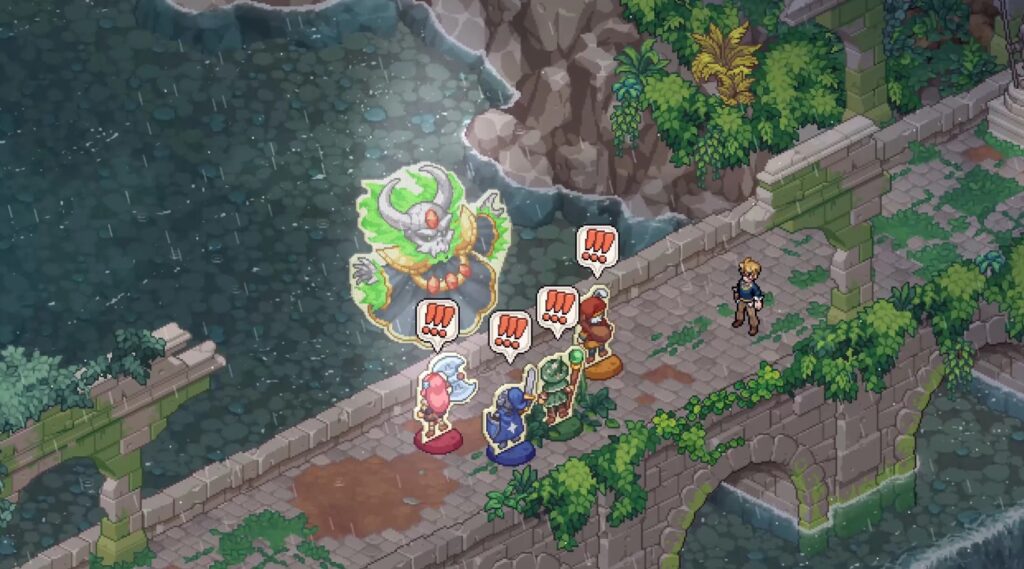
The comparison everyone reaches for is Stardew Valley, and it is instructive here for an unflattering reason. Stardew’s core loop is a single button, held down, repeated thousands of times, and its genius is that the repetition is almost frictionless – you stop noticing the input and start noticing the farm. Witchbrook is proposing the opposite deal: an input you are meant to keep noticing, because noticing it is the fantasy.
That can absolutely work. Deliberate inputs are why fishing minigames exist. But fishing is something you do for a few minutes at a time. Harvesting, scanning, summoning and studying are what you do all day, every in-game day, for however many dozens of hours the campaign runs.
| A Gesture | A Button Press | |
|---|---|---|
| What it buys | The feeling of casting rather than activating | Speed and invisibility |
| What it costs | Time on every single action | Any sense that magic is magic |
| Skill curve | Real – the motion sharpens with practice | Flat almost immediately |
| Risk over 60 hours | Friction compounds into chores | The fantasy quietly evaporates |
| Best case | A game whose rhythm is unlike its peers | A game you can play while half asleep |
Chucklefish has picked the left column. It is the braver pick and the one more likely to produce something memorable, and it is also the one that fails harder if the tuning is off by even a little.
Worth noting that this is the same studio that reportedly moved away from being described as Harry Potter meets Stardew Valley back in 2019, specifically to make the game more its own thing. That pivot was named as the main reason for the long delay. The gesture-based casting looks like exactly what that pivot bought.
What Sits On Top of the Gesture
The systems layer is the part Chucklefish has published in detail, and it is considerably more structured than the hands-on build let on.
| System | What It Covers |
|---|---|
| College | Paying for classes out of your earnings, completing assignments for merits, sitting exams to move up grades |
| Business | Selling what you make through your classes, deliveries by broom or moped, and a Sunday market stall |
| Knowledge | A collection menu tracking everything you have learned |
| Spells | Earned through exams, cast with your wand |
| Wellbeing | A level moved up and down by your daily choices, feeding into income, deals, gifts and exam results |
| Life outside college | Clubs, festivals, gardening, potion brewing, broom races, shops and seasonal events |
The classes themselves are more specific than “magic lessons”: tea, incense and salve crafting, potion brewing, astrological divination, and arcane rituals. Fishing, bug catching and foraging outside town feed both your crafting stocks and your stats in the related schools of magic, so the hobby activities are not sitting off to the side of the curriculum – they are part of it.
Wellbeing is the system most likely to be underestimated. A single value nudged by how you spend your days, which then quietly changes how much you earn, what deals you get offered, how gifts land and how well you perform in exams, is the kind of mechanic that turns a schedule into a decision. It also puts real pressure on the gesture question, because if routine actions feel like work, a system that punishes you for a badly spent day becomes punishing twice over.
What the Witchbrook Game Preview Did Not Show
Keeping this clearly separated, since a 40-minute slice leaves most of a life sim untouched.
- No fixed timetable or class sequence appeared. The build had no formal lesson schedule and no assignments, with learning happening through everyday activity instead. The published feature list says exams and merits exist, so the demo simply did not reach them.
- Farming depth went uncovered. Crops could be harvested; nothing beyond that was explored.
- Romance was a single scheduled date with a classmate, which the player could arrange their day around. The wider relationship systems were not tested.
- Exorcism-related spells were present in the spell list but their purpose was never demonstrated. The previewer read them as a hint of darker material under the cosy surface, which is a genuinely intriguing loose thread.
- Co-op was not part of the demo at all, despite four-player online co-op being confirmed for launch
- Length is unknown. Nobody outside the studio has a figure.
That exorcism detail deserves a flag of its own. A game about tea crafting and broom races carrying exorcism spells in its progression suggests the seaside cosiness has something underneath it. It is the single best reason to watch this one closely between now and January.
The People You Will Be Doing It With
The social layer is where Witchbrook is positioning itself apart from the rest of the cosy field.
Four dateable characters have been confirmed: Hana, Eli, Cormac and Pip. Covenmate storylines are described as playing out like short visual novels rather than as gift-and-heart meters, and rivalries are possible too, which is a notably rarer choice than universal friendliness.
Put that next to the studying mechanic and the design intent becomes clear. Who you spend time with changes what you know, not just how much they like you. A friendship in this game has a transcript attached.
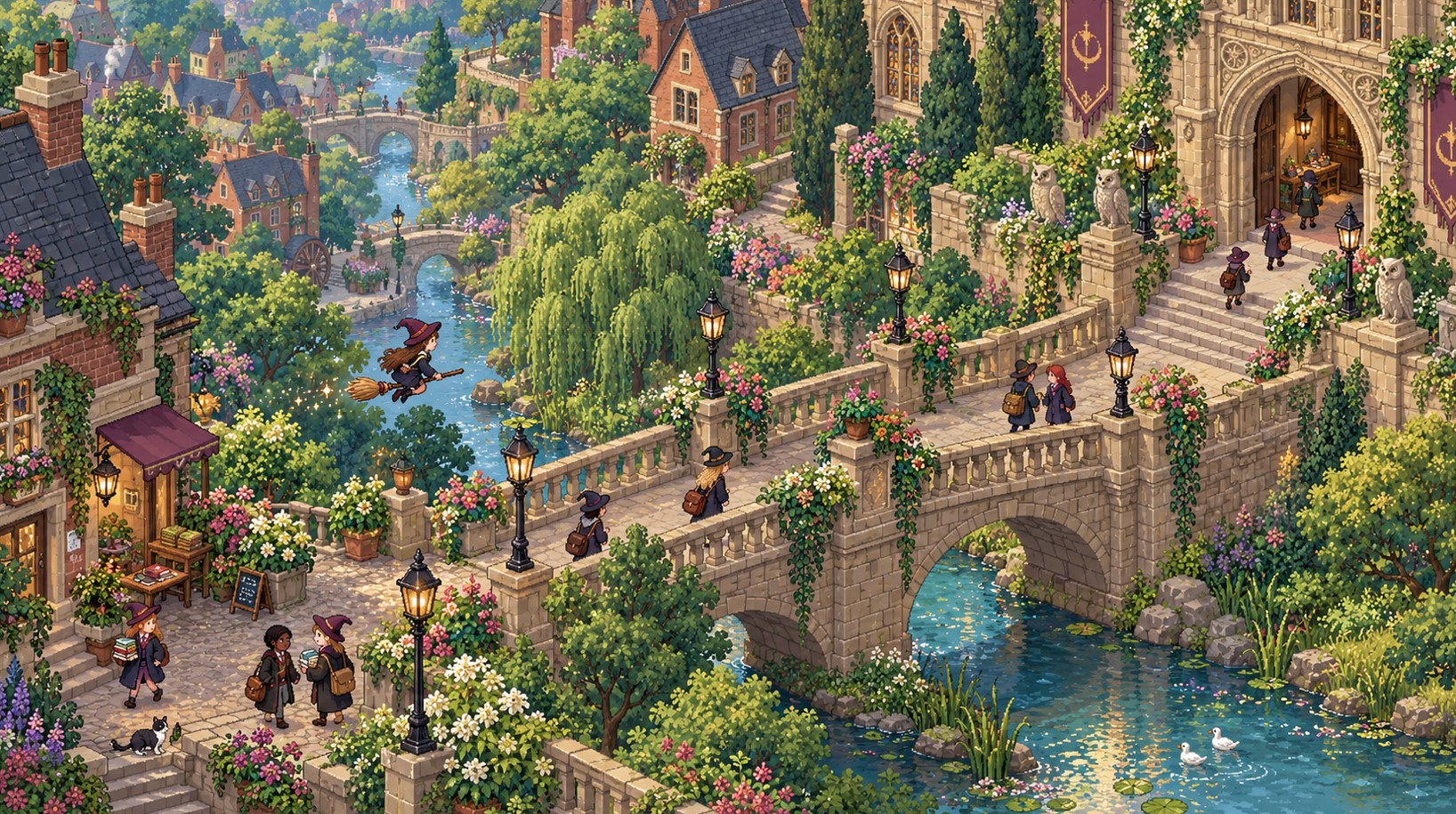
The town itself is Mossport, a sleepy seaside place where you are stepping into your ancestor’s role as the resident witch, with a woodland cottage to decorate and a college – Witchbrook College – at the centre of it. Transport runs on brooms and mopeds, both of which appeared in the trailer.
Ten Years, Two Delays, One Date
Context on how long this has taken, because it is part of the story and it shapes how the preview coverage reads.
- 2016 – first teased, under the name Spellbound.
- 2018 – resurfaces as Witchbrook.
- 2019 – the team steps away from the Harry Potter meets Stardew Valley framing to make the game more distinct, which becomes the main cause of the delay.
- 2025 – the original target window, missed.
- Late 2025 – pushed to 2026 so the world could feel richer, which also opened the door to more platforms and languages.
- Mid-2026 – the Life at Witchbrook dev blog breaks a long quiet stretch.
- October 28, 2026 – January 28, 2027 confirmed at Indie World, with a new gameplay trailer and day-one Game Pass.
- January 28, 2027 – launch, on Switch 2, PS5, PC and Xbox, with four-player online co-op available from the start.
The length of that list is why the TGS previewer ended on a note of concern about the development time rather than pure enthusiasm. It is a fair worry to hold. It is also worth remembering that the delays were spent on exactly the kind of thing the hands-on then praised – a world that feels detailed and a casting system unlike its peers.
Three months is a meaningful amount of tuning time for the specific problem the preview identified. Harvest speed, observation length and the casting wind-up are all numbers in a spreadsheet somewhere, and they are the easiest sort of thing to adjust late.
FAQ
When does Witchbrook come out?
January 28, 2027, announced at Nintendo’s Indie World showcase on October 28, 2026.
What platforms is it on?
Nintendo Switch 2, PlayStation 5, PC and Xbox, with day-one availability on Xbox Game Pass for eligible subscribers.
How does magic work in Witchbrook?
Spells are cast by moving the stick across a magic circle, a motion meant to evoke waving a wand. The same input covers summoning your broom, harvesting crops and observing objects, and it speeds up as you get better at it.
Does Witchbrook have multiplayer?
Yes. Online co-op for up to four players is confirmed for launch, though it was not part of the hands-on demo.
Who can you romance?
Hana, Eli, Cormac and Pip are the confirmed dateable characters. Covenmate storylines play out like short visual novels, and rivalries are also possible.
What did hands-on previews criticise?
Unclear early direction, empty menu entries, and observation, casting and harvesting feeling tedious when sampling features quickly – with the honest caveat that 40 minutes cannot show whether that holds up long term.
How long has Witchbrook been in development?
It was first teased in 2016 as Spellbound and resurfaced under its current name in 2018, making the January 2027 launch roughly a decade in the making.
The Thing to Watch For in January
Most previews of cosy life sims end up describing the same checklist. Crops, fishing, friends, festivals, a cottage to decorate. Witchbrook has all of that, and if you only read the feature list you would file it alongside a dozen others.
The feature list is not where this game lives. It lives in the decision that doing magic should take a moment, and that the moment should be yours to get good at. Every strength in the hands-on coverage traces back to that – the sense that you are casting rather than clicking, the way knowledge becomes something you actively look at rather than something you absorb, the way an unlearned spell turns a corner of the map into homework. So does every worry.
Which gives anyone watching this one a very clear thing to look for when reviews land in January. Not whether the farming is deep or the festivals are charming. Whether, on day thirty, summoning a broom still feels like a small spell or whether it has become a small tax.
Chucklefish has had a decade to get that number right. Three more months to go.
Already picked your covenmate? Share this, bookmark it, and go practise your wand circles on something – and if creative or commercial collaboration brought you here, the YaninaGames team is one message away.