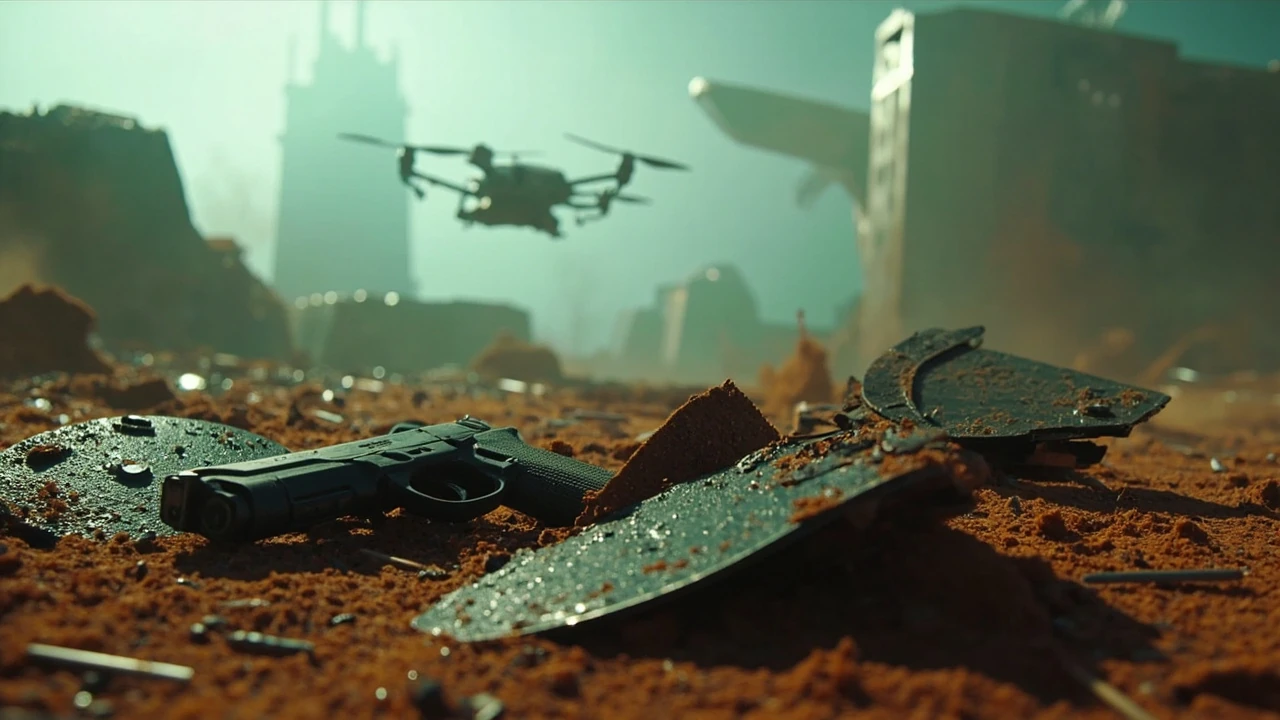
Reduced to rubble in ARC Raiders: what it means and why it matters
Being reduced to rubble in ARC Raiders is the moment a raid goes wrong in a very literal way. The player drops, the camera lingers on the wreckage of their loadout, and the round shifts from active looting to a recovery decision. For a developer or curious systems designer, that moment is one of the cleanest illustrations of consequence in the extraction-shooter genre, because every variable that led to it is visible, repeatable, and tied to design intent. This article walks through the combat mechanics that lead to a player being reduced to rubble, the technical and design decisions behind that state, the progression impact when it happens, and the broader lessons ARC Raiders offers studios building similar systems.
The phrase reduced to rubble in ARC Raiders is more than flavor text. It describes a specific defeat state, a specific screen treatment, and a specific set of recovery choices. Understanding how that state is built, presented, and connected to the rest of the game loop helps developers reason about tension, fairness, and the cost of failure in extraction shooters, while also helping players plan their loadouts more deliberately.
How ARC Raiders defines the reduced-to-rubble state
ARC Raiders treats a defeat during a raid as a full reset of the player’s in-match presence, not just a brief death animation. When a player is reduced to rubble, the match records the event, the player’s carried gear is lost in the way the game specifies for that match phase, and the player returns to the social hub in a defeated state. The visual and audio presentation is designed to make the loss feel heavy: scattered equipment, a still environment, and a camera that does not let the player skip away quickly.
From a production standpoint, this defeat state is the place where several design goals meet at once:
- It establishes a real cost for every fight, so players must weigh risk against reward before engaging.
- It separates “being downed” from “losing the raid,” which keeps individual encounters tense without ending the round on the first mistake.
- It creates a clear handoff between the in-match simulation and the meta-progression layer that lives in the social hub.
- It anchors the recovery loop that gives extraction shooters their long-term rhythm.
For developers, the value of studying this state is that ARC Raiders commits to a single, readable definition of failure. The player is not partially defeated, not in a soft revive state, and not waiting on a teammate in the same way a battle royale player would. The result is a design that is easier to balance because every loss flows through the same pipeline.
Combat causes that lead to a player being reduced to rubble
Most reduced-to-rubble outcomes trace back to a small number of recurring causes, and recognizing them is the first step toward better decision making in a raid. The table below summarizes the most common sources of defeat in ARC Raiders, the design reason each one exists, and the typical counter a developer or experienced player would recommend.
| Cause | How it triggers the reduced-to-rubble state | Design intent | Recommended counter |
|---|---|---|---|
| Direct ARC machine fire | Sustained weapon damage from patrolling or aggroed machines depletes the player health pool past zero. | Establishes threat zones the player must read rather than sprint through. | Use cover, terrain elevation, and the long sightlines machines prefer; avoid open approaches. |
| Ambush from rival Raiders | Player-controlled opponents deal burst damage during a contested extraction or loot spot. | Creates player-driven tension that drives the extraction-shooter identity. | Listen for movement cues, hold high-value loot until you have a route out, and use utility rather than raw firepower. |
| Environmental hazard | Storms, collapsing structures, or hazard fields apply damage over time that can finish a weakened player. | Makes the map itself a rival, rewarding map knowledge and timing. | Track hazard cycles, plan routes around them, and keep healing resources available for the worst windows. |
| Overextension during looting | Player delays extraction while finishing a loot route and is caught with depleted cooldowns or empty magazines. | Tests discipline and time management, not just aim. | Set a personal extraction threshold before the raid, not after. |
| Poor loadout choice for the map | Loadout lacks the range, mobility, or durability the current map demands, leading to fights the player cannot win. | Encourages meta-progression so loadouts feel earned, not just picked. | Match the loadout to the most likely threat: long sightlines favor range, dense interiors favor mobility and utility. |
What unifies these causes is that the game signals them before they become fatal. ARC machines telegraph attacks with movement, audio, and light tells. Rival Raiders give away positions through sound, third-party behavior, and the pattern of recent skirmishes. Environmental hazards are visible on the map and audible before they peak. A player who gets reduced to rubble usually had the information to avoid it; the design rewards players who use that information rather than relying on reaction time alone.
The technical pipeline behind a defeat
From a game development perspective, the reduced-to-rubble state is the visible face of a chain of systems that must agree about what just happened. The combat simulation has to decide the killing blow, the loot system has to decide which carried items are at risk, the match flow has to decide whether the round is still viable, and the meta-progression layer has to record the outcome. If any of those systems disagree, the player experience becomes confusing, and the social space around the game fills up with bug reports rather than strategies.
A typical pipeline looks roughly like this:
- The damage system records the killing event with attacker, weapon, location, and any status effects that contributed.
- The defeat handler transitions the player from a live pawn to a defeated state and disables combat input while keeping the camera alive for presentation.
- The loot resolver checks the match phase, the player’s inventory, and any container or squad rules to determine what is lost and what is recoverable.
- The match flow system either ends the raid for that player or moves them into a spectator or recovery mode if the game design supports it.
- The meta-progression system credits the player with whatever pre-raid commitments the design tracks, such as insurance, reputation gains, or quest progress that survived the loss.
- The presentation layer plays the reduced-to-rubble sequence, including camera work, audio, and the return-to-hub transition.
Each of those steps is a place where a development team can introduce bugs, ambiguity, or unfairness. If the loot resolver treats a container as lost when the design intended it to be recoverable, players will rightly complain. If the meta-progression system awards reputation for a defeat as if it were a win, the loop loses its bite. ARC Raiders has been relatively disciplined about keeping these layers consistent, which is part of why the phrase reduced to rubble in ARC Raiders has become shorthand for a defeat that feels both painful and fair.
Loadout, risk, and the cost of a lost raid
Every raid in ARC Raiders starts with a loadout that represents real investment. Weapons, mods, consumables, and key tools have to be earned, crafted, or purchased, and the game makes the cost of losing them visible at the moment of defeat. That visibility is a deliberate design choice, because it turns every loadout decision into a risk calculation rather than a stylistic one.
For developers studying the game, three loadout patterns are worth tracking:
- High-investment kits: fully upgraded weapons, top-tier consumables, and the best armor available. These kits are powerful but represent a serious loss if the player is reduced to rubble, so they push the player toward safer routes and more cautious engagements.
- Mid-tier generalist kits: balanced weapons, mixed consumables, and reasonable armor. These kits are the workhorse of the early-to-mid game, where the player still has more to learn about the map than about the meta.
- Low-investition scouting kits: cheap weapons, minimal consumables, and light armor. These kits are designed to gather information, complete specific quests, or secure small extractions when the player is not confident in the lobby.
The interesting design move is that the game does not tell the player which kit to use. It presents the cost of failure in the defeat screen and lets the player choose how much they are willing to risk on any given raid. That choice is what gives ARC Raiders its long-term tension: even experienced players still have to decide whether the next raid is worth a full kit or just a scout run.
What being reduced to rubble does to progression
Progression in ARC Raiders lives in two places: the in-match loop, where the player fights, loots, and extracts, and the meta-progression loop, where the player uses recovered and crafted resources to improve their standing, unlock new tools, and prepare for harder content. The reduced-to-rubble state touches both loops, and the balance between them is what makes the game feel like an extraction shooter rather than a purely PvP arena.
When a player is reduced to rubble, the in-match loop ends for that raid. Whatever loot was on the player, in their immediate containers, or in their squad’s shared space is handled according to the rules active at that moment. In many cases, some of that loot is still recoverable, either through a successful squad extraction or through a secondary mechanic the game uses to soften the worst outcomes. The meta-progression loop, on the other hand, is built to keep moving: completed quest steps, reputation gains, and certain pre-raid investments survive the defeat.
The following table shows how different progression elements respond to a reduced-to-rubble outcome, with the caveat that exact values and rules should always be confirmed against the current in-game descriptions, since live-service games tune these numbers over time.
| Effect when the player is reduced to rubble | Why the design treats it this way | |
|---|---|---|
| Carried weapons and mods | Typically lost on defeat, recoverable only through specific game-supported paths. | Makes each weapon choice feel meaningful and protects the long-term economy. |
| Consumables and healing | Lost in the same way as carried gear, with some exceptions for insurance-style systems if active. | Prevents stockpiling consumables as a low-risk strategy. |
| Quest progress | Quest steps completed before the defeat usually persist. | Keeps long-term goals moving even when individual raids fail. |
| Reputation and faction standing | Survives the defeat, often with partial credit for in-match performance. | Rewards learning the game even when the player is still losing raids. |
| Insurance or pre-raid commitments | Can convert part of a defeat into a partial return, depending on the option chosen. | Provides a safety valve for newer players without removing the cost of failure entirely. |
For developers, the key takeaway is that the reduced-to-rubble state is not a wall. It is a controlled loss, and the surrounding systems decide how much of that loss is permanent, how much is recoverable, and how much is simply a tax on time. A well-designed extraction shooter keeps that ratio consistent so the player never feels cheated, even when a raid ends in rubble.
Reading the defeat: visual and audio signals
ARC Raiders leans heavily on presentation to make the reduced-to-rubble moment land. The camera does not cut away immediately, the audio mix drops the combat layer while keeping ambient cues, and the lighting is usually tuned to make the wreckage readable rather than chaotic. Those choices are not accidental. They are the result of a presentation team that has to communicate loss without making the player feel mocked.
From a craft perspective, the defeat sequence has three responsibilities:
- Confirm to the player that the raid is over so there is no confusion about whether to keep fighting.
- Show the cost of the defeat through visible gear, environment state, and audio cues, so the player can internalize the loss.
- Hand the player back to the social hub in a state that supports the next decision: repair, rebuild, requeue, or step away.
That last step is the one that many extraction shooters get wrong. If the return to hub is jarring, the player feels punished. If it is too soft, the defeat loses its weight. ARC Raiders uses the reduced-to-rubble presentation as a bridge, keeping the camera low and the audio quiet, so the loss registers before the player is dropped back into a busy social space.
Design lessons for studios building extraction systems
Studios building their own extraction or high-consequence PvPvE systems can learn a great deal from the way ARC Raiders handles the reduced-to-rubble state. The lessons cluster around three themes: clarity, cost, and recovery.
Clarity of failure
Players should never be unsure whether a raid is over. A clean defeat state with consistent triggers lets players plan around failure rather than fear it. That means using the same animation family for the same cause, the same audio signature for the same outcome, and the same UI for the same progression consequences. The moment any of those layers disagree, the player loses trust in the system.
Visible cost
Failure has to feel costly enough to matter and small enough to be recoverable. The visible equipment on the ground, the consistent loss of carried gear, and the clear distinction between what survives and what does not are all part of that cost curve. Studios that hide the cost of defeat behind opaque numbers or sudden inventory wipes tend to see the same complaint threads repeat on every patch.
Meaningful recovery
Recovery is where extraction shooters earn their longevity. Insurance, partial reputation, recoverable containers, and squad-based rescue mechanics all give the player a path back from a bad raid. Without those paths, the game collapses into a pure PvP arena where the only winning move is to avoid playing. With them, the reduced-to-rubble state becomes a chapter in a longer story rather than the end of one.
Player behavior after a defeat
Most players, after being reduced to rubble, fall into a recognizable pattern: review the raid, adjust the loadout, and requeue. The first step is about understanding what went wrong, the second is about changing the inputs, and the third is about validating the change. That loop is the same loop that exists in competitive PvP games, but it has a different texture here because the cost of failure is so visible.
Experienced players tend to use the following sequence when they have been reduced to rubble:
- Identify the single cause of the defeat, not the chain. Was it the ambush, the storm, the loadout, or the time management?
- Change one variable in the next loadout, not several. Modifying too many inputs at once makes it impossible to learn.
- Pick a raid goal that tests only that variable, such as a specific quest step or a focused extraction route.
- Requeue and treat the next raid as an experiment, not a redemption run.
For developers, that player behavior is itself a design signal. If the loop above does not produce improvement, the underlying systems are not giving the player enough feedback. If it produces improvement too easily, the cost curve is too soft. The reduced-to-rubble state is one of the most useful diagnostics in the game precisely because it is a place where the loop either works or breaks.
Comparing the reduced-to-rubble state to other extraction shooters
Most extraction shooters use some version of the defeated-player state, and comparing them clarifies what ARC Raiders is doing. The table below uses general, design-level observations rather than patch-specific numbers, since live-service games tune these details frequently. The aim is to highlight structural differences, not to crown a winner.
| Design dimension | ARC Raiders approach | Common alternative in the genre | What that means for the player |
|---|---|---|---|
| Defeat presentation | Slow camera, scattered gear, quiet audio, clear transition to hub. | Fast cut to death screen, immediate respawn option. | ARC Raiders emphasizes the weight of the loss rather than quick re-entry. |
| Carried loot | Lost on defeat, with insurance and squad mechanics that can recover part of it. | Always lost, or always recoverable on death. | ARC Raiders sits in the middle, which keeps the risk real without being punitive. |
| Progression carry-over | Quests, reputation, and pre-raid investments usually survive a defeat. | Only raw experience, or only top-level unlocks. | ARC Raiders makes long-term goals feel resilient to short-term losses. |
| Recovery options | Insurance, squad extraction, and partial recovery through game-supported systems. | Either solo-friendly insurance or harsh full-loss rules. | ARC Raiders gives groups a meaningful role without removing solo viability. |
| Time to next raid | Moderate, with hub activities that support repair and planning. | Either very short, encouraging spam, or very long, discouraging experimentation. | ARC Raiders uses the hub as a pacing tool between raids. |
The structural point is that the reduced-to-rubble state in ARC Raiders is not just a death animation. It is a contract with the player about what the game will and will not take from them, and that contract is what makes the rest of the loop feel coherent.
Common misconceptions about being reduced to rubble
A few persistent misconceptions about the reduced-to-rubble state come up repeatedly in community discussion. Addressing them directly is useful for both new players and developers who are still learning the system.
- “It only happens when you run out of health.” In practice, the state can also be triggered by leaving a match in certain ways, by specific hazards, or by conditions the match flow treats as a defeat. Reading the in-game rules for the current season is the only reliable way to know the full trigger set.
- “All your loot is gone forever.” Many of the loss rules depend on the match phase, the container type, and whether insurance or squad systems were active. A defeat does not always mean a total wipe.
- “It kills your progression.” The meta-progression layer is built to keep moving through defeats. Quest progress, reputation, and certain pre-raid commitments are usually safe.
- “It is random.” The state is deterministic given the same inputs. What feels random is usually the result of a chain of small decisions, not the defeat roll itself.
- “It is the same as being downed.” A downed state, where teammates can revive a player, is a different design idea. ARC Raiders separates the two so the cost of a true defeat stays high.
For developers, those misconceptions are useful as a checklist. If your own extraction system generates the same five misconceptions, the underlying rules are probably not visible enough in the UI.
Building a better defeat state in your own project
Studios working on their own extraction or high-stakes PvPvE systems can use the reduced-to-rubble state in ARC Raiders as a reference point. A few practical suggestions follow, framed as questions the team should be able to answer before the first player ever sees the defeat screen.
- Is the defeat state visually distinct from every other state in the match, including downed, disconnected, and spectator?
- Does the loot resolver treat carried gear, container gear, and squad gear with the same rules, or does the player have to learn three different loss behaviors?
- Does the meta-progression layer reward the player for the time they spent in the raid, even when the raid ended in defeat?
- Is the return-to-hub sequence paced so the player can process the loss before being asked to make another decision?
- Does the defeat presentation scale with the cause of the defeat, so a loadout mistake feels different from a genuine ambush?
- Is the loss curve tunable, so the team can adjust how punishing a defeat is without rewriting the combat system?
Answering those questions early reduces the number of late-stage redesigns, and it gives the design team a shared vocabulary for discussing what failure means in the game.
The social layer around a defeat
One underappreciated part of being reduced to rubble in ARC Raiders is the social layer that surrounds it. Players talk about defeats in voice chat, in squad tools, and in community spaces, and the design of the defeat state influences the kind of conversation that happens. A clean, fair defeat tends to produce analysis: “I pushed too far,” “I took the wrong route,” “I should have waited for the storm to pass.” A confusing or unfair defeat tends to produce frustration: “I lost gear I should have kept,” “The rules changed mid-season,” “The match ended for no reason.”
For developers, the social layer is a leading indicator. If community discussion about a defeat is dominated by frustration, the systems behind the defeat are probably not aligned. If discussion is dominated by analysis, the systems are probably doing their job, even when individual players are unhappy with the outcome. The reduced-to-rubble state, because it is so visible, is a useful place to watch that conversation.
How updates can shift the meaning of a defeat
Live-service games tune their defeat systems over time, and ARC Raiders is no exception. Patches can adjust the loss curve for carried gear, change the triggers for the reduced-to-rubble state, or modify how insurance and squad mechanics interact with defeat. For developers, the lesson is that any defeat state has to be tunable without breaking the player’s mental model.
A useful pattern is to separate the defeat state from the loss curve. The state itself, the animation, the audio, the camera work, should remain relatively stable, because players build a mental model of it quickly. The loss curve, what is taken and what is returned, can be tuned more aggressively, because the player experiences it as a number rather than as a moment. ARC Raiders appears to follow that pattern: the reduced-to-rubble presentation is consistent across seasons, while the specific loot and progression rules evolve.
Practical checklist for surviving more raids
For players who want to reduce the number of times they end a raid as rubble, a small set of habits is more valuable than any single trick. The list below is a starting point, not a complete guide, and it should be adjusted to the player’s own experience and the current state of the game.
- Read the match phase before you move. The cost of defeat is not constant across a raid, and the worst time to take a fight is often the phase where the loss is highest.
- Set an extraction threshold before you load in, and treat it as a hard rule, not a suggestion.
- Carry healing and utility that match the map, not the lobby. A long-range sightline map rewards different tools than a tight interior map.
- Listen more than you look. Most ambushes give away their position through audio before they give it away through sightlines.
- Use insurance and pre-raid commitments deliberately, not by default. They are part of the loadout decision, and they change the cost curve in ways the player should understand.
- Review the defeat, not just the loadout. The cause of a rubble outcome is often a decision made several minutes before the killing blow.
For developers, that checklist is also a useful diagnostic. If experienced players cannot follow those steps and consistently reduce their defeat rate, the underlying systems are probably not giving them the information they need.
What ARC Raiders is really showing the genre
At a higher level, the reduced-to-rubble state in ARC Raiders is a small but clear example of how the game treats consequence as a feature rather than a punishment. The defeat is heavy, but it is not arbitrary. The cost is visible, but it is not total. The recovery is real, but it is not free. That balance is what extraction shooters are trying to get right, and ARC Raiders is one of the more disciplined attempts in the current market.
For studios, the state is worth studying not because it is the only way to handle defeat, but because it is a coherent way. Every system that touches the defeat agrees about what the defeat means, and the player can build a working model of that meaning in a reasonable number of raids. That coherence is rare, and it is the real reason the phrase reduced to rubble in ARC Raiders has come to stand for a defeat that feels earned.
Frequently asked questions
What does reduced to rubble mean in ARC Raiders?
Reduced to rubble is the in-fiction way the game describes a defeated player state during a raid. It covers the moment a player is downed beyond recovery, the visual presentation of the defeat, and the immediate transition back to the social hub. It is a designed defeat state, not a generic death animation, and it ties into the game’s loot, progression, and recovery systems.
Is the reduced-to-rubble state the same as being downed in ARC Raiders?
No. A downed state, where a teammate can revive the player, is a separate design idea that exists in many extraction shooters. In ARC Raiders, the reduced-to-rubble state is the final defeat for the raid, while downed or recoverable states, where they exist, are intermediate. Mixing the two is a common source of confusion, and the in-game rules should be checked for the current behavior.
Do I lose all my gear when I am reduced to rubble?
Not necessarily. The loss depends on the match phase, the container rules, and any insurance or squad systems that were active when the raid started. Some gear is lost on defeat, some is recoverable through game-supported paths, and some pre-raid investments survive regardless. The current in-game description of the rules is the only reliable source for exact behavior.
Does being reduced to rubble reset my progression?
No. The meta-progression layer is built to keep moving through defeats. Quest progress completed before the defeat, reputation gains, and certain pre-raid commitments usually survive. The in-match loot is the part that is at risk, not the long-term progression, which is part of why the game feels fair even when an individual raid ends in rubble.
Can I avoid being reduced to rubble entirely?
Not in any practical sense. Defeat is a core part of the extraction-shooter loop, and the design assumes the player will be reduced to rubble on a regular basis. The goal is to make those defeats feel earned and recoverable, not to eliminate them. Loadout discipline, map knowledge, and good time management reduce the rate of defeat, but they do not remove it.
How does insurance interact with being reduced to rubble?
Insurance is one of the pre-raid systems the game offers to soften the loss curve. When active, it can convert part of a defeat into a partial return of carried gear, either immediately or after a delay. It is not a free pass: insurance has its own cost and its own limits, and the player should understand both before relying on it as a default option.
Does being reduced to rubble affect my squadmates in ARC Raiders?
It can, depending on the squad rules active for that raid. Some shared systems share loot, risk, or recovery, which means a single defeat can have effects beyond the downed player. Squad play in extraction shooters is built around those shared rules, and understanding them is part of the difference between a smooth squad and a frustrated one.
Why does the game show the wreckage after the defeat instead of skipping to the hub?
The presentation is part of the design. The wreckage communicates the cost of the defeat visually and gives the player a moment to process the loss before the social hub asks for the next decision. Skipping that moment would make the defeat feel less real and would weaken the tension that the rest of the loop depends on.
Is the reduced-to-rubble mechanic the same in every season or update?
The core presentation is consistent, but the specific rules around loot, insurance, and progression carry-over are tuned over time. Live-service games adjust these numbers as the meta evolves, and ARC Raiders is no exception. The current in-game description of the rules is the only source that should be trusted for exact behavior at any given moment.
What should I learn from a reduced-to-rubble defeat?
The most useful lesson is usually a single cause, not a chain. Identify whether the defeat came from a direct fight, an ambush, an environmental hazard, overextension, or a loadout mismatch, and change one variable in the next raid to test that hypothesis. That loop of small, focused experiments is how experienced players turn frequent defeats into a manageable rate of loss.