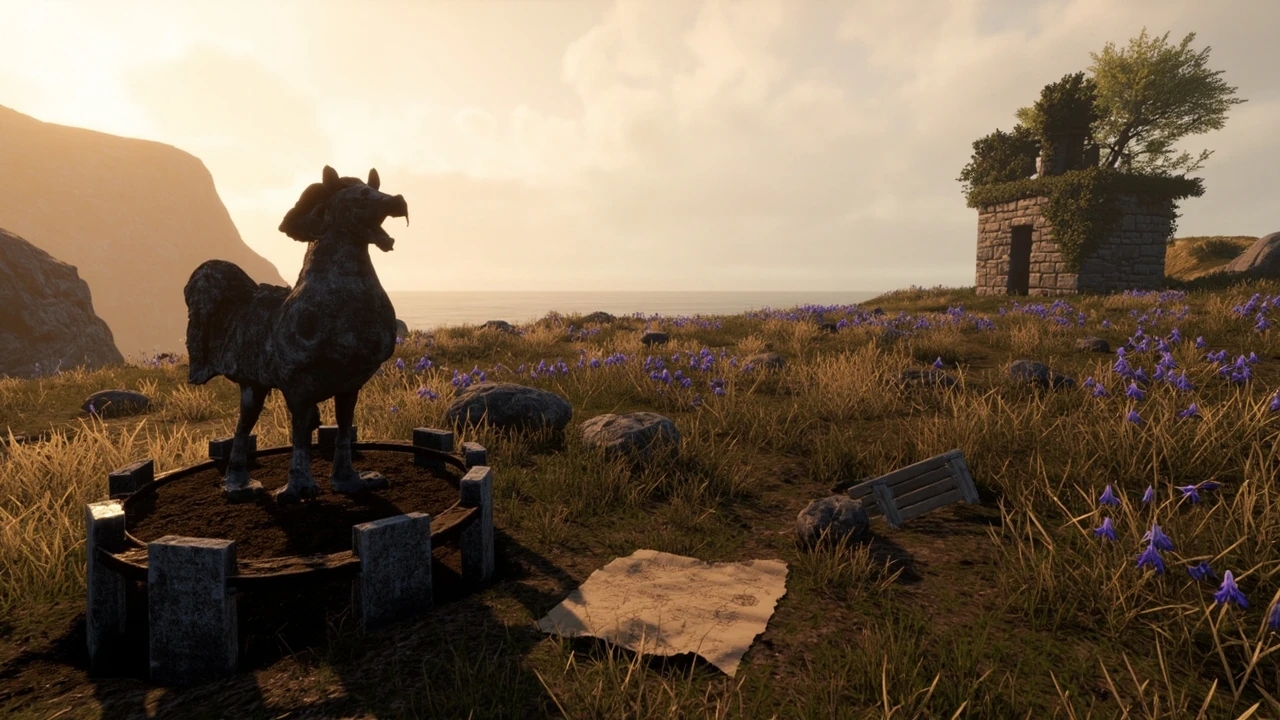
The hippogriff marks the spot: a short Hogwarts Legacy quest that rewards a curious player
Among the dozens of side quests in Hogwarts Legacy, “The hippogriff marks the spot” is the kind of task players tend to bump into while wandering the southern edge of the Feldcroft region. It does not sit in the main journal the way story missions do. It is triggered by reading a specific treasure map, and the only real way to find it is to be in the right place at the right time, which is one reason so many people search for the quest name long after they have already finished the main campaign. The reward is small but distinctive: a hippogriff statue for the Room of Requirement, useful mainly to players who care about decorating their personal space.
This guide covers what the quest actually is, where the treasure map sits in the world, how to read the drawing, what to do when you reach the meadow, and how to handle the small set of bugs and edge cases that have been reported on PC, PlayStation, and Xbox. It also places the side quest in the broader design context of Hogwarts Legacy, because the map and the statue tell a useful story about how Avalanche Software scattered collectible content across the Highlands without forcing the player onto a rails-based quest line. The same ideas show up in many older adventure games, and the convention of marking a hidden reward with a stylized drawing on a scrap of paper is old enough to be covered in a general overview of the trope.
Quest type and how it fits the Hogwarts Legacy quest system
“The hippogriff marks the spot” is a treasure map quest. In Hogwarts Legacy terminology, treasure map quests are not the same as the main story missions, the relationship quests, the assignments from professors, or the field guide pages. They are a self-contained side activity: read the map, find the location, dig or interact, claim a cosmetic reward, close the quest. Avalanche uses this structure for around twenty different map-based quests in the base game and a few more in the DLC regions, each with its own paper prop, dig site, and Room of Requirement reward.
The practical consequence of that design is that the quest does not appear in the main mission log until the player reads the corresponding map. Before that, the only signal that the quest exists is a faint compass ping or, in some cases, nothing at all. Players who skip exploration, or who rush through the Feldcroft region during the main campaign, often finish the game without ever reading the map and therefore never receive the quest. The map is the trigger, the statue is the reward, and the meadow is the destination.
From a game design perspective this is a deliberate trade-off. Treasure map quests reward curiosity rather than progression, and they reuse a single small set of assets: a paper map, a fixed camera at the dig site, a one-line voiceover or toast confirmation, and a collectible that routes back to the Room of Requirement. Avalanche can therefore place many of these without bloating the main quest tree or diluting the central story arc. For a player, the upshot is that the Highlands feel populated even in areas the main story never visits, and a five-minute detour can produce a small, tangible change to a personal space.
What you get for finishing it
The reward is a hippogriff statue used to decorate the Room of Requirement. It has no gameplay effect, no stat boost, and no influence on combat, crafting, or talent builds. The value is entirely aesthetic, and it is most appreciated by players who have already unlocked the basic Vivarium and Conjuration mechanics, because at that point the Room starts to feel like a personal space rather than a utility room.
If you only care about combat or story progression, the quest is genuinely optional. If you care about completing the field guide, decorating the Room, or hunting down every collectible the base game shipped with, it is one of the easier entries in the treasure map sequence and a good candidate for a short detour. There is no penalty for ignoring it, no achievement tied to it on most platforms, and no hidden follow-up that triggers only if the statue is placed in a specific spot.
Where to find the hippogriff marks the spot treasure map
The map is found in the Feldcroft region, which sits to the south of Hogwarts castle and east of the Coastal Mines. The specific location is a small ruined tower at the southern edge of the map, near the cliffs that overlook the sea. The tower is on a low rise, marked by broken stone walls and an ivy-covered doorway. The map itself is on a stone ledge inside the tower, near a small pile of crates and a couple of empty urns.
You do not need any specific spell to reach the map. The tower is open on one side, and a short run from the nearest fast travel point covers the distance in well under a minute. Players who already have a broom can reach it directly, but walking is faster than it first looks because the terrain between the fast travel floo flame and the tower is mostly flat. The ruin is also a short detour from the road that runs between Feldcroft village and the southern hamlets, which makes it a natural find for anyone who follows the side paths instead of sticking to the main track.
The map is a single piece of parchment with a hand-drawn illustration of a hippogriff standing in a meadow. Below the drawing are rough instructions pointing toward a circle of stones. The drawing is intentionally stylized and does not look like a literal aerial view of the destination, so it helps to know the general area before you try to follow the lines on the parchment. In practice most players match the drawing to the landscape by looking for the stone circle first and the hippogriff illustration second.
Recommended order of steps
- Fast travel to the Feldcroft floo flame or the nearest unlocked floo point in the southern Highlands.
- Open the map and confirm the southern tower ruin. Mark it as a custom waypoint if you prefer to use the in-game compass.
- Travel to the tower on foot or by broom and enter through the open doorway.
- Loot the map from the stone ledge and read it from the field guide menu. The quest “The hippogriff marks the spot” starts as soon as the map is read.
- Open the field guide map and select the quest marker. Follow the marker to the meadow in the southern part of the region.
- Use the digging animation at the marked spot or interact with the small ring of stones to trigger the cutscene and claim the statue.
- Place the hippogriff statue in the Room of Requirement from the Conjuration menu or the relevant decoration category.
Total time for a player who already knows the route is usually under five minutes. A first-time player who does not know the tower location should expect ten to fifteen minutes, mostly because the southern Feldcroft cliffs are easy to overshoot if you are not used to the region’s geometry. The path from the floo flame to the tower is forgiving, but the path from the tower to the meadow rewards players who already know that the destination is inland rather than directly south toward the coast.
How to read the hippogriff treasure map
The map shows a hippogriff drawn in profile, with its head turned toward a cluster of small symbols that represent a stone circle. The lines on the map are not navigational. They are decorative, in the style of a child’s drawing of a magical creature, which fits the Harry Potter setting but makes the map harder to use as a literal guide. The one reliable landmark is the stone circle, which corresponds to a real ring of small standing stones in the southern Feldcroft meadow.
If you are lost after reading the map, ignore the hippogriff illustration and focus on the stone circle symbol. Walk toward the closest visible stone ring in the southern part of the region. The correct ring is the one in a flat meadow near a low ridge, not the one inside the enemy camp to the north. The compass marker the game places after you read the map is more reliable than the parchment itself, but it can still route you to the wrong ring on a fresh install, so it is worth knowing the visual difference between the two.
This is the single biggest source of confusion in the quest. The map looks like it is pointing toward the cliffs, but the destination is actually on a plateau slightly inland. Players who walk all the way to the coast end up staring at the sea and wondering why the quest marker will not update. A useful trick is to turn around as soon as you see open water and head back north until the marker stops drifting.
Map landmarks and what they correspond to
| Map element | What it represents | Field confirmation |
|---|---|---|
| Large hippogriff drawing | Thematic decoration, not a landmark | Ignore for navigation |
| Cluster of small dots arranged in a ring | Stone circle at the dig site | Found in the southern meadow |
| Wavy line at the bottom of the map | Coastline to the south | Useful only for orientation, not as the destination |
| Single tree symbol near the top | A lone tree on the ridge above the meadow | Visible from the dig site and a reliable visual anchor |
| Faint X in the center of the ring | The exact dig location | Triggered by the digging animation at the marked spot |
| Short broken line at the top edge | Low ridge separating the meadow from the cliffs | Walk along it to find the meadow from the tower |
Once you reach the stone circle, the interaction is simple. Approach the center of the ring, hold the button to use the digging spell, and a short cutscene plays. A hippogriff statue rises from the ground and is added to your inventory. The quest completes immediately and the journal entry closes. The cutscene is short enough that most players see it once and never trigger it again, even on a second playthrough.
Common bugs, edge cases, and what to do about them
Like most treasure map quests, “The hippogriff marks the spot” has a small library of well-known bugs. Most are version-dependent and were patched in updates that Avalanche shipped in the months after launch, but a few still show up in fresh installs, in DLC saves, and on lower-spec hardware. The list below is based on the publicly reported behavior and is intended to help you diagnose, not to claim that any specific patch version is bug-free.
Map does not trigger the quest
If you read the map and the quest does not start, the most common cause is that the map was read on a save in which the field guide menu was already mid-loading, or in which the player was in a restricted area. Closing the menu, leaving the tower, and reopening the field guide usually resolves it. If it does not, fast traveling to any floo flame and back resets the local state and the quest marker should appear. A small number of players have also seen the issue when a modded field guide file overwrites the default trigger list, which is fixable by removing the mod and reloading the save.
Quest marker points to the wrong meadow
Some players report the marker pointing to a small camp of poachers instead of the correct stone ring. The camp is a known false positive because it has a similar-looking ring of stones near its entrance. If the marker is leading you toward an enemy camp, walk past it and continue south. The real meadow is on a flatter section of ground with a single tree on the ridge above it. The visual difference is small on a cloudy day, which is why the compass marker alone is not always enough.
Statue does not appear in the Room of Requirement
If the statue is not in the Conjuration menu after the cutscene, the most likely cause is that the Room of Requirement has not yet been unlocked far enough to accept decorations. The Room is introduced during the main story, but full decoration access comes later. If you triggered the quest before reaching that point in the main campaign, the statue sits in your field guide inventory and becomes available the moment the relevant menu option opens. Players sometimes mistake this for a bug because the journal entry closes before the item is visible, but the item is held in a separate inventory slot that only appears with the decoration menu.
Digging prompt does not appear
On rare occasions, the dig prompt does not appear at the center of the stone ring. This is most often a collision issue caused by a placed decoration, a familiar, or a summoned creature. Dismissing any summoned entity and moving the player character a few steps back usually restores the prompt. The bug is more common on PC builds with mods that change the player controller file or alter the timing of the digging animation, both of which can desync the prompt from the underlying interaction trigger.
Bug summary by platform
| Symptom | PC | PlayStation | Xbox | Workaround |
|---|---|---|---|---|
| Map does not trigger quest | Occasional | Rare | Rare | Close menu, fast travel, reopen |
| Marker points to enemy camp | Common in early patches | Patched in later updates | Patched in later updates | Walk past camp, head south |
| Statue missing from Room menu | Usually a progression issue | Usually a progression issue | Usually a progression issue | Advance the main story |
| Dig prompt missing | Common with mods | Rare | Rare | Dismiss summons, reposition |
| Quest cannot be completed in photo mode | Common | Common | Common | Exit photo mode first |
| Cutscene plays but quest stays open | Rare | Rare | Rare | Save, reload, approach the ring again |
None of these issues are story-breaking. The quest can be completed in every version of the base game that Avalanche has shipped, including the patches that addressed the major launch-day issues. If you hit one of them, the workaround table above covers the cases that players have reported most often. For anything not listed, a quick reload of the most recent autosave usually clears the affected flag, because the quest state is stored in the same slot as the map reading event.
How the quest compares to other treasure map quests
Hogwarts Legacy uses the treasure map template for roughly twenty side activities in the base game. The structure is always the same: find a map, read the map, follow the marker, dig up a decoration or a small lore item, close the quest. What changes is the region, the visual style of the map, the type of reward, and the difficulty of reaching the destination. A quick comparison helps place “The hippogriff marks the spot” inside that set.
Treasure map quest comparison
| Quest | Region | Reward type | Difficulty | Notes |
|---|---|---|---|---|
| The hippogriff marks the spot | Feldcroft | Room of Requirement statue | Easy | Short walk, no combat |
| Cache in the Castle | Hogwarts | Field guide page | Medium | Requires puzzle interaction |
| Daedalian Keys | Hogwarts | House token | Medium | Tied to a long collection chain |
| Map on a Mountain | Northern Highlands | Conjuration item | Hard | Long climb, exposure to cold |
| The Sphinx in the Dark | Valley | Field guide page | Hard | Tied to a logic puzzle |
| Mountain and Moor | Hogsmeade Valley | Conjuration item | Easy | Beginner-friendly route |
| Flight of the Fwooper | Hogsmeade Valley | Room of Requirement statue | Medium | Requires broom control |
| Sky High and Sea Deep | Coastal region | Conjuration item | Medium | Mix of land and water travel |
The hippogriff quest is on the easy end of the scale. It does not require any spell mastery, any specific talent, or any advanced tool. A fresh character can complete it as long as they have already unlocked the Feldcroft region and have access to a broom or a fast travel point nearby. That low barrier to entry is part of why it appears so often in beginner guides and in search results for players who are still learning how the side quest system works. It is also a useful early example of the stylized map design used across the rest of the treasure map set, so getting comfortable with this one tends to make the harder maps later in the game feel less opaque.
How the quest rewards connect to the Room of Requirement
The Room of Requirement is the closest thing Hogwarts Legacy has to a player home base. It is introduced partway through the main story and expanded across several acts. By the time the player can place decorations, the Room contains a Vivarium, a potion station, a spellcraft station, a loom, and a growing list of cosmetic slots. Treasure map rewards feed directly into that personalization system, and the hippogriff statue is one of many decorative items the Room can hold.
It is not unique in function, and several other quest rewards produce statues of similar size and category. What makes the hippogriff statue a little more interesting is that it is one of the few quest rewards that visually references a magical creature rather than a piece of furniture or a wall hanging. Players who enjoy filling the Vivarium with thematic pieces often pair the hippogriff statue with the niffler and mooncalf decorations earned from other quests. The result is a small menagerie that fits naturally with the magical biology lessons the main story uses as set dressing.
For players who are not interested in decoration, the Room of Requirement is still useful because of its functional stations. Treasure map rewards can be safely ignored in those cases, and the main story progression is not affected by whether the player ever reads a single map. The reward system is layered rather than gated, which means skipping one quest never locks the player out of a different reward elsewhere in the game.
Why the decoration system is designed this way
From a production standpoint, the decoration system exists to give players a reason to keep exploring after the main story ends. Avalanche had to ship a game with a finite number of story missions and a clear ending, and the team needed a way to keep the open world relevant for players who wanted to stay in the Highlands. Treasure map quests, field guide pages, demiguise statues, and Merlin trials all serve that purpose. They are small activities, each with a small reward, that together fill the world with reasons to wander.
For an editor covering game design, the interesting question is whether this approach is sustainable. The hippogriff quest is a good test case because it sits at the intersection of low-stakes reward, high accessibility, and minimal narrative weight. It is the kind of quest that a developer can ship without risking the main pacing, and the kind of quest that a player can complete in five minutes without disrupting their current focus. That is a useful piece of the puzzle when looking at how large open-world games keep their content engaging in the late game, and it is one of the reasons Hogwarts Legacy has held up as a reference point for cosmetic-driven side content.
Player intent at different stages of the game
The same quest can be relevant to very different readers depending on where they are in the game. The most common reader profiles for “The hippogriff marks the spot” are listed below, with the practical implication for each. The point of separating them is that the same set of instructions lands differently for a player who is still in act two and a player who is wrapping up the field guide after the credits.
New players still in the main story
If you are still in the main story, the quest is most useful as a short break from the main missions. It is a good way to see how the treasure map system works before you reach the later regions, where the rewards become more interesting. The hippogriff statue will sit in your field guide inventory until you unlock the relevant part of the Room, which is fine. You do not need to place it immediately, and there is no benefit to rushing the quest before the main story is ready for the decoration menu.
Completionist players finishing the field guide
For completionists, the quest is a checkbox. The reward is cosmetic, the difficulty is trivial, and the route is short. Treat it as one item on a long list. If you are working through every treasure map in order, the hippogriff quest fits naturally between the Feldcroft regional quests and the Hogsmeade Valley quests, because the routes to each map share the same fast travel anchor in the south of the region.
Returning players after the DLC
If you have already finished the base game and are returning to the Highlands with the DLC, the quest is essentially free. You can complete it in a few minutes and add another decoration to the Room. The only thing to be aware of is that some DLC regions share the same field guide menu, so make sure you are reading the correct map. The base game maps and the DLC maps are visually similar and the menu does not separate them by default, which has caught out a few returning players who started the wrong quest by accident.
Players who care about lore
The hippogriff statue does not have a meaningful lore entry, and the map does not include any readable lore text. The quest exists for the reward and for the design reason explained above. Players who are hunting for hidden lore should focus on the field guide pages, the House chests, and the relationship quests, which carry most of the narrative content outside the main story. The hippogriff quest is closer to a museum gift shop purchase than a lore discovery, in the sense that the reward is the appeal rather than the text on the wall.
Design lessons for developers reading this as a case study
For developers and technical artists who are reading the quest through a production lens, “The hippogriff marks the spot” is a useful example of how to scatter low-stakes content across a large open world without diluting the main quest. A few observations from the implementation side are worth keeping in mind, and they line up with patterns that have appeared in other open-world games of similar scope. The points below are not new to the genre, but they are worth restating because they are the ones most often dropped when a project is rushed.
Lessons that transfer to other projects
- Use a single trigger structure for an entire class of side activities. Treasure map quests share the same backend logic, so adding a new one is mostly a content task rather than a code task.
- Keep the reward cosmetic. The hippogriff statue has no gameplay effect, which removes the risk of balance issues and lets the team iterate on placement and look without retesting combat systems.
- Hide the trigger behind a real interaction. Reading the map is the moment the quest enters the journal. That gives the player agency and prevents the quest from feeling like a checklist item that was added by the system.
- Use a stylized map instead of a literal one. The hand-drawn illustration reinforces the setting and the magical tone, and it gives the player a small puzzle to solve without ever blocking the quest.
- Place the destination in a visually distinctive spot. The stone ring on the southern meadow is visible from a distance once you know it is there, which reduces frustration even when the map is ambiguous.
- Document the known bugs in the patch notes. The list of workarounds above came from community reports, and a small in-game hint would have saved players a lot of trial and error.
- Decouple the quest from the decoration menu. The fact that the statue waits in the field guide inventory until the Room unlocks is a quiet but important design choice that prevents the quest from feeling wasted.
None of these are new ideas, and several are standard in modern open-world production. The point of listing them is to show that a quest this small still benefits from clear production thinking. Small quests are the ones that most often get sloppy in late production, and they are the ones that most often break at launch, because they are usually the last items tested before a content lock. A short checklist applied to every small quest tends to pay for itself the first time a patch has to ship without a hotfix.
Frequently asked questions
Where is the hippogriff marks the spot treasure map?
The map is inside a small ruined tower in the southern part of the Feldcroft region, near the cliffs that overlook the sea. The map is on a stone ledge inside the tower, close to a stack of crates. Fast travel to the Feldcroft floo flame and walk south along the cliffs until you reach the ruin. The tower is on a low rise and is visible from the path, and the doorway faces inland so the map is easy to spot from the entrance.
Do I need any spell to read the map or to dig?
No. The map is a standard field guide item and can be read as soon as you pick it up. The digging interaction at the meadow is a simple button press and does not require a specific spell, talent, or tool. A fresh character at any level can complete the quest, although the quest only becomes available after the Feldcroft region has been opened up by the main story.
What is the reward for the hippogriff marks the spot quest?
The reward is a hippogriff statue used to decorate the Room of Requirement. The statue has no combat effect, no stat bonus, and no influence on crafting. It is a cosmetic item aimed at players who like to personalize their Room and the Vivarium, and it pairs well with the niffler and mooncalf decorations from other side quests.
Why is the quest marker pointing to the wrong place?
The most common cause is a known false positive that points to a small poacher camp in Feldcroft. The camp has a similar-looking ring of stones near its entrance, and the quest marker can route to it by mistake. If the marker leads you toward the camp, walk past it and head further south. The correct meadow is on flatter ground with a single tree on the ridge above it, and the ring of stones is smaller and more weathered than the camp version.
Can I complete the quest before unlocking the Room of Requirement?
Yes. The quest can be triggered and finished at any point after the Feldcroft region is open. The hippogriff statue will be stored in your field guide inventory until the relevant part of the Room unlocks. You do not need to delay the quest, and there is no benefit to waiting. The item is held in a slot that only appears once the decoration menu opens, but it is not lost in the meantime.
Is the hippogriff marks the spot quest missable?
No. The quest is not tied to any specific story decision or house choice, and it does not expire at any point in the game. The only way to miss it is to leave the Feldcroft region without ever reading the map. As long as you eventually enter the southern tower and read the map, the quest becomes available and stays available, even after the main story ends.
Does the quest appear in the main journal?
Only after the map is read. Before that, the quest does not exist in the journal and there is no compass marker for it. The map is the trigger, the journal entry is created when the trigger fires, and the compass marker appears only after the field guide has processed the map. This is the same pattern used by every other treasure map quest in the base game.
Does the hippogriff statue affect gameplay in any way?
No. The statue is purely cosmetic. It does not boost any stat, unlock any spell, change any dialogue option, or influence any quest outcome. Its only effect is on the appearance of the Room of Requirement once placed, and it has no interaction prompt of its own beyond the standard placement menu.
Are there any known bugs that stop the quest from completing?
A small set of bugs have been reported, mostly in the months immediately after launch. The most common are a missing quest marker, a marker that points to the wrong camp, and a dig prompt that fails to appear when a summoned creature is nearby. Most of these were fixed in later patches. The remaining edge cases are usually resolved by fast traveling away and back, or by dismissing summoned creatures before the dig, and a save-reload tends to clear anything else.
Is the hippogriff marks the spot quest available in the DLC regions?
No. The quest is part of the base game and is anchored to the Feldcroft region. The DLC regions have their own treasure map quests with their own rewards. If you are searching for a hippogriff statue in the DLC, the one you want is the base game one, because none of the DLC maps point to a hippogriff dig site.
Can the hippogriff statue be placed outside the Room of Requirement?
No. Like the other treasure map statues, the hippogriff statue is restricted to the Room of Requirement decoration slots. It cannot be placed in the Vivarium, on a Hogwarts ledge, or in any of the outdoor spaces in the Highlands. The placement rules are the same as for the niffler, mooncalf, and thestral statues earned from similar quests.