What Does Coding in Online Casino Games Really Take?
So you want to build a slot machine that lives in a browser and pays out real money. Sounds simple from the outside – pretty reels, a spin button, some coins raining down. Then you open the hood. Coding in online casino games sits at this odd crossroads of hard math, real-time graphics, money-grade backend work, and a mountain of compliance paperwork. Our team has shipped a fair number of these, and honestly, we got a lot wrong before we got it right. Here’s what we wish someone had told us early.
Why Are These Games Harder to Make than They Look?
A casino game isn’t really a game in the usual sense. It’s a financial instrument wearing a fun costume. Every spin moves actual currency, gets logged, gets audited, and has to hold up if a player disputes it six months later. That single fact changes how you write every line – e.g. look at the top online casino Malaysia with multiple slots to understand what we actually mean.
Two engineers can build the same-looking slot, for sure. But try making hundreds. One version is just a toy. The other survives a certification lab, a load spike on payday, and a suspicious player with a packet sniffer. The gap between them is entirely in the code.
The Languages that Keep Showing Up
There’s no single “casino language,” but a few show up on almost every project. What you reach for depends on whether you’re on the client, the server, or the math engine.
- C# with Unity – dominant for rich, animated slots and cross-platform builds. Great tooling, huge asset ecosystem.
- TypeScript – our default for browser-first titles, usually paired with Pixi.js or Phaser for rendering.
- C++ – shows up in the math engine and older gaming cabinets where every millisecond counts.
- Lua – a favorite for game logic scripting, since designers can tweak behavior without recompiling.
- Go or Java on the backend, wherever you need steady concurrency and clean transaction handling.
If you’re just starting out, TypeScript plus a solid math background will take you surprisingly far. The fancy stuff comes later.
RNG: The Part You Can’t Fake
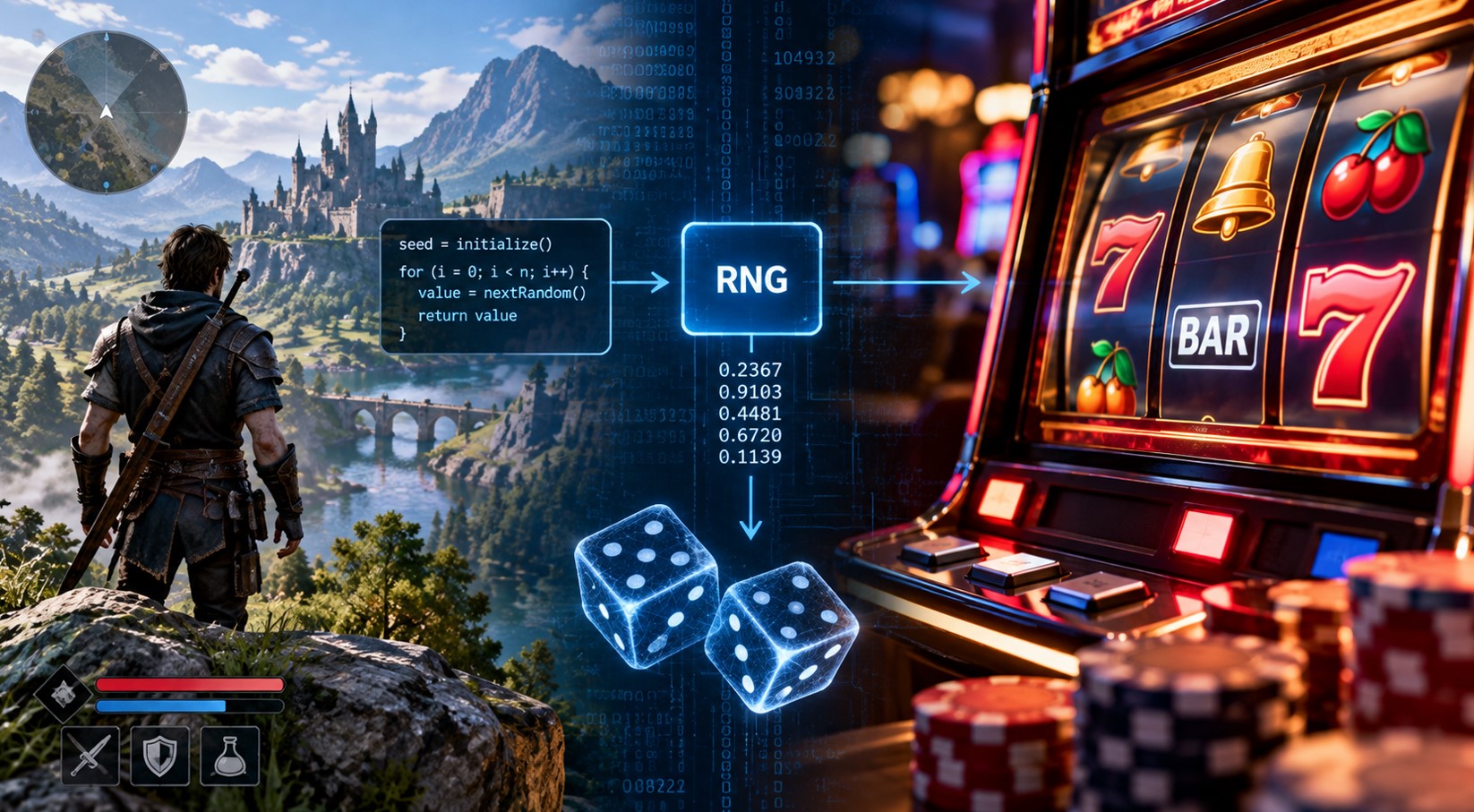
Here’s why it matters. The random number generator is the moral center of the whole product – no matter if it is a mobile game title or an AAA video game. Get it wrong and you’re either cheating players or handing them a way to cheat you. Neither ends well.
CSPRNG, Not Math.random()
Your first instinct might be to grab whatever random function ships with the language. Don’t. Standard pseudo-random functions are predictable enough that a determined person can reconstruct the sequence. You want a cryptographically secure generator – something seeded from real entropy and impossible to run backward.
The generator also has to live server-side. If the outcome is decided on the player’s machine, someone will find it. The client only asks; the server decides and remembers.
Provably Fair, When You Want Trust
Crypto-facing operators often go a step further with provably fair systems, where a hashed server seed plus a client seed lets players verify each result after the fact. It’s extra plumbing, but it turns “trust us” into “check it yourself,” which players love.
“The moment a player believes the reels are honest, half your retention problem is solved. The other half is just whether the game is fun.” – one of our senior devs, after a very long certification week.
The Math Behind the Fun
Every casino game is a spreadsheet in disguise. Before a single sprite gets drawn, someone models the whole thing in numbers.
| Term | What it means | Why it matters |
|---|---|---|
| RTP | Return to player, the long-run payout percentage | Sets the house edge and is legally regulated |
| Volatility | How wild the swings are | Shapes the emotional ride and who the game is for |
| Hit frequency | How often does any win land? | Keeps players engaged between big moments |
A 96% RTP slot doesn’t hand back 96 cents on every dollar – it settles there across millions of spins. Your paytable, reel strips, and bonus triggers all have to add up to that target exactly. Miss it, and the lab sends the build right back.
This is where a math-minded developer earns their keep. You’re balancing probability distributions so the game feels generous in the moment while staying honest over the long run. It’s part statistics, part psychology.
Front-end: Making a Spin Feel Alive
The math can be flawless and the game can still flop if the spin feels dead. Presentation is doing heavy emotional lifting here.
What separates a cheap-feeling slot from a satisfying one usually comes down to timing and feedback:
- Anticipation – reels slowing down just before a near-win, teasing the player.
- Weight – symbols that land with a little bounce, not a flat stop.
- Sound layering – wins that build audibly as they stack.
- Frame budget – holding a steady 60fps even on a mid-range phone.
Tools like Pixi.js, Phaser, and Spine handle the rendering and skeletal animation. But the taste – knowing when to hold a beat before revealing a bonus – that’s craft, not library.

The Backend Nobody Sees
If the front-end is the show, the backend is the vault. And it has to behave like one.
A few things that are non-negotiable on the server side:
- Atomic transactions – a bet debits and a win credits as one indivisible operation, or not at all.
- Idempotency – a dropped connection and a retried request must never double-charge or double-pay.
- Full audit trails – every outcome logged with enough detail to reconstruct a disputed round.
- Concurrency that holds – thousands of simultaneous spins without a race condition leaking money.
This is where a lot of otherwise-good game developers hit a wall. Writing game logic is one skill; writing money-handling infrastructure that never loses a cent under load is a different one entirely. Both have to live in the same product.
| Area | Share of engineering time | Notes |
|---|---|---|
| Math model & RNG | ~20% | Small in code, huge in consequence |
| Front-end & animation | ~35% | Where players judge you |
| Backend & wallet | ~30% | Where regulators judge you |
| Testing & certification | ~15% | Never as little as you hope |
Passing the Testing Labs
Before a real-money game goes live in a regulated market, an independent lab usually has to sign off on it. Names like GLI and eCOGRA come up a lot. They’ll pull your RNG apart, verify the RTP through millions of simulated rounds, and check that the game behaves the same under stress as it does in a demo.
Build for this from day one. Retrofitting audit logs and deterministic replay into a finished game is miserable – we’ve done it, and we don’t recommend it. Bake the paper trail in while the code is young.
A Few Habits that Saved Us Headaches
- Keep every outcome decision on the server. No exceptions, ever.
- Write the math model and the game separately, so you can re-verify RTP without touching the UI.
- Log first, animate second – the record of what happened matters more than the celebration of it.
- Test with weird network conditions early, because real players will find every one of them.
None of this is beyond a motivated developer. It’s just a wider set of skills than most game projects ask for – math, graphics, backend rigor, and a compliance mindset, all in one build. Get comfortable with that spread and you’re most of the way there.
If this saved you a bit of trial and error, we’d appreciate a share across your socials and a spot in your bookmarks – it genuinely helps our small team keep publishing this kind of thing. If you’re working on something in this space and want a hand, the YaninaGames team is open to creative and commercial collaboration. Reach out directly and let’s talk.