What Makes Deckbuilder Games So Addictive?
I have spent more time than I would like to acknowledge playing digital cards at 2 AM. And honestly? I’m not even sorry about it. Deckbuilder games are unlike the typical card game. It is not a game; you are born with the cards that fate hands you, but you are making your deck as you play. Every choice matters. Each card added or missed will define your run. It is as though you made your own weapon in the middle of the fight, and when it functions? Chef’s kiss.
The genre exploded this past decade. We went from a handful of indie experiments to full-blown AAA studios throwing their hats in the ring. Some flopped hard. Others became the kind of games you boot up for “just one run,” and suddenly it’s 4 AM, and you’ve got work in three hours. Even a modest Filipino card game can get to the top of Steam and become a hit among deckbuilder fans. The genre is on the rise, for sure; the largest Tongits ng Gamezone resource reviews dozens of such games, and the count goes on and on.
Why This Decade Changed Everything?
Something clicked around 2019. Slay the Spire proved that roguelike elements and deckbuilding weren’t just compatible – they were meant for each other. Like peanut butter meeting chocolate, except instead of a candy bar, you get an unhealthy obsession with optimizing turn sequences.
But here’s the thing. Not every game that slaps “deckbuilder” on its Steam tags actually gets it right. The best ones understand that variety isn’t just about having 300 cards. It’s about meaningful choices that make you second-guess yourself at 3 AM.
The Titans That Shaped Deckbuilder Games
Let me splinter the big-hitters. They are not just good games, but the ones that caused other developers to say wait, we can do that.
Slay the Spire (2019)
Well, this is where I am beginning. Deal with it. This game borrowed the roguelike formula and combined it with deckbuilding to produce a game with a thousand imitators. You choose one of four characters, all of which play vastly differently, and ascend a spire of bizarre strangers attempting to kill you. The genius? The bigger your deck is, the less useful it gets for doing other things. You cannot just pick up all the shiny cards and grab them; you must think. Really think. And when you nail that brilliant Catalyst poison construction with The Silent, you feel like a tactical genius.
Monster Train (2020)
In case Slay the Spire can be described as chess, Monster Train is 4D chess on a moving train. Literally. You are protecting a train that has more than one story, and the plan becomes crazy. Two clan system implies hybrid constructions that are not expected to work yet happen to do so. I have witnessed a build that, on paper, appeared to be a complete piece of garbage, turning out to be an unstoppable killing machine at the last boss. The game is very generous with experimentation in the sense that you will be eager to play it again.
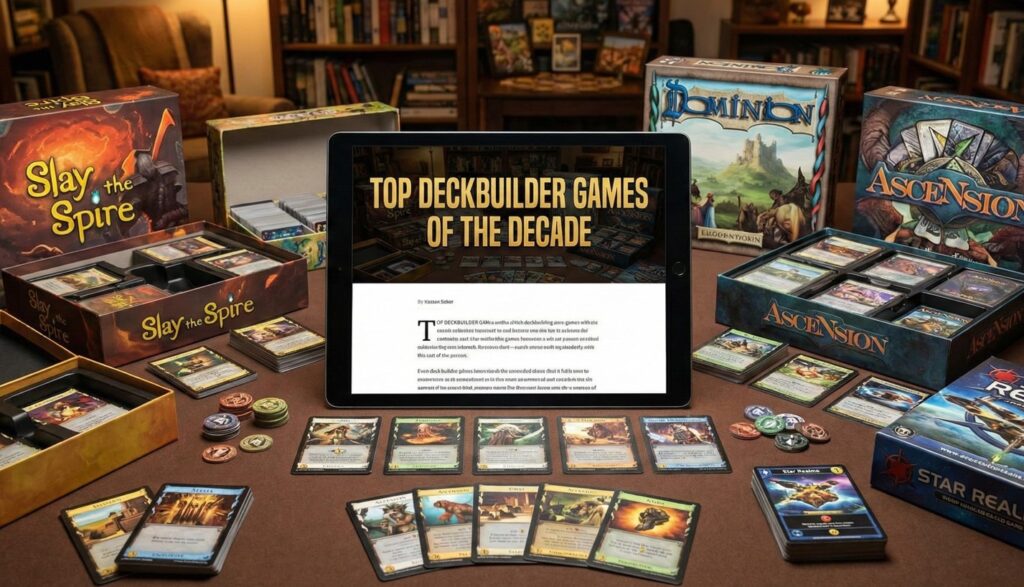
Inscryption (2021)
This one’s weird. Like, properly weird. Daniel Mullins made the deckbuilding games genre and put it in a psychological horror frame, escape room puzzles, and a meta-narrative that will play with your head. You are now sitting opposite a shabby trader in an obscure brothel and the situation becomes even weirder. There is not much to tell unless you have played it. Whatever you are reading, stop reading and experience it blind. Trust me.
The Dark Horse Entries That Deserve More Love
Griftlands (2021)
Klei Entertainment does not miss, and this is evidence. Two different types of decks are combat and negotiation. Yeah, you read that right. Arguing your way out of fights is easy, and the bargaining wars are equally stressful as stabbing someone. Three characters have totally different stories. Not only the same plot, different cards, but really different stories that make you play the game differently.
Roguebook (2021)
This was made by Richard Garfield. The Magic: The Gathering guy? He is not ignorant about cards. The twist in this case is the hex-based exploration and the dual character combinations. And you are not creating a single deck; you are creating synergy between two heroes. The art style slaps, too. Hand-drawn style, which makes each card look like a small masterpiece.
Breaking Down What Makes These Deckbuilder Games Tick
| Game Feature | Why It Matters | Examples Done Right |
| Card Synergy Depth | Obvious combos are boring; hidden synergies keep you exploring | Slay the Spire’s Corruption + Dead Branch, Monster Train’s clan mixing |
| Run Variety | Same cards every run? That’s just memorization with extra steps | Griftlands’ branching story paths, Inscryption’s act structure |
| Risk vs Reward | Safe choices should feel boring; dangerous choices should tempt you | Ring of Pain’s skip mechanics, Fights in Tight Spaces’ positioning risks |
| Progression Systems | Meta-progression that doesn’t trivialize the challenge | Monster Train’s covenant system, Slay the Spire’s ascension levels |
You know what’s funny? The games that tried to do everything usually ended up doing nothing particularly well. The best deckbuilder games this decade understood their core loop and perfected it rather than drowning players in feature bloat.
The Indie Darlings That Punched Above Their Weight
We can discuss the smaller studios that have emerged out of thin air and made us all look like fools because we had a lack of faith in them.
Fights in Tight Spaces (2021)
Imagine that John Wick plays with cards. Every card is a move – punch, kick, dodge, and throw. The catch? You are battling in tight areas where maneuvering is vital compared to your deck setup. It is a spatial combo of chess and deckbuilding games, and somehow it works. It does not get old when you see your well-thought-out combo play out as your character pummels five men in a phone booth.
Vault of the Void (2022)
It flew under so many radars that it is criminal. Void energy alters all that is concerned with resource management. You are not using mana to refresh every turn; you are hoarding energy, using it tactically, and making decisions that will cause the effects to be felt across whole encounters. There are four actually different classes. Not merely various cards, but various basic rules of their playing.
The Deckbuilder Games that Took Risks Experimentally
Ring of Pain (2020)
Card game in a carousel? Sounds terrible on paper. Practices very well. You are playing a set of cards, have no option of what to do but what is immediately before you, and a decision made may be the final one. The minimalism style is invigorating. No deck bloat, no twenty-minute turns. This is pure distillation decision-making.
Wildfrost (2023)
Cute art style conceals sadistic challenge. The charm system provides cards with continuous upgrades, which can be considered precious. And the companion mechanics? You are not dealing with cards; you are dealing with relations among characters. Lost several deckbuilder games due to being overly attached to a certain companion and making poor strategic decisions to keep them alive. No regrets.
Across the Obelisk (2023)
Four-player cooperative deckbuilding? Sounds chaotic. It is chaotic. It’s also brilliant. Coordinating the building with the friends, quarrelling about who deserves which card rewards, seeing the build of the other person with his/her trust me bro work working out, that is the magic. The game does not simply increase the difficulty level for more players. It reinvents strategies. What is successful in single-player is fatal in teamwork.
Modern Takes That Pushed the Genre Forward
| Innovation Category | What Changed | Stand-Out Example |
| Narrative Integration | Story became part of mechanics, not just window dressing | Inscryption’s meta-narrative, Griftlands’ negotiation deck |
| Hybrid Genres | Deckbuilding mixed with other game types | Fights in Tight Spaces (tactics), Nowhere Prophet (strategy) |
| Social Elements | Multiplayer and competitive modes | Across the Obelisk’s co-op, Legends of Runeterra’s PvP |
| Accessibility Options | Making complex games approachable without dumbing down | Monster Train’s tutorial, Vault of the Void’s difficulty scaling |
The Genre-Benders Nobody Saw Coming
Astrea: Six-Sided Oracle (2023)
Not cards, but the DNA of a deckbuilding is pure. You are playing with the dice, rolling dice pools, and generating the same calculated risks that deckbuilder fans love to roll. Just with more cubes. System of purification is masterpieces – it is as good as playing with bad dice out of your pool, as it is playing with Strikes out of your deck in Slay the Spire.
Balatro (2024)
Classic poker hands encounter the mechanics of roguelike deckbuilding games in Balatro. Sounds simple. Absolutely isn’t. The Joker card game establishes combos that are not supposed to exist based on poker rules, and here we are, constructing Full Houses that are multiplied by ridiculous numbers. This one proves that innovation does not necessarily imply reinventing the wheel. It is sometimes about stealing and bending what is known.
Lessons on Strategy from Deckbuilder Games
Here is where the interesting part comes in. This decade did not have only fun deckbuilder games, but it also taught us a lot about making decisions that would be invaluable outside the game:
- Short-term pain, long-term gain. Not playing powerful cards because they do not fit your physique? Delayed gratification at work.
- Adaptation over perfection. The perfect deck is adapted according to what the game throws your way. Rigidity gets you killed.
- Under pressure resource management. Every gold coin, every removal opportunity, every shop visit counts. Waste nothing.
However, this is what makes the difference between good players and great players: everyone knows how to violate his own rules. The build guide that you followed? There are also cases when you need to throw it out the window since RNG presented you with absolutely different choices.
The Development of Challenge and Repeatability
In the early deckbuilder games, there was one difficulty: hard. The recent ten years were subtle:
The Ascension system (levels 1-20) of Slay the Spire was recognized as the gold standard. The levels introduce new modifiers that completely change the way you play the game. You are playing a different game than Ascension 0 by Ascension 20.
Monster Train went even further with Covenants. The twenty-five degrees of increasing catastrophe. However, they are modular, you can look right in to what each tier contributes and this openness makes the challenge feel just as it should be even when it hurts.
The Accessibility Question
This is one of the things that are not mentioned as much, but should be made available to play without making the game easy:
- Non-hand-holding smart tutorials. Monster Train has a tutorial that does not resemble reading a bunch of text on the wall.
- Difficulty options that are not only easy mode. The challenge system in Vault of the Void allows you to set the difficulty to exactly what you want, more difficult.
- Visual clarity. Fights in Tight Spaces makes everything color-coded to know what is dangerous immediately.
The deckbuilder games that nailed this knew something important: being accessible does not mean making games easier. It is also about eliminating obstacles to knowledge without losing the strategic richness.
Where the Genre Is Heading?
Considering the releases of 2024 and future titles, trends are observed.
Genres are becoming faster. We have deckbuilders combined with city-building, with 4X strategy, with dating sims (yes, really). Certain combinations are more successful than others, and the trial and error are good.
The multiplayer is becoming a norm and not an experiment. Competitive deckbuilding was a fad; today it is the norm. Co-op modes are emerging all over.
And the production values? We have moved past the pixel art passion projects with a full voice acting and cinematic presentation. It does not mean that either of them is better than the other, but the range of budgets has increased significantly.
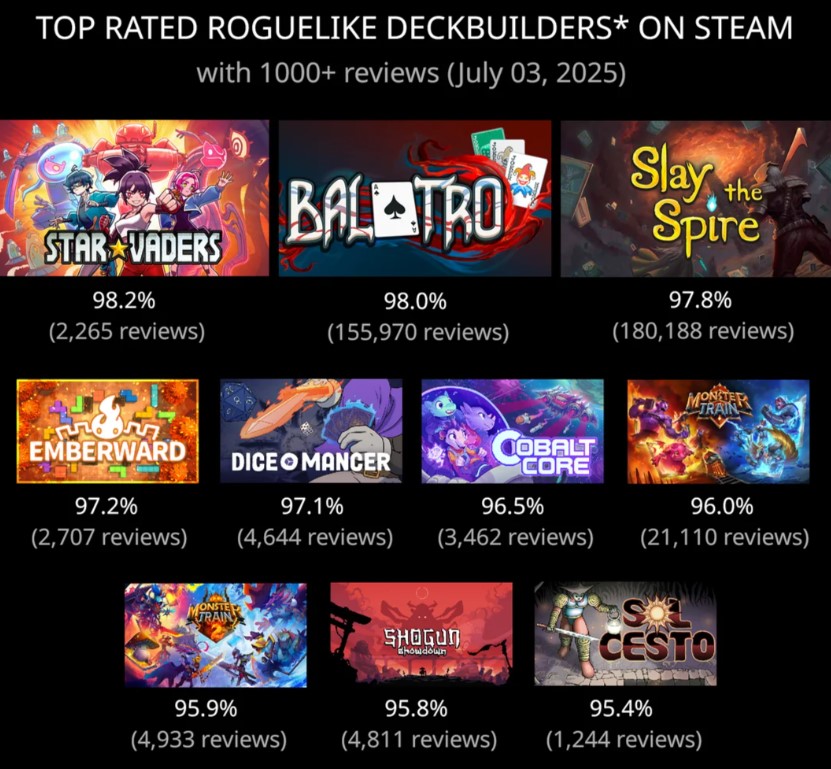
The Mobile Migration
Can’t ignore mobile anymore. What began as fumbling ports were turned into created-to-be-mobile experiences.
The series Meteorfall demonstrated the effectiveness of touch controls. The mobile-first does not imply compromised, as demonstrated in Legends of Runeterra. The difference between PC and mobile deckbuilder games is rapidly shrinking.
Even though we should admit it – there are still some of us who use a mouse to click a card. Old habits die hard.
FAQ
So what are deckbuilder games?
A game in which you have a deck of cards with a simple set of cards and you add, remove or upgrade cards throughout the game. In contrast to the classic card games, in which you assemble your deck and then start playing, in deckbuilder games deckbuilding is a part of the game loop.
Do deckbuilder games require much learning?
The vast majority of the modern ones have well-developed tutorials and begin with simple mechanics before progressing to more complicated ones. Such games as Monster Train or Slay the Spire are actually very easy to get into. It has a high skill ceiling, but not a skill floor.
Would I be able to play these games even though I am not a card game person?
Absolutely. A lot of deckbuilder games this decade would attract strategy players, RPG players, and roguelike players who have never played a card game. The cards merely deliver the system of strategic decisions.
What deckbuilder game is the best one to begin with?
The best point of entry is Slay the Spire. It is clear, clean, and educates you on the basics of genres that can be applied to all other things. And, it is always available somewhere at a discount.
Are these games time consuming games?
The duration of runs is either 30 minutes to 2 hours, based on the game. The majority of them are one more run sessions as opposed to huge time investments. You may well find yourself spending 8 hours doing one more 8 times.
Are deckbuilder games single-player?
Not anymore. Co-op is provided in Across the Obelisk, PvP in Legends of Runeterra, and multiplayer modes in a variety of others. Its genre began as a solo-based genre, but has since expanded extensively.
What is replayable about a deckbuilder game?
Procedural generation, multiplayer characters who play uniquely, unlockable cards and items, difficulty modifiers, and synergies you make by experimentation. The most enjoyable games are hundreds of hours of content due to variation as opposed to repetition.
Wrapping This Up
The last decade has turned deckbuilder games into a dominant presence in the game industry instead of a niche subgenre. We did masterpieces, we did experimental failures, we did games that overturned what can be done with cards and strategy. And the best part? We’re nowhere near done. New releases, new ideas, new ways of shuffling virtual cards and feeling smart about it are released every month.
Give a quick boost to YaninaGames by sharing this post everywhere on social media and saving it to your bookmarks – it’s a simple action that really helps our small team! Every like, repost, and bookmark keeps the momentum going for more exciting projects. If you have ideas for creative teamwork, custom development, or commercial collaboration, don’t hesitate – just drop a message straight to the YaninaGames team.