
Balance Gaming with Academic Studies
It’s 1 am. You have just finished a crazy three-hour gaming session, and then, boom, there is that blinking cursor on a white Word document. In eight hours, you have to submit your essay on the socio-economic causes of the French Revolution. Panic, then the old feeling of guilt.
Since time immemorial, individuals have believed that there is a war between gaming and school. That it or the highway mentality is fake, and it only contributes to burnout. You fail a test and feel guilty of the game you were zoned into, and thus, you are in the same mess.
However, it does not have to be so. The abilities you level to the max in games, such as strategy, planning, and perseverance, you can multiply them in your studies by two.
We are not asking you to play less. We are here to demonstrate to you how to become slicker with a structured mind. Introducing The G.R.I.N.D. Method is your new study-time companion, especially if you are a passionate fan of multiplayer video games.
G = Goal Setting
It is important to have clear and long-term objectives. You would not start a large project without having a primary objective, and you should not do the same thing with your semester.
Passing the class must be your first priority. That is your map, all your big tests, assignments, and daily tasks you must kill.

Consider the syllabus as a project plan. Divide the semester into smaller pieces (weeks). Next, divide each week into daily activities – such as:
- Read Ch. 5, 10 math problems
- Find 3 sources to write the history paper.
When a large task, such as a 20-page paper, seems monstrous, divide it into parts. Identify your sub-tasks: research, outline, draft. It is sometimes useful to see how other people went about it. For academic tasks, this might mean using a resource like PaperWriter to help brainstorm outlines or check sources, breaking a massive project into manageable, smaller steps.
Use a planner or a to-do app (like Habitica, Todoist, or Notion) as your official task list. The psychological satisfaction of checking off a task is a powerful motivator.
R = Routines & Rules
Numerous systems flourish under a binding structure that is predictable. Make those rules a part of your studying process.
Discipline is not about hyping; it is about the system you establish. Your regulations are your order. Here are a few rules to build the routine of balance:
- Have a plain, solid rule: “I will complete one academic activity before I enter into a game. You can read more about the reasons here. Even 20 minutes of reading creates momentum and maintains procrastination at bay”.
- Craft powerful rules. “When it is a weekday, I will study first, and then I will play the game. When I have an exam in 48 hours, I will not play long, demanding games. When I have finished my essay draft, I will reward myself with some game time”.
- Study blocks. Whether you are working in a study group or alone, schedule regular study appointments. Use them as non-negotiable downtime. Guard that time. Assign it equal importance to any other planned obligation.
I = Intervals
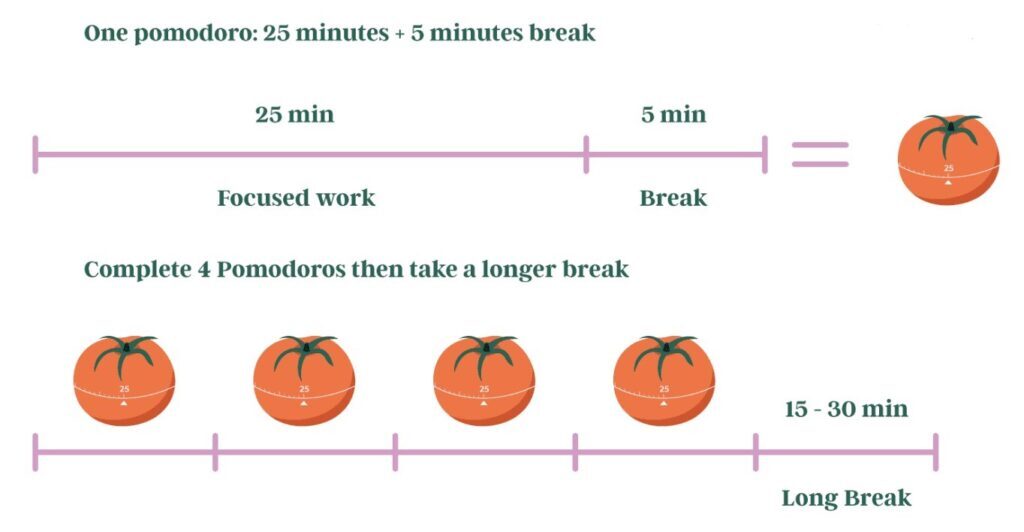
This is the big-hit center of the technique. The Pomodoro Technique is a time-management trick based on concentrated sessions and short pauses. It is aware that our brains prefer crispy chunks, not long-distance low-energy workouts:
- The research sprint. Set a timer to 45 minutes. (A 25-minute Pomodoro is good, though 45 minutes can help to achieve deeper academic results). No cell phone, no Discord notifications, no game launchers. Just 100% focus on school.
- The reward. After the timer is clicked off, begin a 15-minute timer. That’s your earned break. Ensure that there is a hard stop to the activity.
- Rinse and repeat. Once the 15-minute cut is done, get back into the next 45-minute sprint.
This system’s loop feeds itself. Learning is not an obstacle to playing games; it is the reward of your grind. It is extremely easy and sustainable to start your session. You will be amazed at the amount of work you complete within three or four cycles.
N = Non-Negotiables
You are quite good at distinguishing between a minor adjustment and a challenge. You do not waste all your fuel on low-stakes stuff. You leave it to the mission that counts. This is how to balance gaming and academic time periods.
Why then do students spend hours of their lives adjusting a PowerPoint title slide (2% of the grade) and miss the 40% final exam? They lack the priority game:
- Prioritize your to-do list. Each week, take a peek at your planner and choose the tasks at the top. What do you consider the most valuable? What are the most difficult deadlines? Spend that energy on your most productive, high-focus study session of the day.
- Trade-off. You might need to forego a casual game night to study for a midterm. Not losing, just an ROI move of spending time and energy where it counts. Stop wasting yourself on low-priority stuff.
D = Decompression
The final section is concerning your attitude. In case you have been following the G.R.I.N.D. approach, then your gaming is not procrastination. It’s earned chill. That’s the big mindset shift. Guilt? Useless. It will not assist you in studying, and it spoils your game:
- Have a reward to look forward to. Have a grand gaming event, e.g,. a Friday night gaming session with your friends, as the final, huge reward for finishing your weekly chores.
- Kill it. When you are finished with studying, kill it. Close the books, shut the laptop, walk out.
- Play without guilt. When you are playing, get into it 100%.
This method makes you shiver, have fun, and actually have a refreshing gaming experience. It also enhances the effectiveness of the study since you are not struggling to study when your brain is not in the study.
Conclusion: The Strategy To Balance Gaming and Academic Studies
You do not have to decide whether you want to be a rock-star student or a gamer. Actually, your concentration, plan, and determination in difficult assignments are an enormous academic advantage.
These two worlds are not only compatible, as demonstrated by The G.R.I.N.D. Method: Goals, Routines, Intervals, Non-Negotiables, Decompression, but a super-combo. Apply it to school, and you can complete work quicker, leaving you with more time to legitimately game, without any guilt. Balance gaming and academic gaming with the G.R.I.N.D. method, but without grinding.
Stop making school something you hate. Begin to see it as a long-term, rewarding project. What is your favorite 15-minute reward game when you need to take a study break? You may leave your answer to this question when sharing the post online, across your social media. Make sure to add YaninaGames’s site to your bookmarks if you like what we do. Also, you can contact us by email and ask for the collaboration.