The Legend of Zelda Ocarina of Time Remake, Walked Through Area by Area
It arrives on November 5, which is eighteen days away, and the preview embargo has done something unusually helpful: journalists were given five specific areas to play, and between them they have produced a fairly precise picture of what has changed. Those areas are Kokiri Forest, the first half of the Deku Tree, Hyrule Field, Castle Town, and the entire Forest Temple as adult Link. That is a good spread – one starting zone, one child dungeon, the overworld, the hub town and one adult dungeon.
So rather than a feature list, let’s take the walk. Five stops, what changed at each, and what has quietly been taken out along the way.
First, the systems that apply everywhere, because they change how all five feel.
| System | The Original | The Remake |
|---|---|---|
| Jumping | Automatic, based on where you ran off | A dedicated button you press |
| Camera | Locked | Free control |
| Item switching | Menu-driven | An item bar, in the style of Breath of the Wild |
| Ranged aiming | C-buttons | ZR, with gyro aiming for Slingshot and Hero’s Bow |
| Dialogue | Text and grunts | Fully voiced cutscenes |
| Time of day | Outdoors only | Passes everywhere, including towns and buildings |
| Tracking | Nothing | A “Threads of Time” log for story and objectives |
| Ocarina | Button inputs | Button inputs, plus optional playing through the Switch 2 microphone |
That jump button deserves an early mention because it changes a twenty-eight-year-old frustration. In 1998, Link jumped when the ground ran out, which meant a missed platform was often a question of approach angle rather than skill. Pressing a button means a missed jump is now your fault, which is oddly more satisfying. You can also jump from anywhere, including straight onto a vine wall to start climbing.
Stop One: Kokiri Forest and the Great Deku Tree
The opening hour is where the art style argument gets settled for each player individually, and it is worth being straight about: reception has been split. What previews describe is a sharp-edged, figurine-like look that keeps the exaggerated character proportions rather than pushing toward realism. Link’s tunic and hat carry far richer patterns and textures. Kokiri Forest reads as more overgrown, and both the Great Deku Tree and, later, the Forest Temple feel darker and more decayed than their N64 versions.
Real-time lighting is doing the heavy lifting, and the detail preview writers keep returning to is that Navi casts light. A fairy that actually illuminates the space around her is a small thing that changes the mood of every dark room in the game.
The voice acting lands here first, and the early verdicts are specific:
- The Great Deku Tree sounds ancient, weary and frail, which is the correct read of that character.
- Saria’s farewell has been singled out as carrying real emotional weight.
- Navi is the adjustment. She now sounds closer to a teenager or young woman rather than the childlike sprite players have in their heads, and more than one preview flagged that it will take some adjusting.
Not everyone is sold on the look. Some reactions have praised the environmental detail while finding the character models unsettling, with unflattering comparisons made to fan remakes. That argument is not going to resolve before launch.
Stop Two: Hyrule Field
The honest stop, and the one where expectations should be managed.
Hyrule Field is still mostly empty. It has visibly more texture, and previews note that ruined buildings now dot the landscape and that the space feels larger. But it remains what it always was – the connective tissue between Zora’s Domain, Death Mountain and everywhere else, rather than a destination.
If you were hoping for a Breath of the Wild treatment, with shrines and climbable towers scattered across the plain, that is not what has been built. The remake is a remake. Those ruined structures are atmosphere and landmarks rather than content.
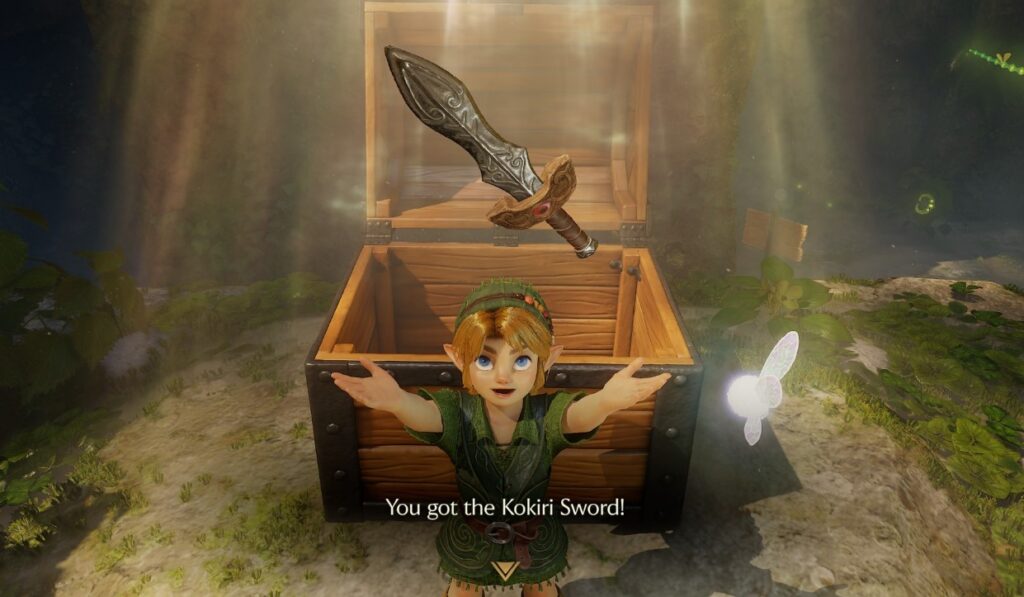
What they do accomplish is navigation. A flat green expanse with nothing on it is genuinely hard to orient yourself in, and scattered ruins give you something to steer by, which matters more now that the camera is free rather than locked.
The Legend of Zelda Ocarina of Time Remake Changes Most in Castle Town
This is the stop with the real additions, and the one worth getting excited about.
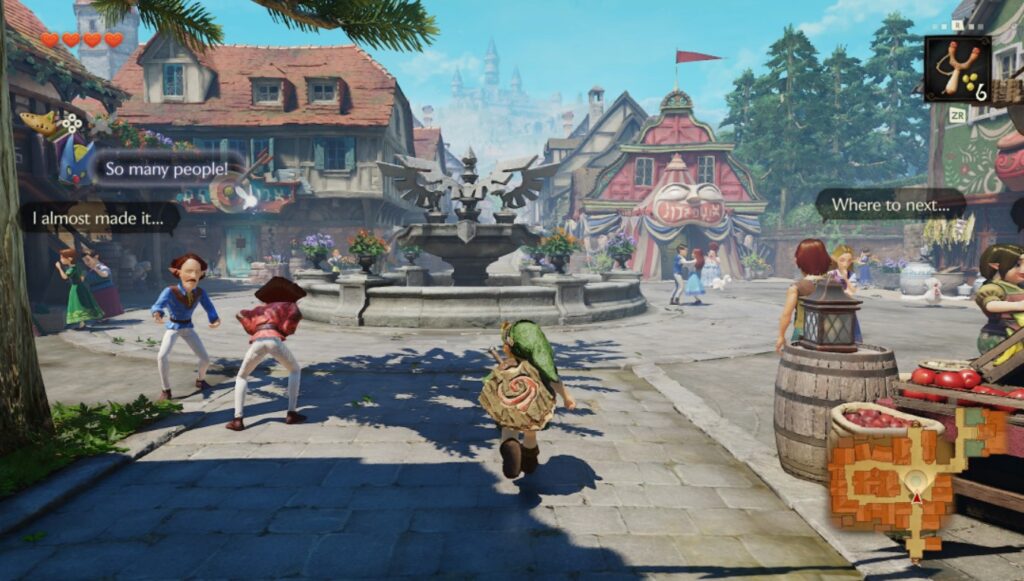
Hyrule Castle Town is now a fully explorable area, and previews consistently describe it as the biggest transformation in everything they played. The comparison being drawn is to Wind Waker’s Windfall Island – not enormous by modern standards, but genuinely inhabited.
What has been added:
- New backstreets, which did not exist in the 1998 layout.
- New characters, including a bearded man who helps you locate another NPC.
- Better NPC animation, with townsfolk behaving playfully rather than shuffling on a loop.
- More detailed and active shops and buildings, so the town reads as a working place.
- Time passing indoors, which means the town has a genuine daily rhythm rather than a frozen interior state.
And then there is the thing people came here for.
A new side quest in Castle Town. The potion shop attendant is in a panic about a bug and asks Link for an empty bottle to catch it. Hand one over and he lets you keep the bottle – now filled with a red healing potion.
That is a small quest, and its smallness is the point. It is exactly the register of Ocarina’s original side content: a stranger with a problem, a trivial favour, a permanent reward. What is notable is that there is no journal entry or quest log tracking it. You find it, or you don’t.
That design decision tells you something about the remake’s philosophy. Nintendo has added a Threads of Time log for the main story and objectives, and then deliberately left the optional discoveries outside it. New content, old discovery rules.
One more change worth knowing: previews report that NPCs point you toward objectives more clearly than before, which is the kind of gentle guidance a 1998 design badly needed without anyone turning on a waypoint.
It is also worth saying what Castle Town is not. Previews are consistent that it remains modest by the standards of a modern open-world hub – this is a denser, more detailed version of a small medieval market square, not a city. The achievement is that it finally behaves like somewhere people live, which the original never quite managed with its handful of looping townsfolk.
Stop Three: The Forest Temple
The adult dungeon, played in full by at least one outlet, and the place where the subtle work shows.
The layout has been tweaked. Longtime Zelda YouTuber Zeltik’s footage shows minor changes to the Forest Temple’s design, described by those reporting on it as minor but meaningful. Nobody has catalogued every difference yet, and Nintendo has not published a list, so the honest framing is that the dungeon is recognisably itself with adjustments rather than a redesign.
The lighting is the standout. The Forest Temple has always been the atmospheric high point of the original game, and previews single out its new lighting as a clear improvement – which, in a dungeon built on twisted corridors, portrait rooms and a gradually rotating central hall, matters enormously.
The other Forest Temple change is narrative rather than structural: Phantom Ganon is now a recurring character rather than a one-off boss. That is a genuine addition to the story’s shape, and it is the sort of change that suggests the remake is willing to extend things rather than only polish them.
Also noted across previews: the shooting gallery minigame has a harder version, with substantially less time to hit the targets, and difficulty that ramps up more gradually than the original’s did.
What the Ocarina of Time Remake Takes Away?
Short section, because so far there is exactly one confirmed removal and it is a good illustration of the trade.
You can no longer run up the drawbridge chains in Castle Town to reach a hidden rupee. That trick is gone, presumably a casualty of the town being rebuilt as a proper three-dimensional space with new geometry.
Anybody who played the original enough to know that rupee existed will feel that one. It is also, in fairness, the sort of thing that happens whenever a hand-built 1998 environment gets reconstructed – the incidental exploits that lived in the seams of the old geometry do not survive new geometry.
The wider point is worth holding through launch week: a remake this thorough will have more of these. Speedrunners in particular should expect a substantially different route map, since the jump button alone changes what is reachable.
| 1998 Original | 2026 Remake | |
|---|---|---|
| Castle Town | A small hub area | Fully explorable, with new backstreets and characters |
| Side quests | The original set | At least one new one, with no log entry |
| Forest Temple | The classic layout | Minor layout tweaks, substantially better lighting |
| Phantom Ganon | A one-off boss | A recurring character |
| Shooting gallery | One difficulty | A new, harder version |
| Drawbridge chains | Climbable, hidden rupee | Removed |
| Hyrule Field | Empty | Still mostly empty, now with ruins |
The Other Things Shipping Around It
A few details that sit outside the game but shape the launch.
Zelda Notes, through the Nintendo Switch App, brings a map, progress tracking, an ocarina and quizzes as a companion layer. Between that and the in-game Threads of Time log, this is by some distance the most assisted version of Ocarina ever released – which will delight newcomers and irritate purists in roughly equal measure.
The microphone ocarina is optional, and it is the detail most likely to produce a viral clip in launch week. Playing Zelda’s Lullaby by humming into a Switch 2 is a genuinely charming idea.
Zelda-themed Switch 2 hardware and accessories are planned for October 29, a week before the game.
Young Link and Young Zelda amiibo are planned for 2027 and will grant special masks in the game. Worth noting the gap: the amiibo arrive more than a year after the game does.
On the credits, this is Nintendo EPD rather than Grezzo, with Eiji Aonuma and Hidemaro Fujibayashi producing – the same pairing behind Breath of the Wild and Tears of the Kingdom. That is a more significant signal than any single feature. This is not an outsourced port.
FAQ
When does the Ocarina of Time remake come out?
November 5, 2026, exclusively on Nintendo Switch 2.
Are there new side quests?
At least one has been found in previews – a potion shop attendant in Castle Town asks for an empty bottle to catch a bug, then lets you keep the bottle filled with red potion. Notably, it has no quest log entry.
What is the biggest change to the world?
Hyrule Castle Town, which is now fully explorable with new backstreets, new characters and far livelier NPCs, drawing comparisons to Wind Waker.
Have the dungeons changed?
The Forest Temple shows minor layout tweaks in preview footage, along with much improved lighting. Nintendo has not published a full list of changes.
What has been removed?
The confirmed removal so far is the ability to run up the drawbridge chains in Castle Town for a hidden rupee.
How do the controls differ?
A dedicated jump button replaces automatic jumping, the camera is now fully controllable, an item bar handles equipment, and ZR plus gyro handles ranged aiming.
Is it voice-acted?
Yes, this is the first version with fully voiced cutscenes. Navi’s new voice, closer to a young adult than a child, is the change drawing the most comment.
Small, Confident Nudges
What comes through most clearly from the previews is restraint. Nintendo could have rebuilt Hyrule Field into an open world, bolted on a dozen shrines, and shipped something that reviewed as a modern Zelda. Instead the field is still mostly empty, the dungeons are still the dungeons, and the biggest addition is a town with backstreets and a man who wants a bottle for a bug.
That is the correct call. The things being changed are the things that aged badly – the automatic jump, the locked camera, the menu-heavy item switching, a hub town that was a hub in name only. The things being preserved are the things that made it work, right down to leaving the new side quest out of the quest log so you have to actually find it.
Eighteen days from now we will know whether the whole game holds that line or whether the previewed areas were the showcase. For now, the evidence points at a remake made by people who understood which parts were load-bearing.
And somewhere in Castle Town there is a man with a bug problem who nobody will tell you about.
Found this before launch? Share it, bookmark it, and go practise Zelda’s Lullaby – and if creative or commercial collaboration brought you here, the YaninaGames team is one message away.