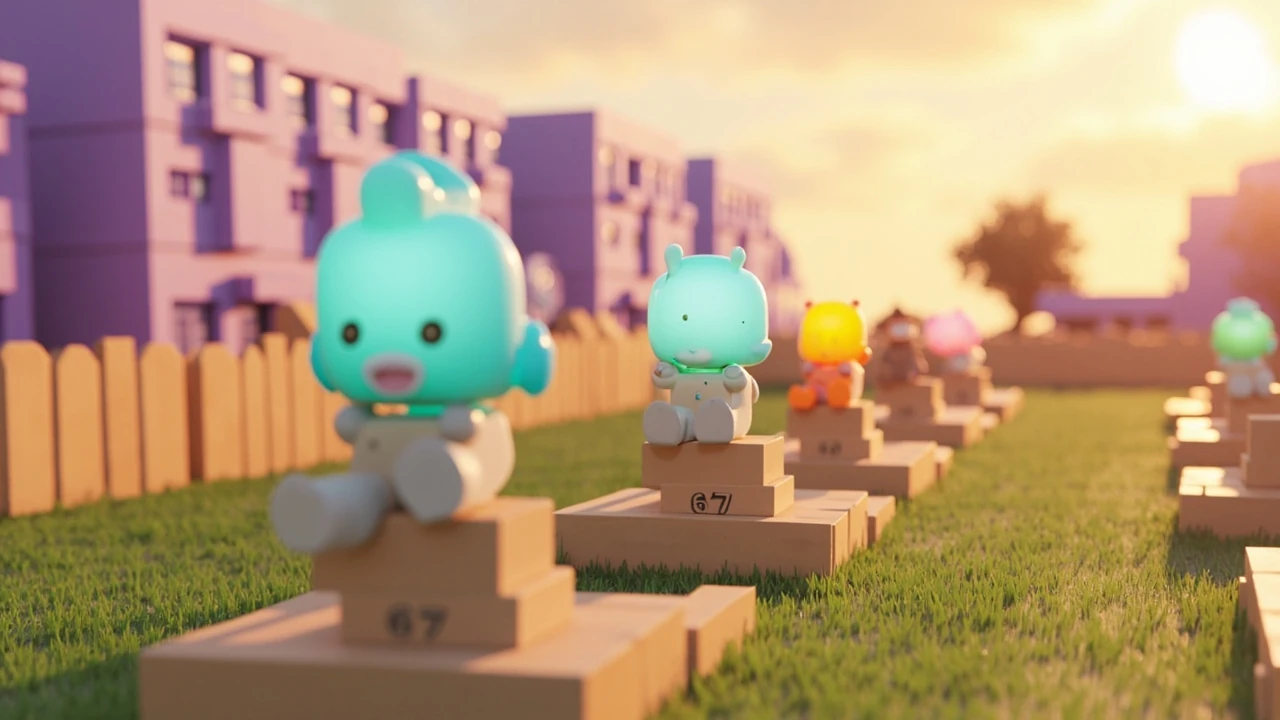
67 steal a brainrot: what the phrase actually means
The query “67 steal a brainrot” looks like noise until you split it into its parts. 67 is a numeric rarity tier inside the Roblox experience Steal a Brainrot, sitting one slot below the rarer 68 and well above the common mascots that fill most starter bases. A “brainrot” is the in-game name for the small meme-shaped unit you collect, and “steal” is the verb that the entire session is built around: walk into a neighbour’s plot, lift a mascot, carry it home, and slot it onto one of your own pedestals. Players search the phrase as a single string because tier 67 has quietly become a community shorthand for the practical upper end of the ladder, rare enough to brag about, common enough to chase in a real play session.
Steal a Brainrot launched on Roblox and grew into a mainstream talking point during 2025, riding alongside Grow a Garden as one of the two breakout experiences of that year. Together, those two titles pushed Roblox’s concurrent user numbers to a level that placed specific Roblox games on the same leaderboards as the largest live-service hits on other platforms, as covered in a major gaming outlet’s reporting on platform scale. The rest of this article stays practical: how the rarity ladder is built, what the 67 slot means inside an economy that includes codes, gifts, and player-to-player trading, and what the rest of us can learn from the way the loop is stitched together.
How Steal a Brainrot is built around the steal verb
The session begins the moment you spawn. Your avatar is dropped into a small starter plot, the camera pans to the nearest neighbour, and a short prompt explains that you can pick up the mascot inside that base and carry it home. There is no combat, no health bar, and no respawn penalty beyond the seconds you lose while hauling a unit. The whole game is a tug-of-war between your ability to walk into a base, lift an object, and leave before another player does the same thing to you.
Under the visible surface, the loop is built from a small number of interacting pieces:
- A lobby hub that holds active sessions and the shared “global” base where the rarest mascots sit behind glass.
- Player plots, which are fenced yards with several pedestals where mascots are placed and which become the physical object of every raid.
- A carrying state in which your avatar holds a mascot above its head and moves at a reduced walking speed.
- A drop-off interaction at your own pedestals, which finalises ownership, pays out the unit’s coin yield, and removes the risk of losing it on the walk back.
The design is the kind of low-friction, high-emotion loop that Roblox audiences respond to. There is almost no tutorial friction, almost no failure state, and almost no waiting. You log in, you steal, you place, you collect, and the next shiny mascot is one map hop away. That single-verb design is also why the game scales so well on phones, tablets, and low-end laptops: a tap to pick up, a tap to drop, and the rest of the moment is just walking.
On a practical level, the simplicity of the loop is what lets the game hold attention across a long session. There is no objective screen telling you that you are falling behind, no daily quest countdown, and no obvious “you lost” state. The only feedback is the visual of a pedestal filling up with a new mascot, and the only loss is the moment another avatar walks out of your yard carrying something you liked. That low-stakes framing turns what could be a stressful competition into something closer to a small, repeatable surprise.
The rarity ladder and where 67 fits
Rarity is the spine of the economy. Every mascot belongs to a tier, and the tier dictates how much it pays out per second, how often it appears in the global base, and how much social weight comes with owning it. The community has settled on a numeric ladder that runs from the most common drops at the bottom to limited one-offs at the top, and tier 67 sits near the upper end of the regular tiers without being the absolute ceiling.
| Tier band | Approximate frequency | Coin payout feel | Player behaviour around it |
|---|---|---|---|
| 1 to 10 | Very common | Trickle of coins | Starter mascots, replaced quickly |
| 11 to 40 | Common | Modest income | Filler pedestals, used as trade bait |
| 41 to 60 | Uncommon | Solid base income | Kept long term, shown off to friends |
| 61 to 66 | Rare | High income | Brag-worthy, often guarded |
| 67 | Rare but achievable | Very high income | The “sweet spot” the community hunts for |
| 68 | Very rare | Top-tier regular income | Status symbol, frequent raid target |
| Event and limited tiers | Time-locked | Variable, often cosmetic | Collected, not necessarily profitable |
Two things are worth noticing about that table. First, the ladder is steep, but not punishing: the gap between 66 and 67 is large enough to feel meaningful, and the gap between 67 and 68 is large enough to feel aspirational. Second, the game does not collapse into a single dominant tier. A player can be content at 60 for a long stretch, ambitious at 67 for a week, and genuinely satisfied at 68 for months. That spread is what makes 67 steal a brainrot a useful search phrase in the first place: it is the tier where most active players are aiming, not the tier only paying users can touch.
Worth noting for new players: the numbers are not a marketing gimmick. They are the language the community uses to compare what they have. When someone in a Discord channel writes “I just pulled a 67,” they are communicating a specific economic position in five characters, and any player who reads the table above knows exactly what that means in terms of payout, raid risk, and trade value. That kind of shared vocabulary is rare in Roblox, and it is one of the reasons the game has held attention past its launch window.
What you actually do with a 67-tier mascot
Once a 67 lands on your base, the session changes shape. The mascot sits on its pedestal, ticks up coins automatically, and turns your plot from a starter yard into a small business. The longer you keep it down, the more coins you bank, which means the cost of losing it to a raid grows over time. That tension between passive income and raid risk is the entire economy in miniature.
There are three reasonable play patterns around a 67 drop, and the game does not push you toward any of them:
- The farmer. You place the 67 in a corner, do not advertise it, and log in twice a day to collect. Income is steady, the mascot is rarely raided because nobody sees it, and the trade-off is boredom.
- The trader. You treat the 67 as a portable asset. It is offered in trade for two or three lower-tier mascots, or for a specific limited event unit that another player is liquidating.
- The show-off. You place the 67 on the most visible pedestal, accept that you will be raided, and reinvest part of the payout into faster defence responses. This is the playstyle that produces most of the clips the game is known for.
All three are valid, and most long-running players move between them as their roster changes. Which one feels best depends on whether you are logging in for income, for social status, or for the kind of small drama that ends up on a short-form video. The point is that the tier itself does not pick a playstyle for you; the loop around the tier does.
One habit that helps across all three patterns: screenshot every trade, every gift, and every successful raid. The game does not keep a deep log of past events, so the only durable record of a 67 passing through your base is whatever you save on your own device. Players who keep a small folder of these screenshots tend to be better at negotiating trades, because they can point to a specific mascot, its glow pattern, and the date they first pulled it.
Codes, gifts, and the rest of the meta
Steal a Brainrot is documented as one of the breakout Roblox experiences of 2025, and the same article describes the standard code pattern that the developer uses to mark milestones. Codes are short strings traded for in-game rewards, published on the developer’s verified social channels, and reshared by community wikis and creators. They tend to drop around specific moments: a new tier being introduced, a player-count record, or a seasonal event. Treat any code list outside the developer’s verified channels as advisory, not authoritative, because expired and invented codes are common in this corner of Roblox.
Gifts are the second pillar of the meta. A gift is a small in-game parcel that can contain coins, a low-tier mascot, or a short boost, and it appears on your pad at random intervals. The gift economy exists as a generosity mechanic, as a soft retention loop, and as a way to let free-to-play players close the gap with paying players without breaking the rarity ladder. From a design perspective, gifts are interesting because they introduce a small amount of variance into an otherwise deterministic economy. A player who plays for thirty minutes a day can still receive a 67 through a gift during a special event, even if they would never grind one out of the global base.
| Mechanic | What it gives the player | Why it exists in the design | Risk if overused |
|---|---|---|---|
| Codes | Small bundles of coins or limited mascots | Drives follows on official channels | Devalues grind if handed out too often |
| Gifts | Surprise parcels with random contents | Adds variance, helps free-to-play | Can dilute the rarity ladder |
| Trading | Player-to-player swaps, no Robux middle layer | Builds a social graph around the game | Encourages alt accounts and scams |
| Rebirth or reset currencies | Optional long-term progression layer | Adds a second axis beyond raw income | Confusing for new players if not signposted |
Trading sits in the same neighbourhood. The community treats high-tier mascots as a barter currency, and the closer a unit is to 67 or above, the more liquid it tends to be. This informal market is what makes a 67 drop feel different from a 64: both are rare, but 67 has enough volume and recognition that you can find a counterparty quickly if you decide to flip it for something you would rather keep.
There is a small but important distinction between the in-game trade and the off-platform trade. Inside the session, the swap is mediated by the game’s own UI, which reduces the risk of one side walking away with the mascot before the other side confirms. Outside the session, the swap happens in Discord servers, Roblox DMs, or community hubs, and the only protection is the trust between the two accounts. That is why most long-running players keep high-tier trades inside the game when they can, and reserve the off-platform chat for low-stakes swaps and negotiation.
Why “67” became a search term on its own
Two forces made the number travel. First, content creators frame their best finds as “I finally got a 67,” which compresses an entire sentence of explanation into two characters plus a mascot name. The second force is algorithmic: short, numeric, high-traffic phrases get pulled into recommended searches and autocomplete boxes quickly, and once “67 steal a brainrot” started showing up in suggestions, it became a self-reinforcing loop. New players who had never seen a tier list typed the phrase, found pages that explained it, and used the same phrase in their own clips, which fed the cycle again.
For developers reading this, the takeaway is that a single rarity tier can carry as much brand weight as a named character. Steal a Brainrot did not need a marketing campaign around the number; the players did that work because the tier mattered inside the game. If you are designing a similar loop, the lesson is that rarity needs a public face, and a number is one of the cheapest faces you can give it.
Search behaviour around the phrase also tells you something about how Roblox audiences research the games they play. Unlike traditional PC or console titles, where a player might read a Steam page or a Polygon review, a Roblox player often searches the exact number they saw in a clip and lands on a page that explains the tier system in plain language. That is why pages about 67 steal a brainrot tend to be read in under three minutes and bounced quickly: the reader wants the answer to one specific question, and the rest of the article is decoration.
Roblox scale and the context behind the search
It is hard to explain why so many people type “67 steal a brainrot” without acknowledging the platform underneath. Roblox has been one of the most consistent growth stories in interactive entertainment, and Steal a Brainrot sits inside a small group of experiences that pulled in audiences normally associated with Steam. As additional context, GamesRadar+ reported on platform scale during the same period, and two Roblox titles were responsible for the bulk of the surge. That kind of scale is the reason a niche tier like 67 is searchable at all: there are enough players hunting it to make the phrase a real query on its own.
There is a secondary effect to the platform growth, and it is worth naming. When a single Roblox experience pulls tens of millions of concurrent users, the social media algorithms that surface clips and search suggestions treat it like any other mainstream entertainment release. That lifts niche terms like “67 steal a brainrot” into the same autocomplete space as the names of well-known Steam titles, which means the audience searching for the tier is no longer only the players already inside the game. Curious outsiders, parents, and adjacent gaming audiences now land on the same pages, and those readers are part of why the phrase keeps growing.
What 67 steal a brainrot teaches a game developer
Even if you never intend to ship a Roblox experience, the design of Steal a Brainrot offers concrete lessons that transfer to other projects.
One verb is enough to anchor a session. There is no combat system, no quest log, and no dialogue tree. The entire game is a single verb, “steal,” and the design wraps enough around that verb to keep players engaged for hours. When you are scoping a new project, ask whether one verb can carry the first prototype, and resist the urge to bolt on extra systems until that verb has been pressure-tested.
Rarity needs a public, memorable vocabulary. The numeric ladder, complete with a single anchor point that the community can talk about, is what gives players a shared language. Without a tier system, every mascot would just be a thing, and conversations about the game would have nothing to point at. The same logic applies to cosmetics, weapon classes, or building pieces in other genres: if players cannot name what they have, they cannot flex it.
Thefts are features, not bugs. Losing a mascot to another player is the most memorable moment in the game, and the developers build around that fact instead of against it. Thefts create stories, stories create clips, clips create the next round of players. Any game that tries to prevent all forms of loss risks killing its own retention loop. The trick is to make loss recoverable in a session or two, which is exactly what the gift and trade economy does.
Free-to-play players need a real ladder rung, not a consolation prize. The fact that a patient free-to-play player can reach tier 67 through gifts, trades, and steady play is what keeps the economy from splitting into a paying and a non-paying player base. A 67 is a meaningful target for both, and that shared target is what makes the search phrase legible to the audience at large.
Documentation has to be a first-class feature. The game’s rarity ladder only works because the community has built a shared table of what each tier pays, how often it spawns, and how it trades. The developer did not ship that table as a built-in menu; it grew on wikis, Discords, and YouTube descriptions. Any new entry in the genre should treat that documentation as part of the product, not as something players will assemble for free.
How to chase a 67 without burning out
For players who want the 67 tier specifically, the practical path is short. Start by filling the lower pedestals so that your base is active even when you are not playing, because that produces the coin flow you will need for any trade or upgrade. Spend a few sessions learning where the global base tends to refresh, and learn to recognise a 67 on sight: the icons have a distinctive glow, and the carrying animation slows you down enough that you can react before you commit to a bad run.
Trade carefully. A 67 is valuable because it is rare, and that same rarity means you will see lowball offers, scam attempts, and impatient buyers. Use the community-trusted trade hubs, screenshot every trade, and never hand over a mascot before the other side has paid in full. If you are a younger player, this is the single most important habit to build, because scams are a bigger long-term loss than bad RNG.
Finally, accept that the loop is the point. A 67 is a goal, but the session-by-session joy of the game comes from the steal itself, the surprise of a gift dropping, and the small social moments of someone else’s base being just as chaotic as yours. If you are grinding only for the tier number, you will burn out before you get it. If you are logging in to play, the 67 tends to find you inside a few weeks.
A few additional habits help, and they are easy to skip. Set a small daily target, like refreshing the global base three times or completing two trades, and stop once you have hit it. Keep a written note of the codes you have already redeemed, because the in-game code menu does not always grey out expired strings. And avoid the temptation to grind on a low-Robux alt, because most anti-cheat layers in this corner of Roblox treat alt-based farming as a ban-worthy behaviour, even when the player is well-intentioned.
How the loop changes when you add a second player
Solo Steal a Brainrot is fine, but the game is built for two or more. When you are online with a friend, the economy changes because there is now a defender and an attacker in the same conversation. You can split roles, with one of you carrying while the other blocks the path, or you can run distraction raids while your friend sweeps the global base. The social layer also makes the 67 tier more valuable, because the bragging rights of a successful joint heist are larger than the bragging rights of a solo grab.
The developer lesson here is that the steal verb scales horizontally before it scales vertically. You do not need new mechanics to make a session more interesting when friends are involved; you just need enough room on the map and enough spawn density to keep multiple players busy at the same time. A second player also acts as a soft anti-scam layer, because a trade that one of you finds suspicious can be flagged by the other before the mascot leaves the pedestal.
For parents watching two siblings or two friends play together, the second-player dynamic is also the easiest way to keep trading safe. A pair of accounts trading with each other can rehearse the negotiation flow inside a closed loop, and the parent can step in to review the trade without having to navigate an open Discord channel where strangers are present. It is a small habit, but it teaches the same trade hygiene that the older players in the community treat as common sense.
Common misconceptions about the 67 tier
Three myths keep showing up in player discussions, and they are worth addressing directly.
- “67 is the highest tier.” It is not. 68 is higher, and event mascots are usually treated as their own category above both. 67 is the highest regular tier that most players can realistically obtain during a normal play session.
- “Codes always drop a 67.” They do not. Codes usually contain a mix of coins, boosts, and lower-tier mascots. If a code page promises a guaranteed 67, treat that as a strong signal that the page is not authoritative.
- “Trading a 67 is always worth it.” It depends on what you trade it for. A 67 for a 67 is fair, a 67 for a 60 is a downgrade, and a 67 for a limited event mascot can be either, depending on the event and the current demand.
None of these myths are malicious, and most of them come from players who are new to the rarity ladder. The cleanest way to defuse them is to point newcomers at the tier table earlier rather than later, so they have a reference frame for any number they see in a clip or a trade chat.
There is a fourth misconception that comes up less often but is worth a sentence: “the tier number is the only thing that matters.” It is not. Two mascots in the same tier can have different payout curves, different visual glows, and different community reputations. A 67 that came out of a limited event, for example, can trade for more than a standard 67 even though the tier number is the same. Treat the number as a rough guide, and treat the specific mascot as the actual asset.
Where the design starts to show its edges
No game is perfect, and Steal a Brainrot has visible weak points that any future iteration of the formula would need to address.
- The carrying state slows the player to a crawl, which is intentional, but it also means raids can be decided by who has the faster internet connection rather than who plays smarter.
- The global base can empty out during off-peak hours, which turns the grind into a waiting game for players in smaller time zones.
- The trade economy has very little built-in dispute resolution, which puts younger players at risk and pushes the social moderation work onto Discord servers rather than the game itself.
- The numeric ladder is rigid, and the community has already started to ask for sub-tiers and variant rarities that the current system cannot easily express.
- The visual difference between adjacent tiers is subtle, which makes it harder for new players to learn the rarity ladder from in-game cues alone.
These are not deal-breakers, and they are also not reasons to skip the game. They are the design points that a future Roblox hit in the same genre would need to solve if it wanted to push past Steal a Brainrot’s current ceiling, and they are useful notes for any developer reading the title as a case study rather than as a destination.
From a player perspective, the most visible limitation is the empty global base during off-peak hours. If you log in at 3 a.m. in a smaller region, you can spend twenty minutes walking between empty pedestals, and the frustration is real. The current workaround is to play during regional peak hours or to join a private server with friends, but neither of those fixes the underlying density problem. A future build that adds regional shard rotation, or a small AI-driven NPC mascot pool, would go a long way toward smoothing that rough edge without changing the core loop.
What to check before you trust a “67 steal a brainrot” guide
The query is popular, which means the internet is full of low-effort pages trying to capture it. Before you trust any guide, run through this short list.
- Does the page name the developer’s verified social channel, or does it only link to anonymous listicles?
- Does it explain how rarity works, or does it just hand out a “tier list” with no source?
- Does it warn about scams, or does it push a specific trade site without context?
- Is the code list dated, and is the date within the last two weeks?
- Does it describe the 67 tier as a goal, or does it oversell the tier as a guaranteed jackpot?
- Does it mention the platform context, or does it pretend the game exists in a vacuum?
If a page fails two or more of those checks, treat it as decoration rather than advice. The 67 tier is real, the steal loop is real, and the codes do exist, but the surrounding information ecosystem is full of low-quality pages that recycle each other, and the only reliable anchors are the developer’s own channels and a small number of long-running community wikis.
One small trick that experienced readers use: search the same phrase twice, once on Google and once on YouTube, and compare the top three results on each. If the same handful of pages dominates both surfaces, the information has been cross-linked enough to be considered stable. If the results are wildly different, the topic is still shifting, and the safe move is to wait a week before trusting any specific code or trade advice.
Quick reference for the 67 tier
| Question | Short answer |
|---|---|
| Is 67 the highest tier? | No, 68 and event mascots sit above it. |
| How often does a 67 appear? | Rarely in the global base, more often in gifts during events. |
| Is 67 worth trading? | Yes, if the trade is fair and the other side is verified. |
| Do codes give 67 mascots? | Usually no, but events sometimes include one. |
| Can a free-to-play player obtain 67? | Yes, through patience, trading, and gift drops. |
| How long does it take to reach 67? | Anywhere from a few days to a few weeks, depending on session length. |
| Is 67 safer than 68 on your base? | Marginally, because fewer players target it for raids. |
Frequently asked questions
What does “67 steal a brainrot” mean?
It refers to a tier 67 mascot inside the Roblox game Steal a Brainrot. The phrase has become shorthand for players who are hunting that specific rarity, because 67 is the practical upper end of what most players can reach in a normal session.
Is 67 the rarest tier in Steal a Brainrot?
No. Tier 68 sits above it, and several event and limited mascots sit above that. Tier 67 is the highest regular tier that most players can realistically obtain without paying for a boost.
How do I find a 67-tier mascot?
The most reliable methods are refreshing the global base, opening gifts during events, and trading lower-tier mascots up to a 67 with a verified partner. Codes occasionally hand out high-tier units, but that is not guaranteed.
Do codes in Steal a Brainrot always include a 67?
No. Most codes are small bundles of coins, boosts, and low-tier mascots. Treat any code page that promises a guaranteed 67 as unreliable.
Is trading a 67 for two 60s a good deal?
It depends on the specific mascots, but a flat 67 for two 60s is usually a downgrade in raw income. If one of the 60s is event-limited, the trade can become fair or even favourable.
Can I get a 67 without spending Robux?
Yes. Free-to-play players obtain 67s through patience, gifts, and trades. The grind is slower, but the loop is designed to allow it.
Why is Steal a Brainrot so popular right now?
The game combines a simple steal loop with a public rarity ladder, and it launched on Roblox during a period of unusually strong platform growth. The combination pushed it into mainstream coverage and made its tier numbers, including 67, searchable terms in their own right.
Is the game safe for younger players?
The base game is designed to be family-friendly, but the trade economy exposes younger players to scams. Parental guidance on trading, especially around high-tier units, is a sensible precaution.
What is the difference between a 67 and a 68?
68 is rarer, pays out more per second, and is treated by the community as a status tier. 67 is the most common high-tier mascot and is the practical target for most players.
Where can I check whether a code is real?
The developer’s verified social channels are the only fully trustworthy source. Community wikis are a useful second reference, but always confirm the date and the channel that originally published the code.