The Rise of Gaming Aggregators
Gaming ecosystems are spreading across consoles, mobile stores, cloud platforms, iGaming, and Web3, and each layer tends to speak its own technical language. Nowadays, gaming aggregators are services that let operators reach many content studios through one integration instead of dozens of separate contracts. An API hub is a broader infrastructure layer that exposes unified interfaces for content, player data, and operations across multiple products and channels. Together, these components are quietly replacing the older “one provider, one custom build” pattern that no longer scales for global distribution.
At the same time, online gambling platforms show how far this model can go. In that environment, a casino software API already connects thousands of titles, payment flows, risk controls, and compliance checks under a single technical roof. As similar patterns move into the general gaming space, these hubs start to look less like simple middleware and more like an operating system. Let us explore how modern gaming aggregators work, why they matter, and how they are evolving into full-scale gaming super-platforms.
What Gaming Aggregators and API Hubs Actually Do?
Gaming revenue is growing. It is currently around 184 billion dollars in 2023 and will be approximately 205 billion dollars in 2026. The game-focused API market is also expanding and is expected to be near to 4.65 billion by 2030. This demonstrates the significance of programmable interfaces in the provision of content and execution of services.
Instead of entering into contract obligations with every studio, companies rely on one integration layer that standardizes game launch, session management, and reporting. It might be the only feasible method of accessing numerous storefronts, gaming sites or regional partners simultaneously for small and mid-size projects.
Programmable interfaces offer a central point of game content, player data, wallets, bonuses, reporting, and occasionally payments and identity. Product teams should not be connected straight to every external service. They adopt an internal hub that normalizes protocols, error codes, and data models. This reduces disintegration among consoles, mobiles, clouds, and other gaming elements.
How Gaming Aggregators Became the Most Advanced Example of API Hubs?
The consolidation model has turned out to be a highly structured infrastructure layer in iGaming. A typical gaming aggregator offers one API that lets an operator access thousands of slots, live, instant, crash games, and table games. With new online games, the same layer typically ensures that reporting, settlement, and wallet calls are consistent and ensures that all are compliant with the rules of various jurisdictions in markets that are regulated by regulators such as the MGA or UKGC.
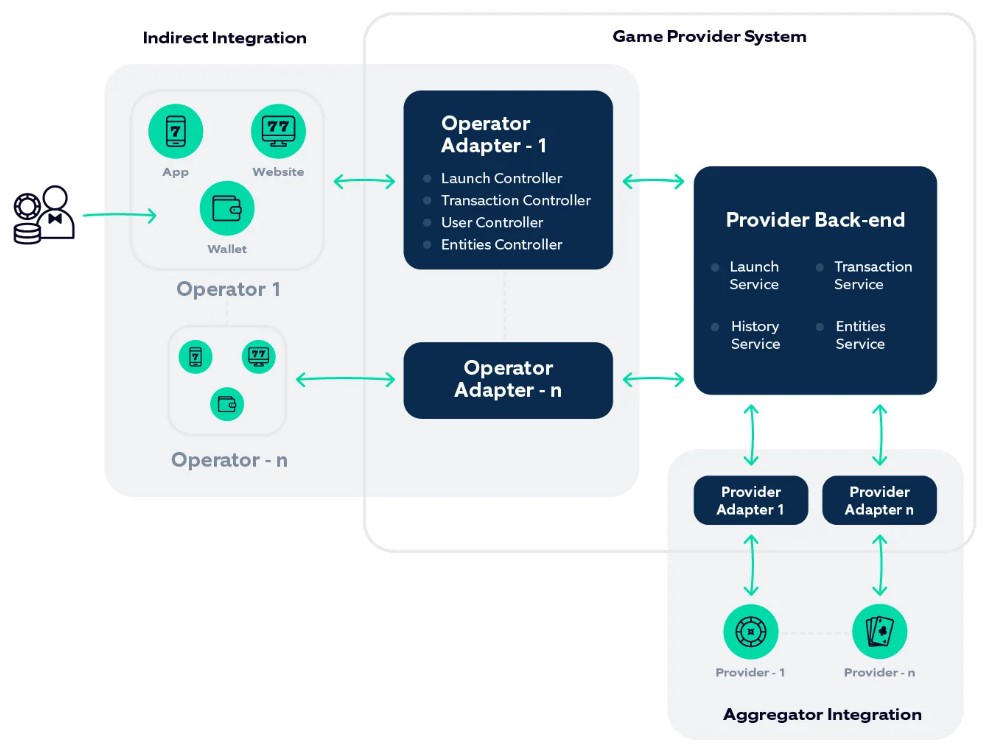
Reliable API providers of gambling software demonstrate how a single API can manage all the content updates, reporting, jurisdiction regulations, and numerous integrations with studios simultaneously. The same interface can handle new titles, determine what games are being made available in certain regions, and RTP (return to player) settings. At the same time, it helps to maintain a stable contract on the front end of the gaming operator.
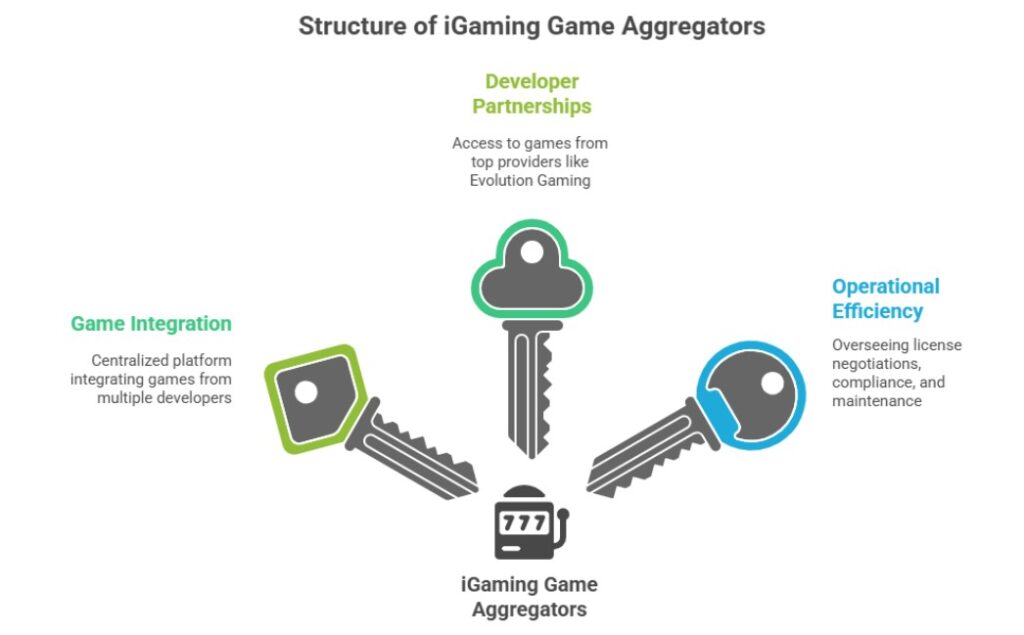
Since it is a matter of real money, these APIs should also be compatible with KYC providers, AML tools, and testing laboratories, such as GLI, iTech Labs, or eCOGRA, to demonstrate fairness and reliability. What is produced is one of the most sophisticated API-based gaming infrastructures ever.
Key Components Of a Typical Licensed Gambling API Package:
| Component | Purpose | What Matters for Developers |
| Game Launch API | Launches slots and live games | Stable endpoints, predictable parameters, low response times |
| Player Authentication API | Verifies players before gameplay | JWT/OAuth2 support, encryption, KYC integration |
| Balance & Wallet API | Transfers bets and winnings | Instant transactions, idempotency, anti-duplication safeguards |
| Game History API | Provides logs and round histories | Clear schemas, JSON/REST standards, consistent identifiers |
| Bonusing API | Manages bonuses and free spins | Flexible rules, segmentation, expiry logic |
| Reporting API | Exposes KPIs and operational statistics | Near real-time data, filters, exports to BI tools |
| Compliance API | Enforces regulatory requirements | RTP controls, responsible gambling flags, age and geo limits |
From Gaming Aggregators to Super-Platforms
The next layer of complexity comes when these hubs stop being “just integration services” and start configuring whole businesses. A super-platform is a layer of infrastructure that provides aggregation, operations, payments, compliance, and configuration in a single environment and can support a variety of products and brands.
Evolution process:
- Gaming aggregators mainly bundle the content from many studios, giving many games one simple integration.
- An API hub brings together content, wallets, events, and reporting, and the major advantage of this is that it reduces duplication of products and channels.
- A super-platform is an operating system to gaming businesses, which consolidates configuration, compliance, payments, and partner management.
Modular APIs
The APIs of gaming platforms become flexible as they proceed in this direction:
- One of the modules is game launch and session management.
- Another one is payments and currency conversion.
- The third is segmentation, rewards, and messaging.
Another compliance section liaises with licence-specific regulations, game availability, and jurisdictional tags. Because all the modules are connected via the same hub, operators can add or delete functionality without necessarily having to rewrite the whole stack.
Cross-Product Ecosystems
The conventional models had separated casinos, sportsbooks, and in-game stores. They are connected via super platforms by common services. Games, sports bets, and in-play purchases can be served by one wallet because one promotion engine can be used to trigger free spins, odds boosts, or discounts. This ecosystem is expanded by cloud layers, some of which are put near end users in important regions to enhance latency.
Multi-Market Distribution Unified Configuration
Super-platforms grown from gaming aggregators can unlock the majority of their business value in diverse settings. The core panel determines game design, payment options, bonus policies, and variations of the UX that will be active in each market and under each brand. Expansion to a new region is a configuration adjustment, and not an addition of logic.
Why Do Gaming Companies Move Toward API-Driven Distribution?
In older publisher-centric models that were older, each new partner typically required its own builds, custom SDK development, and lengthy certification cycles. This fails when a studio requires connecting with numerous stores, cloud services, and controlled areas simultaneously.
This is reduced to one integration, many outlets by API-driven distribution, since a hub communicates with many downstream channels on behalf of the studio or operator. The same concept is visible in the case of general gaming space, where a single hub can be connected to storefronts, analytics services, customer support tools, and live operations platforms.
The features sought by companies adopting hub-based distribution:
- Greater access to the market due to one technical connection.
- Improved turnaround times since new channels are added to the hub.
- Less engineering overhead and a better understanding of integrations.
- More convenient feature switches through configuration flags.
- Easy access to local partners, modes of payment and compliance services.
Technical Foundations Behind API Hubs
This integrated operation may appear easy at a distance, but the system behind it is multi-layered. The providers have to deal with traffic on a global scale, comply with various regulations, and collaborate with both small and large partners, such as small studios and large operators. Regulators and testing labs (MGA and UKGC, GLI, iTech Labs, and eCOGRA) in the international gambling industry demand that the operators demonstrate fairness, stability, and traceability throughout the entire system.
Key technical foundations:
- Load balancing, geo-distribution, and caching. Hubs spread traffic across many servers and regions so that requests from Europe, Asia, or Latin America do not all go to one data center. This reduces the delivery time and cushions the core services against spikes.
- Unification of protocols and transformation of data. API hubs translate between many different protocols and data formats, turning them into one consistent structure. This enables the clients to find it easier to use the system and allows the hub to alter internal mappings when necessary.
- Events, logs, dashboards, KPIs. Central dashboards enable operations teams to have a quick view of problems, such as a provider outage or a wallet sync problem. Detailed event trails and logs also assist in dispute resolution, investigation of fraud, and passing a regulator audit in regulated environments.
What Can General Game Developers Learn From iGaming APIs?
Online gaming products are more strictly controlled, but they demonstrate tendencies that contribute to any entertainment. One of the lessons is configuration to launch new regions. Central settings allow operators to enable or disable content, payment options, and sections of the interface in each market.
The second lesson is the shared compliance layer. Age checks, country blocks, or data rules are added at the outset and used across the board in iGaming sites. These elements send play data to analytics, which are used to segment, predict churn, and offer personalized offers. Regular game makers, when it comes to season rewards, XP boosts, can follow the same steps and battle passes.
Finally, many gaming aggregators are turning into API marketplaces for content. Studio membership occurs through a fixed procedure, and then the studios select which operators or regions have access to their games. Other segments of the game industry are considering the same approach to publisher collaboration, cloud library, or themed bundles.
How to Choose an API Hub/Aggregator?
In the case of companies seeking partners, it is easy to see the maturity of the partner through clear documents. The presence of good API references, examples, and sandbox tests is an indication that the provider is concerned about developers. The partner must also back the areas to which the company desires to be, provide modules such as CRM, jackpots, reporting, payments, and have the chance of expanding with the business.
A few anonymized examples:
- A medium-sized mobile studio had plans to enter the three regulated markets without local payment and KYC solutions. A multi-vertical hub, which already served those areas, allowed the studio to open within less than four months rather than the anticipated 12 months without much of a client build difference.
- A local operator had their own casino and sportsbook systems with wallet discrepancies. Once the two products were on the same hub, one wallet and reporting system was developed. This simplified financial reconciliation and reduced the support tickets for balance errors.
- It was a cloud-gaming service that delivered high-end games to low-end devices and an API hub that managed entitlements, subscriptions, and regional catalogues. This allowed product teams to experiment with promotions and bundles without having core engineers per campaign.
Key Partnership Risks And How To Assess Provider Reliability
| Potential risk | What it Means | How to Verify | Tools/Sources |
| No valid licence | The provider operates illegally, and games may be manipulated | Check the license number and status | Regulators such as MGA, UKGC, Curacao eGaming |
| Fake or unclear RTP figures | Games may be configured unfairly | Request certificates and audit reports | GLI, iTech Labs, eCOGRA |
| Slow API or frequent outages | Traffic and revenue loss due to downtime | Review SLA and historical uptime | Monitoring tools (UptimeRobot, Pingdom) |
| Opaque payout policies | Financial risk for the operator | Examine contracts and reputation | B2B forums, professional references |
| Limited support | Little help during peak load or incidents | Test support responsiveness | Live chat, ticket systems |
| Hidden fees | Higher long-term costs than advertised | Audit pricing structure and invoices | Financial reviews and internal cost tracking |
Preparation often matters as much as provider selection:
- Build an internal API layer that shields products from external changes.
- Standardize core metrics such as DAU, ARPU, retention, and latency across channels.
- Prepare for event-driven architecture so that key actions emit structured events.
- Plan configuration models that reflect multi-jurisdiction requirements and brand differences.
Common Integration Mistakes And How To Avoid Them
| Mistake Type | What Happens | How to Avoid |
| Wrong wallet sync | Bets and winnings are recorded incorrectly | Validate transactional endpoints and test thoroughly in the sandbox |
| Slow loading | Games open in 3-10 seconds or more | Optimize CDN usage and monitor API latency systematically |
| Incorrect callback handling | Servers ignore or mishandle game events | Verify signatures and implement web-hook processing |
| Improper bonus mapping | Players receive incorrect bonuses | Use detailed test scenarios and strict business rules |
| Geo-restrictions ignored | Games appear in prohibited countries | Apply provider GeoIP filters and maintain allow/deny lists |
| Missing logs | No data for audits or incident analysis | Enable central logging and suitable log retention policies |
| Poor error handling | Front ends crash on unexpected API responses | Implement global error handlers and reasonable retry logic |
According to the expert Clara Hazel, gaming aggregators, API hubs, and other infrastructure layers are now key assets. They allowed companies to control a variety of products in most of the global markets through a single control system in normal gaming and online gambling. The providers of gaming software API demonstrate that a clear, traceable, and rule-based design can support thousands of games, numerous partners, and stringent regulatory regulations.
Help us grow the YaninaGames community by sharing this post far and wide across your favorite social platforms and saving it to your bookmarks for quick access later. Your shares and saves mean the world to our passionate team as we continue crafting innovative gaming experiences. If you’re interested in exploring creative partnerships or commercial opportunities, feel free to reach out directly to the YaninaGames team – we’d love to hear from you!